 Do Son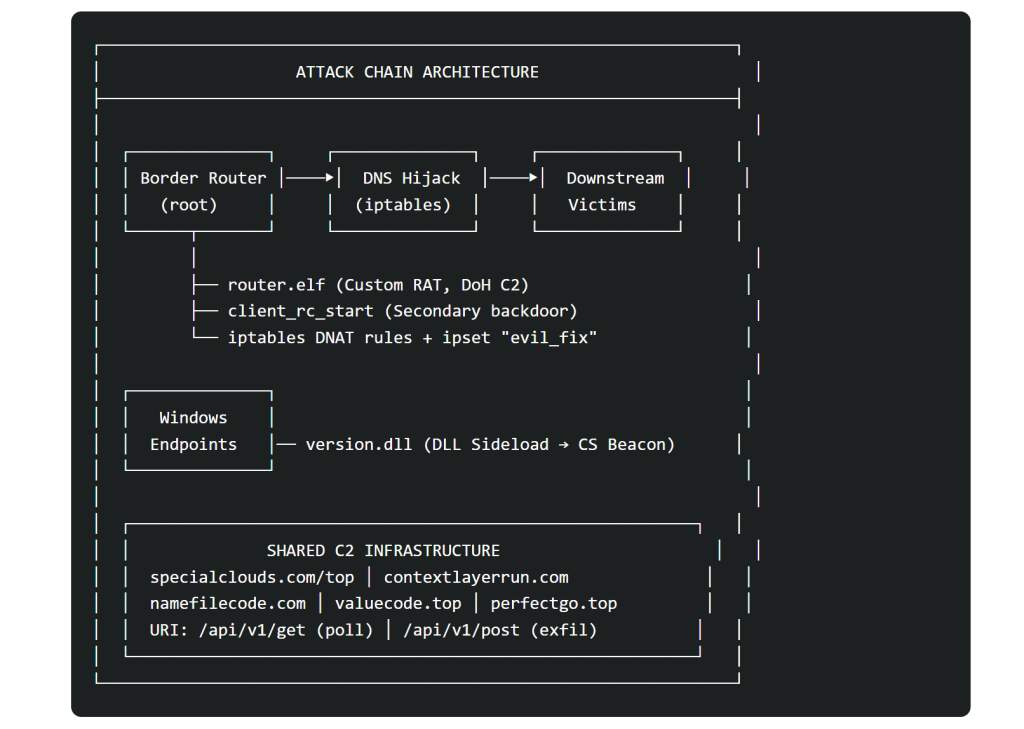
CAMPAIGN OVERVIEW | Image: Y4er
A sophisticated cyber espionage campaign is currently striking enterprise operations across Southeast Asia. Specifically, a China-nexus group has successfully deployed a dangerous custom Linux router implant onto border routing devices. This malicious operation deliberately targets edge systems to bypass traditional endpoint security protections entirely. Consequently, the stealthy framework gives the threat actors unchecked access to internal corporate web traffic. Security teams must update their defense baselines quickly to counter this infrastructure threat vector.
Anatomy of the Custom Router Implant
To begin with, the core file operates as a static binary built using the GCC compiler. The executable, discovered as router.elf, incorporates a stripped structure to hinder deep forensic reconstruction. Furthermore, the malware uses unique encryption to shield its internal network layout. The analysis explains that “The implant protects its embedded C2 configuration using a custom stream cipher”.
Evasive Communication Protocols
Subsequently, the threat architecture relies on DNS over HTTPS (DoH) queries to communicate. This tactical choice allows the payload to route its traffic seamlessly through the legitimate Cloudflare resolver. Therefore, standard perimeter monitoring applications fail to flag the malicious beaconing requests. In addition, the encoded configuration holds specialized string properties. For example, the web request headers hardcode a specific language parameter set to zh-CN.
Weaponizing Routers via DNS Redirection
Moreover, the threat syndicate alters native system properties to expand its operational footprint. The group manipulates firewall rules directly to execute massive router DNS hijacking across downstream connections. Specifically, the configuration implants rogue entries inside the device’s iptables network setup. The technical writeup notes: “The adversary implants persistent iptables NAT rules on the compromised router to redirect all downstream DNS traffic to attacker-controlled resolvers”.
Targeting Software Updates
Concurrently, this configuration routes local domain lookup packets directly through unauthorized internet ports. The adversaries implement a dynamic packet map known as evil_fix to process transactions. This custom set allows the actors to perform targeted interceptions against critical software updates. Ultimately, achieving root access grants the attackers absolute dominance over all connected workstations.
Expanding Access to Windows Endpoints
In addition, the malicious actors expand their footprint to internal Windows hosts. The intrusion pipeline delivers a secondary cracked Cobalt Strike framework via DLL sideloading. To do this, the threat actor forces a legitimate background tracking application to execute a rogue file called version.dll. This endpoint beacon shares identical backend communication properties with the primary custom Linux router implant.
Coordinated Management Networks
Therefore, this overlapping layout confirms a singular, well-organized management cluster. The group utilizes identical user-agent parameters and sleep patterns to organize activities. However, standard antivirus systems often fail to monitor the edge devices directly. Defenders must inspect outward connections for unexpected secure queries. Implementing rigid firewall filters remains essential to block these sophisticated network intrusions.
Support Our Threat Intelligence
Find our threat intelligence and malware analysis helpful? Support our work today and unlock a 100% ad-free reading experience!
 Buy Me a Coffee
