Predating Stuxnet: How the “fast16” Malware Secretly Sabotaged Nuclear Weapons Simulations
 Do Son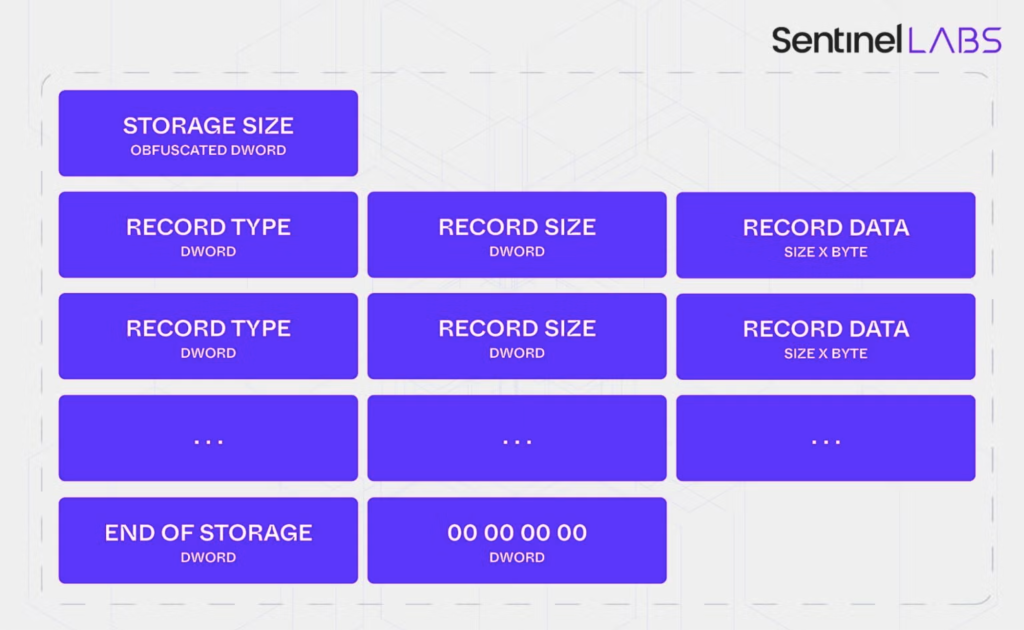
Structure of the internal storage | Image: SentinelOne
In the annals of cyber warfare, Stuxnet has long been considered the premier example of malware specifically engineered to alter physical reality by manipulating industrial control systems. However, a stunning technical report released by Symantec’s Threat Hunter Team has exposed a previously hidden chapter in the history of state-sponsored digital sabotage.
Security researchers have uncovered fast16, a highly specialized sabotage framework whose oldest software components appear to date back to roughly 2005—pre-dating Stuxnet’s deployment by nearly two years. Rather than targeting physical programmable logic controllers (PLCs) on a factory floor, fast16 executed its mission entirely in the digital realm. It was custom-built to compromise the highly specialized engineering software used to design high-explosive and impact physics systems.
As the Threat Hunter Team reveals in its core findings: “New analysis confirms the targeted applications and reveals fast16 was tailored to corrupt uranium-compression simulations central to nuclear weapon design.”
To understand the sheer sophistication of fast16, one must look at how it establishes its foothold inside an isolated network. Once deployed, the malware drops a kernel-level file system filter driver designed to monitor all file access on the host.
The driver waits silently until EXPLORER.EXE initializes and then maps out files compiled with the Intel Fortran or C++ compilers. The hook engine holds a table of 101 highly distinct byte-pattern rules. Whenever a matching target application is read into memory, the engine alters the code stream on-the-fly: “Each rule fires when a specific instruction sequence is read from disk and either captures an absolute address or places a hook to malicious code in an injected .xdata section.”
These rules were not random; they were uniquely tailored to inject an early Lua 5.0 virtual machine into commercial engineering suites—specifically LS-DYNA and AUTODYN. Both are premium, explicit-dynamics software applications heavily used across aerospace, military, and academic research institutions to simulate transient blasts and explosive behaviors.
Once embedded within the simulation process, fast16 didn’t crash the application or alter obvious data lines that would immediately alert a developer. Instead, it relied on three surgical algorithmic attack routines—Mechanisms A, B, and C—designed to introduce subtle, compounding inconsistencies into the software’s thermodynamic equations.
The hooks for Mechanism B specifically targeted LS-DYNA runs. The malware scanned volatile memory to see if the user selected specific mathematical models designed for modeling high-explosive behavior, such as the Jones-Wilkins-Lee (JWL) or Lee-Tarver Ignition and Growth models. It then monitored the material data points. The report outlines the precision of this threshold:
“Then, the Cauchy stress tensor output values (sig_xx, sig_yy, sig_zz) of any model run after are modified down to 1% of their true values if the density of the material reaches 30g/cm³.”
Why 30 g/cm³? In the physical world, a density value of 30 g/cm³ is an explicit mathematical marker. It represents the extreme threshold that uranium can only reach under the immense shock compression of a high-explosive implosion device. By artificially tapering down the Cauchy stress tensor values—which dictate material compressibility and thermodynamic pressure—the software would trick researchers into believing their core layout was compressing much more efficiently than it ever could in reality.
Forensic analysis of the 101 hook rules reveals that the attackers were engaged in a multi-year cat-and-mouse game with their targets. The rules can be divided into 9 to 10 distinct software groups, indicating that as the target organization updated their versions of LS-DYNA or AUTODYN to newer builds, the malware authors sequentially built and deployed matching rule updates to track the software’s lifecycle.
The historical impact of this tampering remains profound. Whether the modifications falsely simulated successful supercriticality or introduced statistical anomalies, fast16 functioned as an invisible brake on nuclear engineering programs, quietly inducing mathematical confusion to stall weapon development.
The Threat Hunter Team concludes that the staggering domain knowledge required to build fast16 cements its place as a milestone in structural sabotage: “The framework belongs to the same conceptual lineage as Stuxnet, in which malware was tailored not just to a vendor’s product but to a specific physical process being simulated or controlled by that product.”
Support Our Threat Intelligence
Find our threat intelligence and malware analysis helpful? Support our work today and unlock a 100% ad-free reading experience!
 Buy Me a Coffee
