The Spider’s Web: How Iranian Hackers Compromised FBI Director Kash Patel’s Personal Gmail
 Do Son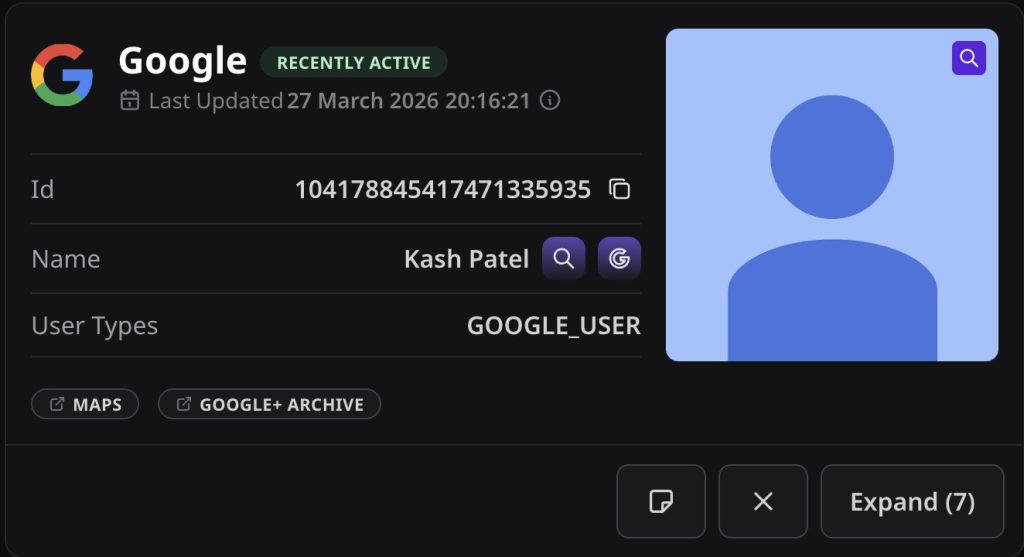
Image: @IntCyberDigest
Recently, the personal Google email account of FBI Director Kash Patel was compromised by the Handala Hack Team, a cybercriminal syndicate with ties to Iran. This collective subsequently published Patel’s private photographs, antiquated resumes, and an assortment of other personal dossiers.
According to the publicly disseminated caches, the compromised materials predominantly comprise correspondence and documents spanning the epoch from 2010 to 2019. This repository encompasses personal imagery and curricula vitae, conspicuously devoid of highly classified or sensitive intelligence pertaining to the United States government.
Nevertheless, the mere possession of an email address empowers one to harvest a wealth of supplementary intelligence via open-source investigative instruments. These digital footprints are gleaned from publicly accessible or previously breached datasets across myriad platforms, consumer evaluations on eBay, Snapchat accounts, and compromised credentials from various other digital domains.
Synthesizing the intelligence procured through these open-source tools, it appears Patel harbors a profound affinity for Spider-Man. Across a multitude of digital platforms, he consistently adopts the moniker “SpiderKash,” a pseudonym that even serves as the prefix for the compromised email address itself.
The X (formerly Twitter) account @IntCyberDigest has amalgamated a diverse array of intelligence channeled through the open-source community. However, mindful of latent security perils, this community has abstained from directly broadcasting Patel’s various passwords—despite the stark reality that such credentials are effortlessly retrievable from public databases using the compromised email address.
Furthermore, consumer reviews bequeathed upon mercantile platforms offer a window into the target’s quotidian habits. For instance, one may deduce Patel’s predilection for patronizing Hong Kong merchants and navigating Toyota vehicles. To expunge such indelible footprints from the digital ether is an endeavor bordering on the impossible.
The Handala Hack Team is widely believed to be inextricably tethered to Iranian intelligence apparatuses; indeed, the United States government classifies it as a cyber warfare proxy subordinate to the Iranian state. Consequently, American authorities previously orchestrated a crackdown, seizing a fraction of Handala’s digital domains to stymie the proliferation of plundered data.
Yet, the syndicate swiftly pivoted to nascent domains, resuming their public dissemination of stolen dossiers. Handala even brazenly proclaimed within a digital missive upon their site: “Kash Patel, the man who once proudly emblazoned his name upon FBI headquarters, now joins the registry of successfully subjugated victims.”
Industry savants posit that this kinetic strike manifests as an orchestrated psychological offensive waged by Iran against the backdrop of broader US-Iranian friction, expressly designed to humiliate American sovereign officials. While it may not inflict catastrophic operational ruin upon said officials, the inevitable besmirching of their honor renders it a profoundly vexing ordeal.
Furthermore, the United States Department of State has promulgated a $10 million bounty to unmask and apprehend the orchestrators, whilst the FBI has avowed to pursue an exhaustive inquisition to hold the masterminds accountable. Kash Patel, for his part, has hitherto maintained a stoic silence regarding the breach.
Support Our Threat Intelligence
Find our threat intelligence and malware analysis helpful? Support our work today and unlock a 100% ad-free reading experience!
 Buy Me a Coffee
