 Do Son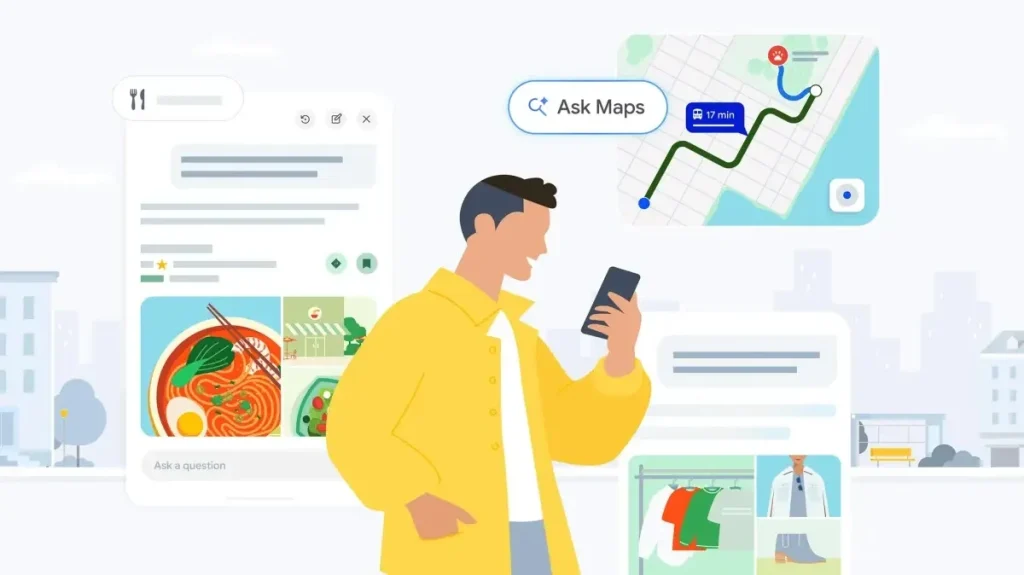
In March of this year, Google introduced “Ask Maps,” a conversational AI, to completely revitalize the navigation experience within Google Maps. Now, the tech giant has announced a massive expansion of its capabilities. By integrating autonomous agentic functions and deeply embedding Gemini’s Personal Intelligence, Google Maps officially evolves from a mere navigation tool into an exclusive, comprehensive personal assistant catering to all facets of daily life.
Seamlessly Integrating Delivery and Reservations
In the near future, Ask Maps will effectively run errands on your behalf. During a recent demonstration, Amanda Leicht-Moore, Senior Director of Product at Google, showcased the process of ordering food directly through the map interface. Simply by expressing a desire for avocado toast and an oat milk latte to the chatbot, the system automatically curates nearby recommendations and initiates the ordering sequence.
Initially, this feature will collaborate with industry partners such as Toast, Square, and Uber Eats. For users who routinely rely on delivery services for their daily meals and late-night cravings, the prospective integration of further platforms will yield a profoundly seamless experience for ordering and price comparison. Beyond everyday dining, Ask Maps now supports conversational hotel reservations and activity exploration. You can directly inform the AI of your budgetary constraints, desired room dimensions, and preferred nearby attractions. The system instantaneously compares prices, verifies room availability, and ultimately directs you to a partner website to finalize the booking.
Deep Gmail Integration for Global Travel
Arguably the most potent killer application within this update is the Personal Intelligence driven by Gemini. This feature holds immense allure for business travelers and backpackers who frequently orchestrate international itineraries.
Envision arriving in Paris for a corporate engagement or touching down in Osaka for a holiday; upon granting authorization, Ask Maps automatically extracts flight details and hotel confirmation receipts directly from your Gmail. Subsequently, you need only inquire, “What are the recommended local culinary delights near my hotel?” The system will generate a bespoke itinerary based upon your verified accommodation, entirely eliminating the tedious chore of toggling between disparate applications and emails to copy addresses.
Privacy and Commuter Widgets
Google emphasizes that this Gmail connectivity remains disabled by default, ensuring users retain absolute dominion over their privacy; future updates will see further integration with Google Calendar. Furthermore, to accommodate public transit commuters, Ask Maps can now generate Live Widgets directly within the conversational interface. Whether you are orchestrating an island-hopping voyage via ferry or undertaking a routine cross-district commute, these widgets instantaneously display wait times and delay statuses for ferries or shuttles, enabling you to orchestrate your itinerary with absolute precision.
Fostering Community Collaboration Globally
To guarantee the absolute veracity of mapping data, Google has also introduced conversational editing capabilities to the Local Guides community. Should one discover an alteration in a storefront’s operating hours, uploading a photograph of the updated signage prompts Ask Maps to automatically recognize the discrepancy, verify the modification with the proprietor, and submit it for formal review.
The English iteration of the Ask Maps conversational feature will expand to encompass over 150 countries and regions, including Japan, Australia, Canada, and Mexico. Notably, the Live Widgets and Personal Intelligence will launch globally in tandem, whereas the highly anticipated food delivery, hotel reservation, and conversational editing functionalities will debut exclusively in the United States before embarking upon a gradual worldwide rollout.
Editorial Perspective
Google is actively materializing the Universal Commerce Protocol (UCP) proposed at this year’s Google I/O 2026 conference. When an AI agent possesses the capability to not only interpret maps but also scrutinize emails, secure hotel accommodations, and dispatch food deliveries, it becomes glaringly apparent that Google Maps has transcended its origins as a mere cartographic application. It now stands as Google’s most formidable terminal weapon in its endeavor to monopolize the gateway to physical consumer commerce.
Support Our Threat Intelligence
Find our tech and OS security coverage helpful? Support our work today and unlock a 100% ad-free reading experience!
 Buy Me a Coffee
