 Do Son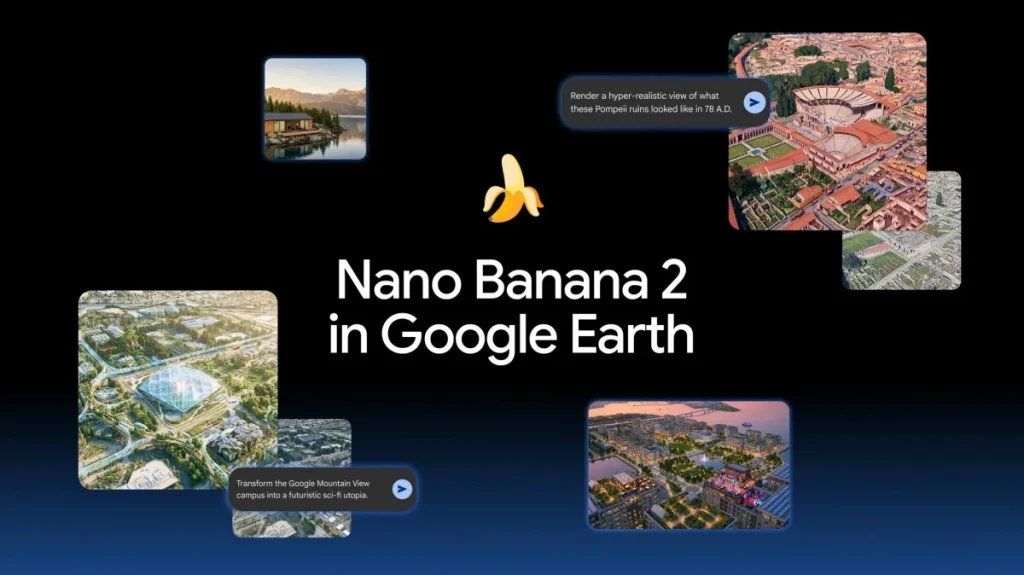
Google recently announced a provocative update: the integration of its potent AI image generation model, Nano Banana 2, directly into Google Earth. This novel feature empowers users to “materialize” historical scenes or transform barren landscapes into modern architectural marvels using simple text prompts. However, when a platform fundamentally predicated on “authentic geographical data” begins to overflow with “AI-generated” fictitious imagery, a critical question emerges. Does Nano Banana in Google Earth image generation genuinely enhance utility, or does it risk reducing the platform to another engine for manufacturing “AI hallucinations”?
The Historical Dilemma: Pompeii in 78 A.D or 79 A.D?
Google’s promotional materials highlight a seemingly educational use case. A teacher, they suggest, could instruct the AI to conjure a “hyper-realistic view of the ruins of Pompeii in 78 A.D.” The algorithm purportedly transforms modern ruins instantly into “bustling, colorful streets of the Roman Empire.”
Yet, this specific example immediately exposes severe historical and logical vulnerabilities.
Firstly, the historical consensus establishes that the catastrophic eruption of Mount Vesuvius destroyed Pompeii in 79 A.D. Perhaps Google’s official example deliberately selected “78 A.D” to depict the city’s pre-disaster prosperity. However, the fundamental problem remains: satellite imagery simply did not exist two millennia ago. Consequently, the “hyper-realistic” streets generated by the AI are inherently fabricated. They are images algorithmically “patched together and hallucinated” based on contemporary photographs of ruins, historical texts, and likely, Hollywood movie sets.
For visual learners, this might serve as a vibrant supplementary tool. But for rigorous geographical and historical pedagogy, superimposing these “highly realistic yet fundamentally speculative” images directly onto a mapping service is perilous. It creates a significant risk that users will mistake “fictional rendering” for “historical fact.”
Commercial Awkwardness: A “Cheat Code” for Real Estate Renderings?
Beyond educational scenarios, Google aggressively courts commercial users. Official statements claim Nano Banana 2 can be utilized to “create professional real estate plans.” For instance, it can re-imagine an empty lot in Tokyo as an “open space, vibrant shopping and retail district.” Alternatively, it can conjure a “modern lakefront cabin built with sustainable local materials” out of thin air on a vacant parcel.
Undeniably, the generative capabilities driven by Gemini 3 Pro Image (the underlying technology of Nano Banana Pro) have already caused a stir in architectural visualization. It accurately simulates lighting, textures, and glass reflections to produce remarkably lifelike images.
But returning to grounded commercial logic, is this feature truly practical? Imagine a commercial real estate developer who lacks the commitment to hire professional architects and 3D artists for precise renderings. Instead, they casually generate an “AI-looking lakefront cabin” to placate a client. What serious investor would commit substantial capital based on such a blind, algorithmic proposition?
The Boundary Crisis: When “Real Maps” Meet “Fictional AI”
Nano Banana 2 is undeniably the crystallization of Google’s technological prowess in image generation. To mitigate potential controversies, Google applies visible watermarks to these generated images. Furthermore, they embed SynthID digital watermarks imperceptible to the human eye to definitively flag the content as AI-generated.
However, the core value proposition of Google Earth has perpetually been its provision of an “objective reflection of the real world,” meticulously captured by satellites, aerial photography, and Street View vehicles. By introducing an arbitrary “God-mode” that allows users to modify the past and future at will, the platform gradually blurs the crucial boundary between “documentary reality” and “creative fiction.” Without more stringent layer separation or robust fail-safes, we will likely soon witness a deluge of fake news articles across the internet, breathlessly proclaiming the “discovery of ancient civilization ruins via Google Earth.”
Support Our Threat Intelligence
Find our tech and OS security coverage helpful? Support our work today and unlock a 100% ad-free reading experience!
 Buy Me a Coffee
