Google & Samsung Launch Galaxy XR: The $1,800 AI Headset to Battle Vision Pro
 Do Son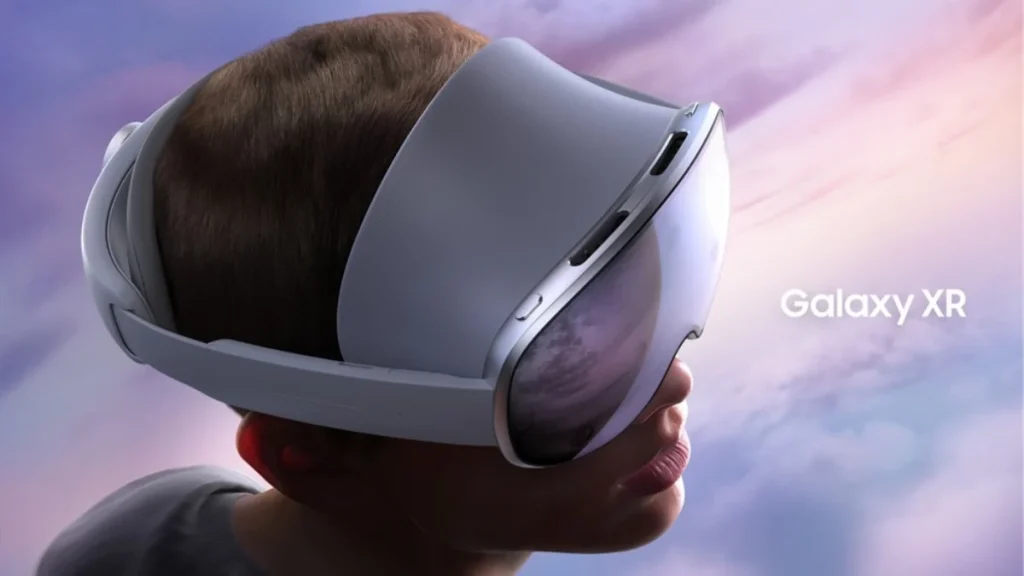
Google has officially confirmed the release of the Galaxy XR, the long-anticipated Android extended reality headset jointly developed with Samsung and Qualcomm under the codename Project Moohan. The device is now available for purchase in the United States and South Korea, priced at $1,800 USD —just over half the starting price of Apple’s Vision Pro.
The Galaxy XR represents the culmination of a three-way collaboration between Google, Samsung, and Qualcomm. It is powered by the Snapdragon XR2+ Gen 2 processor, paired with 16GB of RAM and 256GB of storage.
One of its most striking features lies in its display technology. The headset employs Micro OLED panels with a total pixel count of 29 million—surpassing the Vision Pro’s 23 million—and a resolution of 3552 × 3840. It delivers a 96% DCI-P3 color gamut, outperforming the Vision Pro’s 92%, though its refresh rate tops out at 90Hz, lower than Apple’s 120Hz specification.
In terms of ergonomics, the Galaxy XR has a notable advantage in weight, coming in at just 545 grams, including the forehead cushion—significantly lighter than the Vision Pro’s 750 grams (with the M5 chip). Samsung highlights its balanced ergonomic frame, designed to distribute pressure evenly across the forehead and back of the head, minimizing facial strain during extended use.
The device features dual high-resolution passthrough cameras for mixed reality (MR) experiences, alongside six external tracking cameras and two eye-tracking sensors. Like the Vision Pro, it also supports the capture of 3D spatial photos and videos.
The Galaxy XR incorporates iris recognition for authentication, allowing users to unlock the device or enter passwords within compatible applications.
For power, the headset uses an external battery pack weighing around 302 grams, providing approximately two hours of general use or up to 2.5 hours of video playback—comparable to the 2.5–3 hour battery life of the Vision Pro equipped with the M5 processor.
According to Sameer Samat, President of the Google Android Ecosystem, Android XR is the first Android platform designed entirely around Gemini, Google’s generative AI framework. This means the device will deeply integrate Gemini’s capabilities, while all apps available on the Google Play Store can run natively on it. Google has also redesigned several core applications, including:
- Google Maps – integrated with Gemini for navigation and immersive 3D viewing experiences.
- Google Photos – uses AI to automatically “spatialize” 2D photos and videos.
- YouTube – allows users to ask Gemini to locate specific videos or provide contextual details.
- Circle to Search – enables object recognition in passthrough mode; users can circle real-world items with gestures to search them instantly.
- Other apps – including Google TV, Chrome, and Google Meet, all optimized for Android XR.
The Android XR interface supports multitasking, allowing users to open multiple resizable app windows and use Gemini voice commands to automatically arrange them in virtual space.
For entertainment, the Galaxy XR supports 4K virtual cinema, 180°/360° VR content, and major streaming platforms such as Crunchyroll, HBO Max, and Peacock, offering a rich selection of immersive experiences. On the gaming front, titles like NFL Pro Era and Inside [JOB] are featured, while Gemini can provide real-time AI-powered gameplay assistance.
Interaction is primarily handled through hand tracking and gesture control, though a physical controller is available for more precise input. Both the controller and the travel case are sold separately, priced at $250 USD each.
Samsung further announced that customers purchasing the Galaxy XR before the end of the year will receive a complimentary “Explorer Pack”, which includes 12 months of Google AI Pro, YouTube Premium, and Google Play Pass subscriptions, along with NBA League Pass (for U.S. customers) or Coupang Play Sports Pass (for South Korean users), among other premium app services.
Related Posts:
- Cisco Warns of Critical RCE Flaw (CVE-2025-20363) Affecting Firewall and Router Software
- Cisco Issues High-Severity Security Alert for IOS XR Software (CVE-2025-20138)
- Android Studio Narwhal Arrives: AI Agent Mode, XR Tools, and K2 Kotlin Now in Stable Release
- Cisco Alerts on Public Disclosure of CVE-2025-20115 – BGP Flaw Puts Networks at Risk
Support Our Threat Intelligence
Find our tech and OS security coverage helpful? Support our work today and unlock a 100% ad-free reading experience!
 Buy Me a Coffee
