 Do Son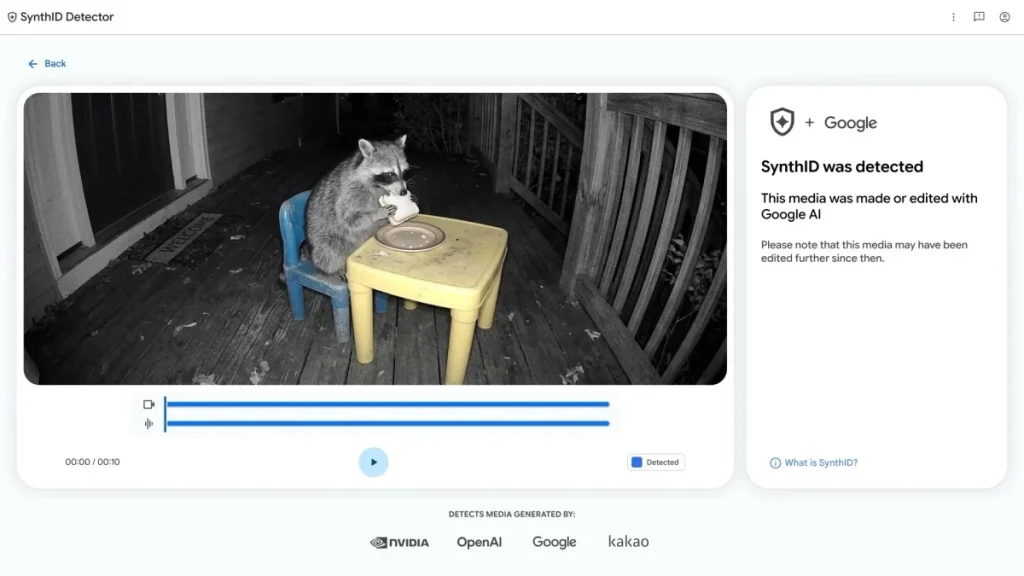
As generative AI technologies proliferate, defending against deepfakes and disinformation has emerged as an imperative for the tech industry. After over a year of restricted testing exclusively for journalists and media professionals, Google has officially unveiled its AI content identification instrument, the SynthID Detector, to the general public. Now, anyone can navigate to the dedicated portal (synthid.com). Consequently, they can swiftly ascertain whether the image, video, or audio before them is the handiwork of artificial intelligence.
Supporting a Multitude of Models: Apple Intelligence to Join the Defensive Vanguard
Serving as Google’s premier weapon against AI-fabricated disinformation, the Google SynthID AI detector currently possesses the capability to successfully identify content generated or manipulated by mainstream AI engines, including Google Gemini, OpenAI, NVIDIA, and Kakao. This web-based utility is entirely complimentary. However, to circumvent malicious abuse, individuals must authenticate their identities using a Google, OpenAI, or Apple account. In addition, authentication is required prior to conducting an analysis.
Notably, Google is demonstrating a profound ambition to establish cross-ecosystem defenses. Official announcements foreshadow that SynthID will soon stand among the pioneering diagnostic tools equipped to recognize images birthed by “Apple Intelligence.” For example, this includes those originating from the Image Playground feature. Although Google previously integrated SynthID watermark and C2PA content credential detection within its “Circle to Search” and Gemini applications, the independent launch of this dedicated website undeniably lowers the barrier to entry for the broader public. Consequently, this strategic move empowers individuals unaccustomed to Google’s AI ecosystem. It provides them with a potent instrument for autonomous discernment and self-protection.
Watermarks Are No Panacea: The Unresolved Enigma of Universal Diagnostic Standards
While the SynthID Detector represents a monumental stride in anti-counterfeiting measures, Google candidly acknowledges that this system is not “absolutely bulletproof.” Contemporary AI detection is besieged by three inherent limitations:
- Standard Fragmentation: Various technology leviathans employ disparate watermarking techniques, rendering SynthID incapable of intercepting all non-aligned AI content. For instance, Meta is presently testing its proprietary identification tool, yet this instrument exclusively recognizes images rendered by Meta’s latest Muse model, conspicuously failing to support even its own legacy iterations.
- The Inability to Distinguish Between Pure Generation and Subtle Refinement: The SynthID Detector merely indicates the presence of AI intervention. It cannot discern whether an image is a complete fabrication conjured entirely from prompts or a genuine photograph merely polished using an AI-powered erasure tool to remove background clutter.
- The Risk of Watermark Eradication: Although SynthID’s digital watermarks are ostensibly resilient against compression and cropping, they remain vulnerable to malicious extraction under scenarios of extreme, destructive editing.
In a steadfast commitment to expanding this defensive perimeter, Google pledges to continually cultivate its consortium of strategic partners. Notably, the pioneering voice generation vanguard, ElevenLabs, has already declared its intent to align with the SynthID watermarking coalition.
Support Our Threat Intelligence
Find our tech and OS security coverage helpful? Support our work today and unlock a 100% ad-free reading experience!
 Buy Me a Coffee
