Google’s “Virtual Satellite” is Here: New AI Model AlphaEarth Foundations Maps the Planet with Unprecedented Detail
 Do Son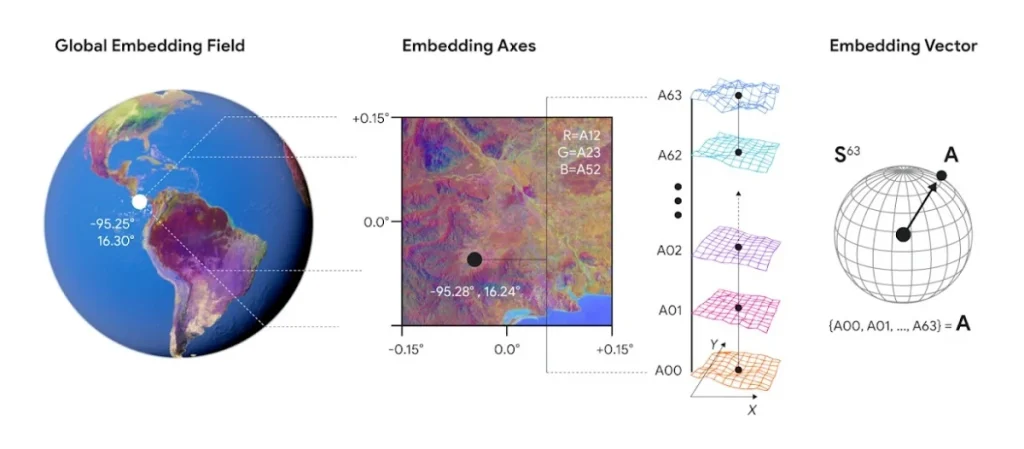
Google has announced the launch of AlphaEarth Foundations, a groundbreaking artificial intelligence model designed to function as a “virtual satellite” capable of observing and analyzing changes across the Earth. By integrating vast amounts of publicly available data from optical satellites, radar systems, and climate simulations, the model employs embedding techniques to construct a real-time, continuously updated global view, enabling researchers to monitor environmental transformations with unprecedented speed and precision.
Unlike traditional satellite image processing, AlphaEarth Foundations does not rely on a single data source. Instead, it aggregates massive daily datasets from diverse Earth observation systems—ranging from climate models and remote sensing imagery to surface material parameters. The planet’s land and coastal regions are divided into grids of 10 by 10 meters, with each grid undergoing automated feature analysis and tracking, covering everything from vegetation classification to land-use changes.
According to Google, the “embedded summaries” generated by AlphaEarth Foundations not only provide detailed insights into surface dynamics across various regions but also achieve a dramatic reduction in file size. On average, the storage required is just one-sixteenth of that needed by comparable AI models, significantly reducing data processing and storage costs while enhancing the efficiency and scalability of Earth observation research.
In an official statement, Google remarked: “AlphaEarth Foundations represents a significant step forward in understanding the state and dynamics of our changing planet.”
The model supports a wide range of temporal and spatial tasks, such as generating highly accurate crop health maps, analyzing patterns of deforestation, and predicting coastal erosion risks.
Over the past year, Google has already granted more than 50 research institutions early access to its Satellite Embedding dataset, derived from AlphaEarth Foundations, for real-world application testing. This dataset, which contains annual embedded summaries of geospatial data, aids scientists in building temporal-spatial models that track changes over time. It is now officially available on Google Earth Engine, opening new possibilities for researchers and developers across numerous domains.
For example, research teams can utilize AlphaEarth’s refined surface classification to monitor crop vitality and water availability in a given region, or track shifts in forest coverage to issue early warnings about illegal logging in tropical rainforests. Climate researchers can also analyze historical coastal change data to assess the tangible impact of rising sea levels on vulnerable areas.
Beyond its accuracy and efficiency, Google emphasizes the flexibility and scalability of AlphaEarth Foundations, with plans to incorporate additional data types and integrate with real-time observation systems, pushing global environmental monitoring closer to near-instantaneous responsiveness.
Google has long been committed to advancing AI for Earth observation and sustainable development, notably through Google Earth Engine, a cloud-based platform for environmental data analysis that assists governments and researchers in monitoring climate change and managing natural resources. AlphaEarth Foundations marks the next phase of this initiative, transitioning from mere data visualization to sophisticated AI-driven inference, accelerating both the speed and depth of our understanding of Earth’s condition.
As extreme weather events, natural disasters, and human-induced degradation intensify, real-time insights into the planet’s changing environment are becoming an urgent global priority. Google’s AI-powered “virtual satellite” initiative not only lowers technical barriers for research institutions but also introduces innovative solutions for intelligent environmental management and sustainable development.
Currently, Google continues to refine the architecture of AlphaEarth Foundations and adjust its data update intervals. Future developments may include finer spatial resolutions and the integration of advanced AI-powered predictive capabilities, heralding a new era in Earth observation—one driven at its core by artificial intelligence.
Related Posts:
- Amazon’s AI Boom Collides with Climate Pledge: Carbon Emissions Soar 6%
- Critical 0-day Trend Micro Endpoint Security Vulnerability
- Linux Leaps to Record 4.44% Market Share: Open-Source OS Hits All-Time High in July
- AI Powers a Phishing Frenzy – Zscaler Report Warns of Unprecedented Threat Wave
- New ‘Planet Stealer’ Malware Emerges: Your Passwords and Crypto Wallets at Risk
Support Our Threat Intelligence
Find our tech and OS security coverage helpful? Support our work today and unlock a 100% ad-free reading experience!
 Buy Me a Coffee
