 Do Son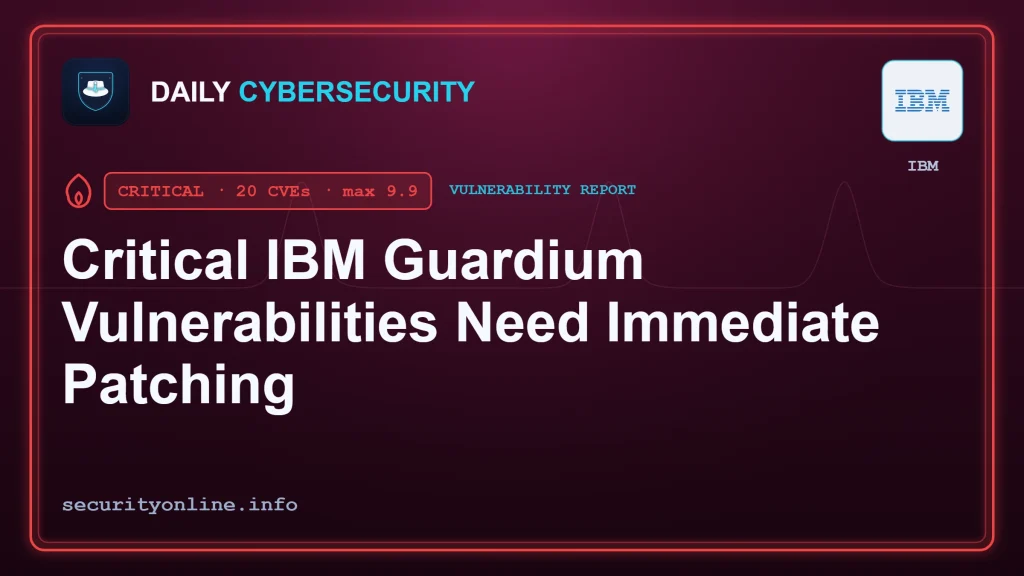
TL;DR
Security researchers recently uncovered over 20 critical IBM Guardium vulnerabilities impacting data protection systems. These flaws allow remote attackers to execute arbitrary code or inject SQL commands without authentication. Administrators must apply vendor patches immediately to secure their database environments against these threats.
- Total: 20 CVEs
- Severity: 11 Critical · 8 High · 1 Medium
- Actively exploited: None confirmed
- Highest severity: 9.9 (Critical · CVSSv3) — CVE-2026-84064
- Action: Apply the latest security updates now
See a CVE's exploit risk spike before it becomes a headline.
Get EPSS spike alertsNotable CVEs
| CVE | CVSS (CVSSv3) | Type | Status |
|---|---|---|---|
| CVE-2026-84064 | 9.9 | CWE-89 | Not exploited |
| CVE-2026-84078 | 9.9 | CWE-306 | Not exploited |
| CVE-2026-84075 | 9.9 | CWE-306 | Not exploited |
| CVE-2026-80442 | 9.9 | CWE-78 | Not exploited |
| CVE-2026-82340 | 9.8 | CWE-94 | Not exploited |
| CVE-2026-84082 | 9.8 | CWE-89 | Not exploited |
| CVE-2026-81657 | 9.8 | CWE-502 | Not exploited |
| CVE-2026-80441 | 9.8 | CWE-89 | Not exploited |
Why It Matters
IBM Guardium secures sensitive databases for thousands of Fortune 500 enterprises globally. Therefore, these IBM Guardium vulnerabilities create massive risks for global data privacy. Specifically, several flaws achieved CVSS ratings between 9.8 and 9.9. These near-perfect scores indicate severe danger for enterprise infrastructure. Attackers can exploit these weaknesses remotely without any user interaction. Furthermore, a successful breach could expose highly classified corporate records. Corporate security teams rely heavily on these appliances for compliance monitoring. Consequently, compromising the monitoring tool blinds the security operations center. Currently, no exploitation in the wild has been confirmed. Also, security teams have not detected any public proof-of-concept exploit code. However, the sheer volume of these bugs demands urgent attention. Leaving systems unpatched invites catastrophic data breaches across critical enterprise networks. Delaying remediation exposes sensitive corporate assets to unnecessary danger. Threat actors frequently target security infrastructure to hide their tracks.
How The Attack Works
Deserialization And Code Execution
The most alarming flaw involves insecure deserialization within the Change Audit System listener. According to the advisory, “A network attacker able to reach TCP port 16017 may submit crafted serialized messages and potentially cause unintended code execution in the Guardium appliance.” Attackers simply send malicious data packets to the exposed port. The system fails to validate this input before processing it. Consequently, the application runs the attacker’s hidden payload. This specific weakness requires no prior authentication from the attacker. Another severe bug exists within the certificate export command-line tool. A privileged user can inject operating system commands directly. This grants the attacker root privileges over the entire appliance.
SQL Injection And Access Bypasses
Many other IBM Guardium vulnerabilities stem from improper input neutralization. Attackers can submit malicious SQL statements through various web endpoints. For instance, the Load Balancer Servlet fails to sanitize requests. This failure allows attackers to bypass strict database controls. They can then read, modify, or delete protected records. Furthermore, the New Query Builder REST Processor shares similar flaws. Attackers can manipulate the REST endpoint to extract sensitive telemetry. Additionally, missing authentication checks leave critical functions totally exposed. Anyone can access privileged load-balancer operations without logging in. The system also contains hardcoded credentials in certain binaries. A low-privileged user can recover these master secrets easily. They can use these secrets to unlock the internal database.
Affected Versions
These critical flaws affect IBM Guardium Data Protection version 12.2. Specifically, the vulnerabilities impact the core data protection components. They also compromise load balancers and administrative web interfaces. If your organization runs this specific release, you face immediate exposure. This product version operates in highly secured environments worldwide. Therefore, the impact of these flaws spans across multiple industries. Administrators must check their deployed versions without delay. Deployments operating on older unpatched branches might also require audits.
Patch Or Mitigation Steps
System administrators should upgrade their security appliances right away. The vendor released a cumulative fix pack on Fix Central. The official bulletin states, “IBM Guardium Data Protection has addressed these vulnerabilities in an update.” Furthermore, the vendor added, “IBM encourages customers to update their systems promptly.” You can find the required downloads on the IBM Security Advisory page. If immediate patching is impossible, teams should restrict network access. Blocking untrusted traffic to TCP port 16017 helps prevent attacks. However, only applying the official software update completely removes the risk. Security teams must prioritize these installations to protect sensitive data. Companies must treat these updates as an emergency maintenance task. Verifying the integrity of existing logs is also highly recommended.
Support Our Threat Intelligence
Find our vulnerability reports and weekly recaps helpful? Support our work today and unlock a 100% ad-free reading experience!
 Buy Me a Coffee
