 Do Son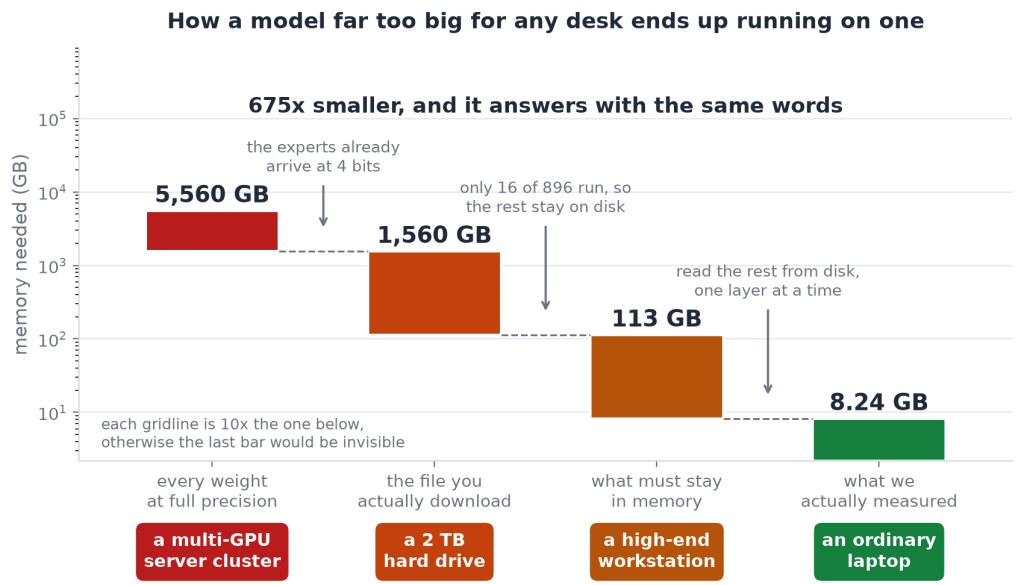
Developer FareedKhan recently set out to execute the formidable Kimi K3 model on consumer-grade hardware. Typically, running a model of this magnitude locally proves entirely impossible for standard devices. However, the developer engineered a pure C99 inference engine to achieve local execution. At peak performance, the system processes output at 20 seconds per token. Conversely, under a restricted 8GB memory footprint, the speed drops to 33 seconds per token.
The central pillar of this project involves executing inference for Kimi K3 on a single CPU and 8GB of RAM. Crucially, the system operates without relying on GPUs, deep learning frameworks, or BLAS libraries. While the project does not aim for practical high-speed deployment, it serves a profound purpose. It illuminates the Mixture-of-Experts (MoE) architecture of Kimi K3 while proving the feasibility of running massive models on memory-constrained devices.
On-Demand Weight Streaming Reduces Memory Footprint
The Kimi K3 model checkpoint spans an astounding 1.56TB. Approximately 93 percent of this volume consists of routed expert weights. During token generation, the model activates merely 16 out of 896 experts. Consequently, the Kimi K3 in C implementation avoids loading all expert weights into RAM. Instead, it retains them on an NVMe solid-state drive, streaming specific weights into memory only during active computation.
These expert weights are stored in a packed 4-bit format. The engine executes matrix multiplication directly on this compressed format, bypassing traditional, computationally expensive dequantization steps. Meanwhile, the dense backbone of the model is repacked into a single file. Each layer’s weights align according to specific layer offsets. During inference, the system streams one layer at a time. This design allows users to adjust their memory budget, effectively balancing RAM usage against processing speed.
Achieving 8.24GB Minimum RAM at 33 Seconds Per Token
The developer tested the engine on a machine equipped with dual AMD EPYC 7763 processors and NVMe SSD storage. Throughout the benchmark, four installed GPUs remained entirely idle. Under the minimum preset, peak process memory reached a remarkably low 8.24GB. However, performance was severely constrained, requiring approximately 33 seconds to generate a single token.
Increasing the memory budget to 128GB while remaining CPU-bound improved performance to 20 seconds per token. This throughput represents the practical ceiling for this CPU-centric architecture. Consequently, allocating additional memory yields diminishing returns for generation speed. Remarkably, output streams remain byte-level identical across all memory configurations. This consistency confirms that aggressive caching and streaming strategies preserve inference precision, even as storage bandwidth and CPU processing remain the primary bottlenecks.
Support Our Threat Intelligence
Find our tech and OS security coverage helpful? Support our work today and unlock a 100% ad-free reading experience!
 Buy Me a Coffee
