Microsoft’s Declaration of Independence: The New MAI Models Challenging OpenAI and Google
 Do Son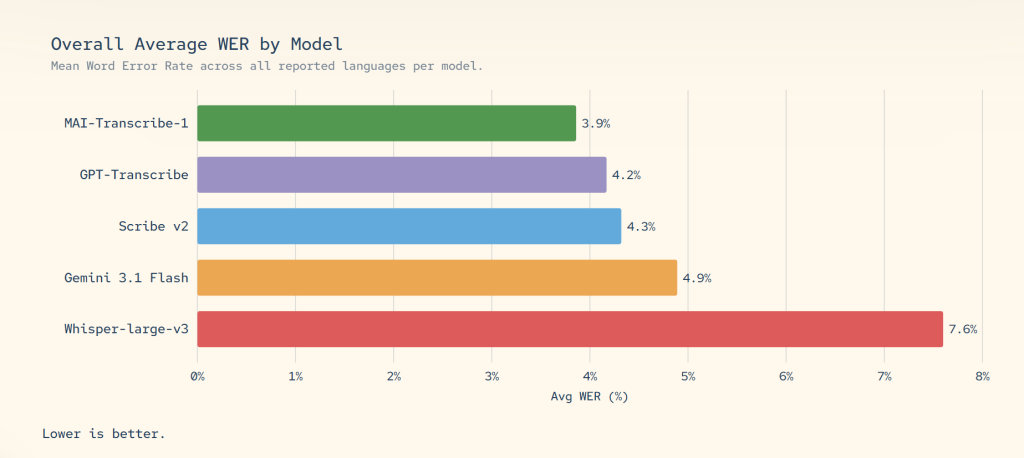
Under the stewardship of Microsoft’s AI visionary, Mustafa Suleyman, the “Superintelligence” collective has unveiled a triad of foundational artificial intelligence models, meticulously engineered ex nihilo within the corporation’s own sanctuaries. These encompass the phonetic recognition architecture MAI-Transcribe-1, the vocal synthesis engine MAI-Voice-1, and the visual generative model MAI-Image-2. This milestone signifies not merely Microsoft’s inaugural demonstration of proprietary prowess capable of eclipsing Google and OpenAI in singular domains, but also a formidable declaration to Wall Street; through aggressive tariff strategies and staggering hardware efficiency, its colossal infrastructural investments are now primed for transformation into potent instruments of profitability.
The “MAI” lineage precisely targets the three most commercially lucrative echelons of enterprise AI, debuting synchronously upon Microsoft Foundry and the nascent MAI Playground:
- MAI-Transcribe-1 (Speech-to-Text): The vanguard of this revelation. According to the FLEURS benchmarks, it achieved a mean Word Error Rate (WER) of a mere 3.8% across 25 primary dialects—not only surpassing OpenAI’s ubiquitous Whisper-large-v3 but utterly decimating Google’s Gemini 3.1 Flash in 22 languages. Most profoundly, Suleyman underscored that this architecture mandates “scarcely half the GPU telemetry” of its adversaries, while its batch transcription velocity outpaces extant Azure solutions by a factor of 2.5.
- MAI-Voice-1 (Text-to-Speech): Distinguished by its transcendent generative celerity, it synthesizes sixty seconds of high-fidelity, naturalistic prose in under a second and supports sophisticated vocal cloning from a mere fragment of audio. Microsoft has issued a bellicose challenge to startups such as ElevenLabs by decreeing a highly competitive tariff of $22 per million characters.
- MAI-Image-2 (Image Generation): Presently ensconced within the triumvirate of the Arena.ai leaderboard, this model boasts a generative velocity double that of its predecessor. Integrated into Bing and PowerPoint, it seeks to seize market share with “bottom-dollar” pricing—demanding $5 per million input inference tokens and $33 for output.
The catalyst for this sudden emergence of apex models lies in a clandestine diplomatic reconfiguration. Suleyman divulged that the primordial 2019 covenant with OpenAI “explicitly interdicted” Microsoft from independently cultivating Artificial General Intelligence (AGI). However, as OpenAI pursued external computational and fiscal alliances with entities like SoftBank, Microsoft seized the opportunity to recalibrate.
In the ensuing negotiations, Microsoft successfully unshackled itself from these constraints. While the bilateral licensing alliance persists until at least 2032, Microsoft now enjoys “absolute sovereignty” to marshal computational resources, acquire telemetry, and architect its own Frontier Models without impedance. Perhaps most startling is the revelation that these models—rivaling the apex offerings of tech titans—were forged by incredibly compact cadres.
Suleyman revealed that “our phonetic model was the labor of a mere ten individuals, with the visual collective being similarly sparse.” In stark contrast to Meta’s expenditure of hundreds of millions to recruit legions of researchers, Microsoft endeavors to prove that through architectural ingenuity and “pristine lineage” data, a small vanguard can manifest miracles.
This philosophy of “Humanist AI,” coupled with rigorous stewardship of training data copyright, serves as Microsoft’s primary allure for enterprise clientele—such as financial and medical institutions—who demand absolute compliance and security. The genesis of the MAI series is essentially a defensive maneuver centered on “cost reduction and efficiency optimization.”
By displacing third-party architectures within internal products like Microsoft Teams and Copilot with MAI models, Microsoft can profoundly diminish the Cost of Goods Sold (COGS), utilizing less than half the GPU resources of its competitors. In the external marketplace, Suleyman candidly expressed that their pricing strategy is designed to “undercut every cloud leviathan, including Amazon and Google.”
Phonetic and visual models are merely the prelude; Suleyman has articulated that Microsoft’s ultimate ambition is the cultivation of Large Language Models capable of a frontal collision with GPT-4 and Gemini, thereby achieving total “AI self-sufficiency.” Through this successful foray, Microsoft has demonstrated its formidable engineering acumen, signaling that in the impending conflict of titan models, it shall no longer remain merely the “benevolent financier” lurking in the shadow of OpenAI.
Support Our Threat Intelligence
Find our tech and OS security coverage helpful? Support our work today and unlock a 100% ad-free reading experience!
 Buy Me a Coffee
