NVIDIA Brings CUDA to RISC-V: A Game-Changer for AI and Heterogeneous Computing
 Do Son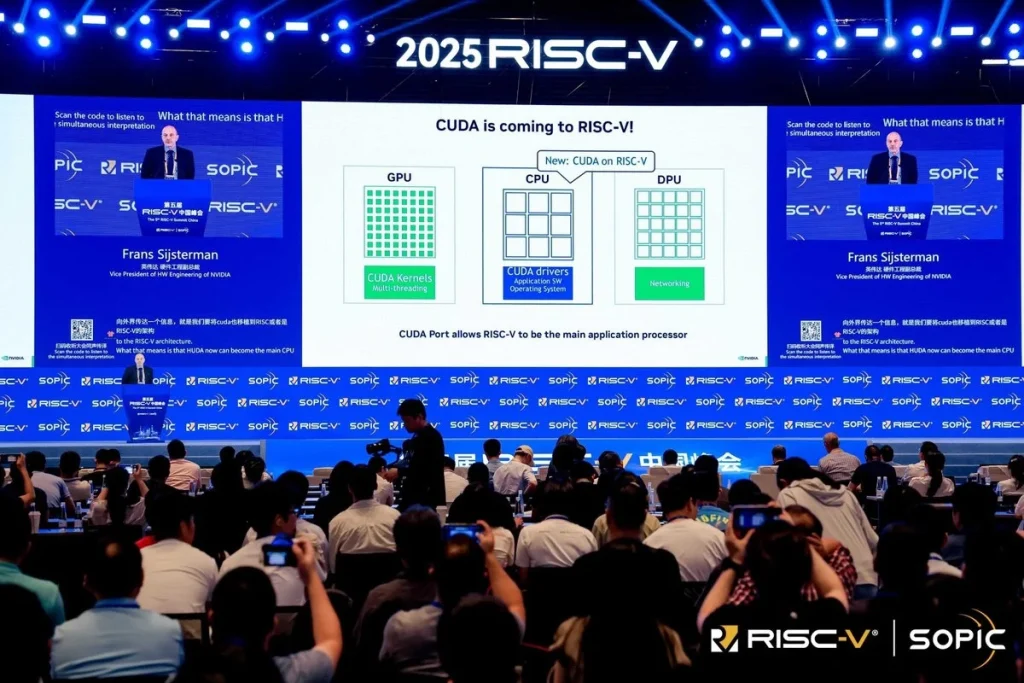
At the recently held RISC-V Summit China, Frans Sijsterman, Vice President of Hardware Engineering at NVIDIA, announced that CUDA will be extended to support processors based on the RISC-V architecture. This move signifies that NVIDIA’s pivotal technology for deep learning and GPU-accelerated applications will soon operate within a more diverse processor ecosystem—further broadening the horizons of heterogeneous computing.
Historically, CUDA has been deployed primarily on x86 or Arm-based processor platforms. The decision to incorporate support for RISC-V not only aligns with NVIDIA’s commitment to maintaining architectural openness in pairing CPUs with its GPUs, but also underscores the company’s growing strategic emphasis on the Chinese market. Amid rising tensions between the U.S. and China, coupled with escalating licensing costs associated with the Arm architecture, an increasing number of Chinese developers are pivoting toward the open-source RISC-V architecture as a viable alternative to traditional x86 or Arm-based designs. Expanding support for RISC-V thus positions NVIDIA to seize new opportunities in emerging markets.
NVIDIA has a longstanding history of adapting its GPUs for integration with diverse processor architectures. In the past, it collaborated with IBM to integrate GPUs with POWER PC processors for accelerated computing. More recently, it developed the Grace CPU based on the Arm architecture, leveraging NVLink technology to enhance the synergy between GPU and CPU. Combined with its extensive experience in x86 integration, the addition of RISC-V support now affords NVIDIA’s GPU ecosystem even greater configurability and application versatility—empowering users to build acceleration platforms tailored precisely to their computational needs.
On another front, during Computex 2025, NVIDIA unveiled its NVLink Fusion design initiative, aimed at fostering collaboration with processor manufacturers such as Fujitsu and Qualcomm. The initiative aspires to drive the development of large-scale AI acceleration systems that are more attuned to real-world computational demands.
While a specific timeline for CUDA’s official support for RISC-V processors has yet to be announced, this development aligns seamlessly with NVIDIA’s long-term strategy emphasizing heterogeneous computing and platform openness. It not only reinforces NVIDIA’s technological leadership within the global AI ecosystem but is also expected to significantly elevate the visibility and practical adoption of the RISC-V architecture across real-world applications.
Related Posts:
- RISC-V’s open source architecture impacts chip design
- Hardware Acceleration Arrives in OpenBSD, Ending Long Wait
- Debian 13 “Trixie” Nears Release with Official RISC-V Architecture Support
- Google, Samsung, and Qualcomm Support Open Source RISC V Processor
Support Our Threat Intelligence
Find our tech and OS security coverage helpful? Support our work today and unlock a 100% ad-free reading experience!
 Buy Me a Coffee
