NVIDIA DCGM Exporter Flaw CVE-2026-47483 Lets Attackers Crash GPU Monitoring
 Do Son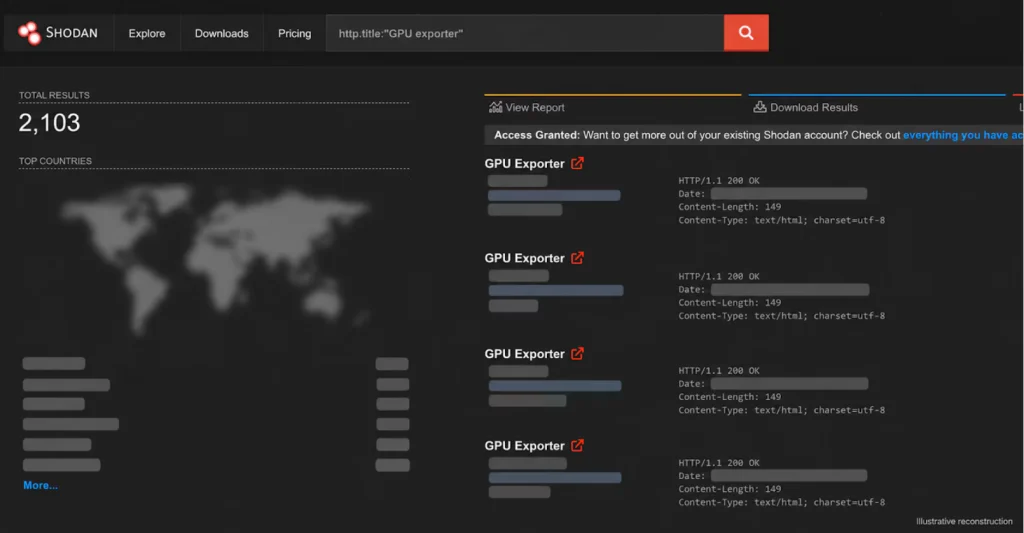
A simple Shodan query
TL;DR
NVIDIA has patched CVE-2026-47483, a high-severity flaw in NVIDIA DCGM Exporter with a CVSS score of 8.2. Unauthenticated attackers can flood its profiling endpoints and crash GPU monitoring. Researchers found more than 2,000 servers exposing the exporter to the open internet.
- CVE: CVE-2026-47483
- CVSS: 8.2 (High · CVSSv3)
- Product: NVIDIA DCGM
- Affected: 0.0 to 4.5.2, 0.0 to 4.8.2
- Impact: CWE-770
- Status: No confirmed exploitation yet
- EPSS: 0.3% (30-day)
- Action: See vendor advisory
Route critical CVEs to one Slack channel, everything else to another.
Try Team free for 14 daysSecurity firm Lava found the bug after it enabled the tool on one of its own GPU clusters. In its research on the NVIDIA DCGM Exporter vulnerability, Lava says an attacker could “crash the monitoring service, blind operators to GPU health and activity.” NVIDIA then published a security bulletin on July 28, 2026.
Why It Matters
Thousands of GPUs in plain view
Lava ran four internet scans between March and May 2026. It observed roughly 2,100 hosts serving exporter metrics. Together, those hosts reported more than 12,000 unique GPUs. Lava estimates the hardware is worth about $100 million.
Every host answered over plaintext HTTP. None of them asked for a password. As the researchers put it, “Anyone who could reach these endpoints could see what hardware organizations were running.”
The exposed fleet was not limited to older cards. Lava counted 312 NVIDIA B200s and 32 B300s from the current Blackwell generation. It also saw H100s, H200s, and many GeForce RTX 4090 and 5090 cards.
Who is exposed
The exposed exporters belonged to nearly 300 organizations. Consumer GPU and mining farms made up 35% of the exposed GPUs. Neoclouds followed with 25%, and hosting providers accounted for 19%.
By location, the United States hosted 44% of the GPUs. Romania and China followed with 17% and 16%. Lava also found customer deployments on Voltage Park, Lambda, Northern Data, and DigitalOcean. Voltage Park alone had 71 public DCGM Exporter hosts. However, the provider confirmed its customers deployed all of them. Its security team then contacted the affected users.
How the Attack Works
DCGM Exporter reads telemetry from each GPU on a host. It then serves those metrics over HTTP, usually on port 9400, so Prometheus can collect them.
The tool is written in Go. Some deployments also expose Go’s built-in profiling interface at /debug/pprof/. In fact, about a quarter of the exposed hosts in Lava’s scans did so.
Certain profiling endpoints keep a request open for a duration the caller chooses. As a result, many parallel requests drive memory use higher. Eventually, the exporter runs out of memory and crashes. Lava reproduced this behavior with NVIDIA’s official container “without modifying it.”
The damage can reach beyond the monitoring tool. According to Lava, the CPU and RAM pressure could slow training or inference jobs on the same host. NVIDIA’s advisory also lists low-impact information disclosure as a possible outcome. Still, a crashed exporter does not necessarily stop the GPU workload itself.
Exploitation status
No exploitation in the wild has been confirmed. The CISA coordinator entry for the CVE lists exploitation as “none.” Lava says it tested the attack only in a controlled lab, not against public servers. No public proof-of-concept has been confirmed either.
Affected Versions
- NVIDIA DCGM Exporter on all platforms, in releases before 4.8.2.
- NVIDIA DCGM releases before 4.5.3, which the bulletin also lists as an updated version.
Deployments that bind the exporter to a routable interface face the highest risk. In those setups, /debug/pprof/ can become reachable along with /metrics.
Patch and Mitigation Steps
- Upgrade NVIDIA DCGM Exporter to version 4.8.2 or later.
- Keep the –enable-pprof flag off unless you need profiling. Current releases make the endpoint opt-in.
- Bind exporters to a loopback or private interface.
- Restrict access with firewall rules or security groups so only monitoring systems can connect.
- Protect Prometheus query APIs and target pages in the same way.
- Set alerts that flag unexpected exporter crashes.
Lava’s guidance is direct. Node Exporter, DCGM Exporter, and Prometheus “should not be directly reachable from the public internet” without a clear need and access control.
The wider monitoring problem
The scans also turned up 12,096 public Prometheus Node Exporter hosts. These leaked InfiniBand adapter models, firmware versions, and kernel details. Those hosts are a separate exposure, not confirmed CVE-2026-47483 targets. Even so, the combined data let researchers tie GPU activity to the servers and networks around it.
The lesson for AI teams is simple. Companies spend millions on GPUs, yet they often leave the tools that watch them open to anyone. Patching NVIDIA DCGM Exporter closes this flaw, but locking down every exporter closes the bigger gap.
Support Our Threat Intelligence
Find our vulnerability reports and weekly recaps helpful? Support our work today and unlock a 100% ad-free reading experience!
 Buy Me a Coffee
