NVIDIA Open-Sources Audio2Face: Generative AI for Lifelike Character Animation is Now Free
 Do Son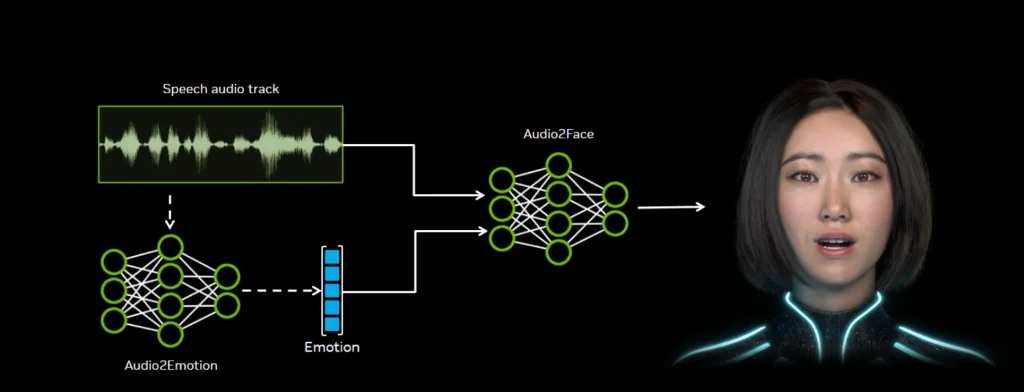
NVIDIA has announced the open-sourcing of its Audio2Face model and accompanying SDK, enabling game and 3D application developers to more seamlessly integrate this advanced technology for creating lifelike character animations and immersive interactive experiences. Alongside the model and software development kit, NVIDIA is also releasing a comprehensive open-source training framework, allowing developers to fine-tune or customize the system according to specific needs, thereby offering exceptional flexibility of use.
A highlight of Project R2X, first showcased at CES 2025, Audio2Face leverages generative AI to automatically transform speech into vivid facial expressions and natural lip movements.
From in-game character dialogues to customer service bots, and even real-time interactions with virtual streamers, this technology delivers remarkably accurate lip-sync and expressive emotion. Developers can generate dynamic facial animations without painstaking frame-by-frame design, significantly reducing labor costs and shortening production cycles.
On a technical level, Audio2Face not only aligns precisely with the phonemes and intonations in speech but also streams the generated results as animation data, suitable for both offline rendering and real-time applications. This versatility makes it equally powerful for pre-rendered high-quality content and interactive, latency-sensitive scenarios such as NPC conversations or live-streamed virtual personas.
The technology has already seen widespread adoption across the gaming and entertainment industries. Studios such as Codemasters, GSC Game World, NetEase, and Perfect World have integrated Audio2Face into their titles, while independent software vendors including Convai, Inworld AI, Reallusion, Streamlabs, and UneeQ are employing it to craft deeply immersive virtual interaction solutions.
By making Audio2Face open source, NVIDIA aims to further expand its application ecosystem, providing developers with extensive resources and use cases on the NVIDIA ACE for Games platform. Moreover, the technology can be paired with other generative AI tools to build comprehensive digital avatar solutions.
Traditionally, facial animation required skilled artists painstakingly refining every detail—a time-consuming and costly process that struggled to meet the demands of real-time applications. With Audio2Face now open-sourced, independent teams and startups can access this technology at a lower barrier of entry, producing digital characters that are stylistically distinct yet fluid and realistic. For gaming, this promises to dramatically enhance NPC interactivity, while in media, entertainment, and customer service, it offers more authentic conversational experiences that narrow the gap between the virtual and the real.
As generative AI proliferates across industries, NVIDIA’s decision to open-source Audio2Face represents more than just a release of tools: it marks a step toward the standardization and democratization of “digital human” technologies. In the years ahead, whether in gaming, filmmaking, or enterprise applications, this innovation is poised to unlock entirely new forms of interactive engagement.
Related Posts:
- Amazon Unveils Nova Sonic: A Unified Model for Natural Voice AI Interactions
- Supply Chain Attack on Popular Animation Library Lottie-Player Targets Web3 Users
- Windows Hello Update: Microsoft Disables Facial Recognition in the Dark Due to Security Flaw
- FBI Warns of Generative AI’s Role in Amplifying Fraud Schemes
Support Our Threat Intelligence
Find our tech and OS security coverage helpful? Support our work today and unlock a 100% ad-free reading experience!
 Buy Me a Coffee
