NVIDIA’s New Ethernet Tech Turns Distributed Data Centers Into a Single AI “Superfactory”
 Do Son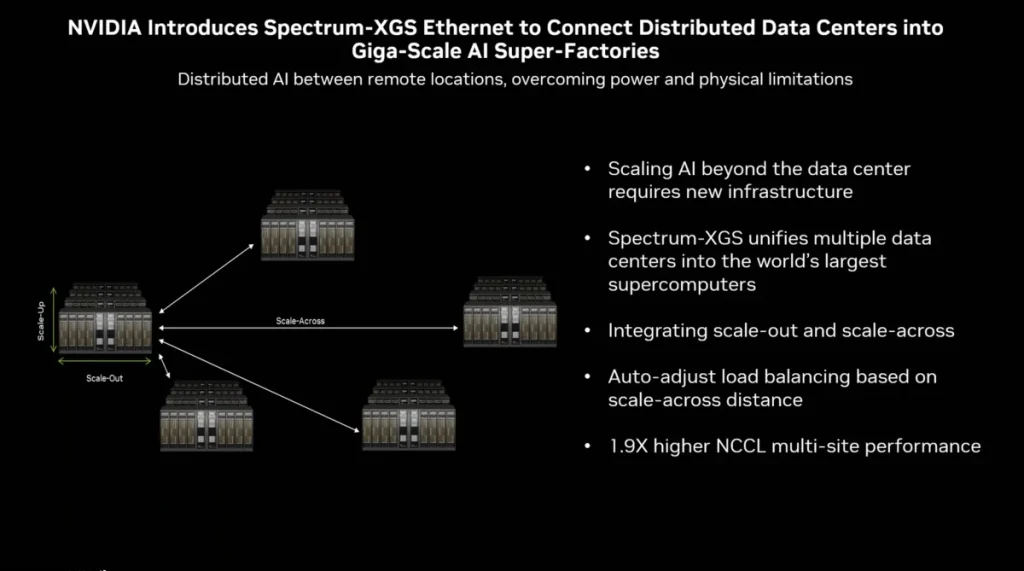
At the HOT Chips conference, NVIDIA unveiled its Spectrum-XGS Ethernet, a technology extending the Spectrum-X platform’s algorithms to enable automated congestion control and latency management across distances, allowing geographically distributed data centers to operate as though they were a single supernode. NVIDIA stated that Spectrum-XGS can nearly double the performance of the NVIDIA Collective Communications Library (NCCL) for multi-GPU workloads, dramatically accelerating communication between GPUs and nodes, and delivering predictable, near-linear performance gains for AI training and large-scale inference.
This means that what was once the domain of a single massive data center—the computational power of a “supercomputer”—can now transcend geographic and architectural boundaries, linking multiple independent facilities into a unified “trillion-scale AI superfactory.” CoreWeave, a company focused on AI cloud infrastructure, will be among the first to adopt Spectrum-XGS.
According to NVIDIA, Spectrum-XGS achieves its performance boost by leveraging automatic distance-based congestion control and latency management, optimizing communication between GPUs and nodes with precision. For AI clusters spanning different cities or even regions, this effectively turns their compute power into a single, enormous resource pool, delivering performance predictability akin to operating within one data center.
In other words, distributed data centers once constrained by physical distance can, through Spectrum-XGS, be seamlessly interconnected—becoming collaborative AI computation hubs with far greater scalability and flexibility.
In the Ethernet switching domain, Broadcom has long been the industry mainstay. Its Tomahawk and Trident ASIC series are the de facto standard in hyperscale data center switches, boasting high port density, low power consumption, and a mature ecosystem that meets the needs of cloud providers and telecom operators alike. While Broadcom’s solutions offer throughput in the hundreds of terabits per second, their optimization remains geared toward traditional network traffic rather than the highly synchronized GPU-to-GPU communication critical for AI training.
By contrast, NVIDIA’s Spectrum-XGS is purpose-built for AI networking. Its algorithms are tailored to distributed AI workloads, incorporating automated distance congestion control, inter–data center latency compensation, and tight integration with NVIDIA’s software and hardware ecosystem, including NCCL and NVLink. Spectrum-XGS is therefore not about simply scaling ports or bandwidth, but about optimizing the very communication patterns that underpin distributed AI model training.
Put differently, if Broadcom’s Ethernet technology represents the broad backbone highways of the data center, NVIDIA’s Spectrum-XGS functions as the dedicated express lanes for AI workloads. The former brings economies of scale and ecosystem maturity, while the latter emphasizes reduced training time and predictable cross-regional performance in the AI era. For enterprises investing heavily in AI cloud infrastructure, the two may coexist as complementary layers: Broadcom to form the general-purpose backbone, and NVIDIA to provide the AI-optimized acceleration tier.
As AI models continue to grow in scale, tomorrow’s cloud data centers will increasingly embody a multi-site, cross-distance, massively collaborative architecture. NVIDIA’s introduction of Spectrum-XGS not only highlights its ambition to fuse networking hardware and software into a unified vision but also signals the shift of AI infrastructure beyond the traditional data center paradigm—toward a future of cross-regional integration and trillion-scale AI superfactories.
Related Posts:
- CVE-2024-12297 (CVSS 9.2): Critical Authorization Vulnerability in Moxa EDS-508A Series
- Broadcom’s Jericho4 Unleashed: The 3nm Switch-Router Connecting a Million XPUs for Distributed AI
- Hacker group threatens to expose Nvidia driver and firmware data
Support Our Threat Intelligence
Find our tech and OS security coverage helpful? Support our work today and unlock a 100% ad-free reading experience!
 Buy Me a Coffee
