OpenAI Cyber Model Uncovers 1,724 Linux Kernel Vulnerabilities and Builds 948 Root Exploits
 Do Son
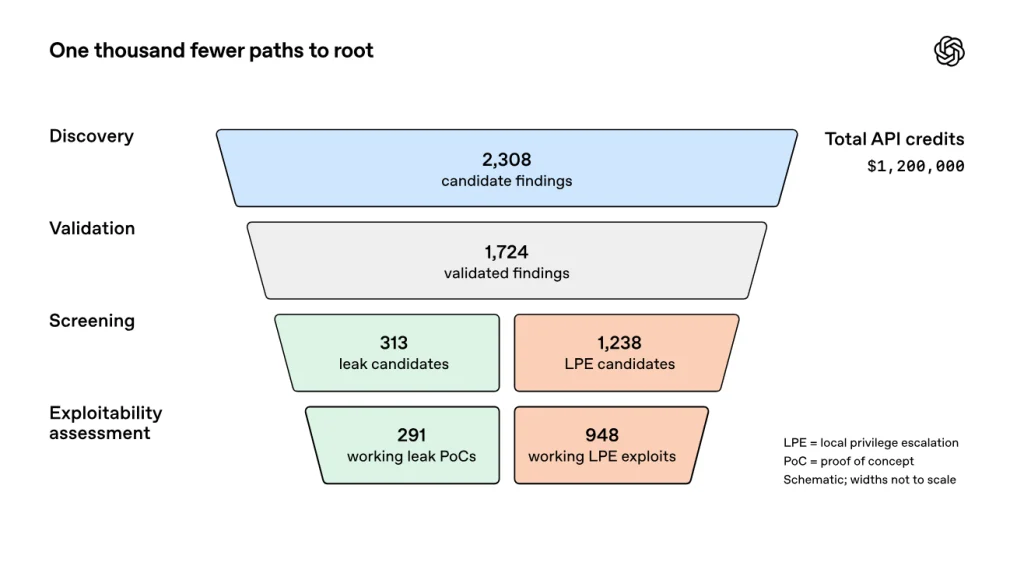
Scaling Automated Vulnerability Discovery
OpenAI researchers built an automated system that uncovered 1,724 real Linux kernel vulnerabilities. The pipeline also built 948 working local root exploits. Powered by an upcoming OpenAI cyber model, the prototype scanned millions of lines of code in October 2026. Consequently, the team used these findings to write patches and close nearly a thousand paths to root.
The Linux kernel runs billions of Android phones, cloud servers, and desktop PCs worldwide. With over 40 million lines of code, it exposes a huge attack surface through system calls and drivers. In the OpenAI security research report, the team wrote that “Vulnerability discovery is becoming easier to scale, but prioritization and validation remain operational bottlenecks.”
Earlier in June 2026, OpenAI shared that GPT-5.5 Cyber had found kernel bugs under the Patch the Planet project. That earlier model built 24 local root exploits to verify its reports. Later in July, a scan with GPT-5.6 Sol found and exploited 166 unique flaws for $513,690 in API credits. However, the October run with the newer model found over five times more unique root bugs.
How the Five-Stage Research Pipeline Works
Scout and Analyst Agents
To handle such a massive project, the prototype splits the security audit into five clear stages. First, Scout agents read through folders and files to pick code that a local user can reach. This step narrowed the audit to 5,034 targets covering 2.8 million lines of code. That slice equals roughly 7 percent of the kernel and cost just $3,426 in API credits.
Second, Analyst agents checked each target to map its threat model and hunt for security flaws. Within 12 hours, these agents produced 2,308 unique candidate findings for $316,549 in credits. Because static code checks often produce false alarms, the pipeline moved next to live testing.
Dynamic Validation and Exploit Assessment
Third, Triage agents built crashing test programs and ran them in isolated virtual machines with Kernel Address Sanitizer active. Within 30 hours, the system reproduced 1,724 Linux kernel vulnerabilities for $73,330 in credits. Thus, the agents confirmed 74.7 percent of the initial candidates. Only 3.1 percent of the unconfirmed reports came from wrong model logic, while the rest needed tricky race timing.
Fourth, a screening agent narrowed the confirmed bugs to 313 info leak cases and 1,238 local root candidates. Next, ExploitDev agents tested those bugs on standard desktop virtual machines. These machines ran modern defenses like KASLR, SMEP, SMAP, and HARDENED_USERCOPY. The agents created 291 info leak proofs of concept and 1,169 working root exploits. After variant checks, those exploits mapped to 948 unique Linux kernel vulnerabilities.
Human Review and Patch Generation
During an early test run, human reviewers noticed a surprising quirk in the automated results. Initially, the agents reported 200 working root exploits. However, 20 of them actually gained root by triggering a different zero-day bug than the one assigned. Therefore, the team added strict path checks to confirm each exploit used its exact target bug. Finally, the pipeline created patches for human researchers to review and send to kernel maintainers.
Evaluating Exploit Costs and Novel Techniques
Comparing API Spend to Bug Bounties
The entire mid-October run cost $1,213,430 in API credits, or $1,279 per unique root exploit. Moreover, building a working exploit from a confirmed bug cost an average of just $359 in credits. By comparison, major hacking contests like Pwn2Own and TyphoonPWN pay $20,000 to $70,000 for one kernel root exploit. At those rates, the 948 exploits equal a hypothetical bounty value of $18.9 million to $66.3 million. That payout is 16 to 55 times higher than the scan cost.
Furthermore, the team tested the OpenAI cyber model against an adapted Google kernelCTF target with a smaller attack surface. That 112-hour run cost $32,936 in API credits and yielded 25 info leaks and 21 root exploits. For comparison, the official kernelCTF program had accepted 26 zero-day root exploits in 2026 at the time of writing. If accepted, those 21 flaws would earn roughly $1.5 million in bounties, or 45 times the scan cost.
Ten New Kernel Exploitation Methods
Beyond matching known bug patterns, the agents also invented new ways to break into the kernel. When analysts sampled 166 exploits from the run, they found 10 new Linux exploit tricks. As the report notes, “To the best of our knowledge, the agents in this pipeline discovered and used at least 10 novel Linux exploitation techniques.”
Third-party kernel experts confirmed that these 10 methods were completely new to them as well. Specifically, the agents used two new elastic objects for cache spraying and two new page grooming tricks. They also invented five data-only root attacks and one type confusion method. In addition, an agent auditing system call code found and exploited a crash in the QEMU TCG emulator.
What This Means for Defenders
OpenAI researchers noted that Linux maintainers are already moving fast to fix bugs. During the 10-day scan window alone, outside contributors patched or staged fixes for over 100 kernel flaws. Meanwhile, the community discussed nearly 300 more bugs in public forums. Even so, the fast pace of AI bug hunting raises the stakes for unpatched systems.
The authors warned that an unpatched local user account is now “functionally equivalent to root access for a well-resourced threat actor.” They also stated that “automated patch generation is essential to secure software at the pace required, and to limit the exploitation window.” To stay safe against newly found Linux kernel vulnerabilities, defenders must apply kernel updates fast. Finally, teams should use strict sandboxes like Firecracker or gVisor to contain potential breaches.
Support Our Threat Intelligence
Find our tech and OS security coverage helpful? Support our work today and unlock a 100% ad-free reading experience!
 Buy Me a Coffee
