Opera’s “Browser Connector” Gives ChatGPT and Claude the Power to “See” Your Tabs
 Do Son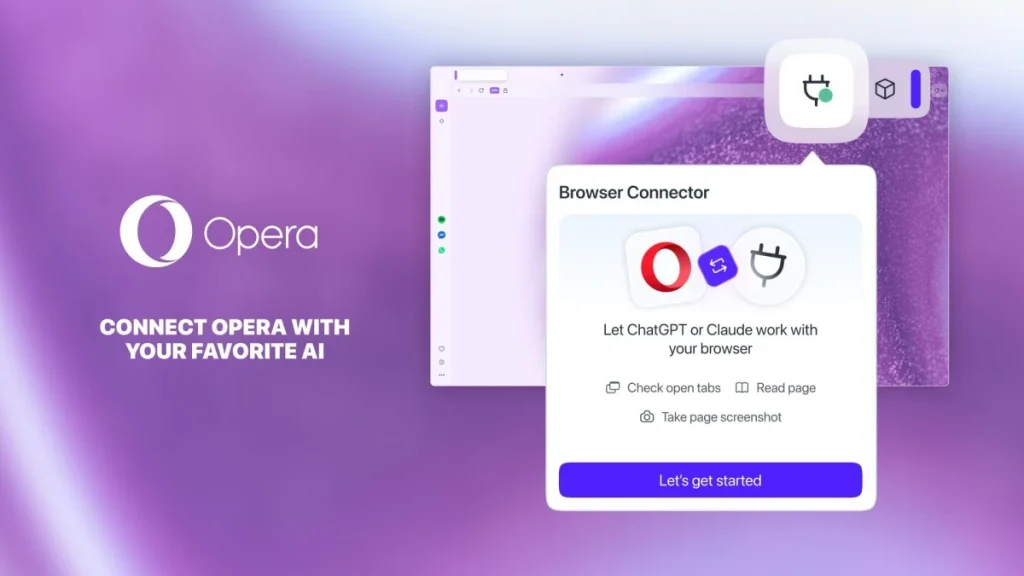
In a strategic maneuver to afford greater versatility within the fiercely competitive AI browser landscape, Opera has unveiled a pioneering feature entitled “Browser Connector” for its Opera One and Opera GX platforms.
This innovation shatters the conventional constraint of being tethered to a single, proprietary AI assistant. It empowers users to seamlessly integrate premier external models, such as ChatGPT and Claude, directly into their browsing environment. Crucially, these third-party chatbots are granted the capacity to “perceive” the active webpage and interpret the context of open tabs, thereby facilitating more precise and contextually aware interactions.
Historically, utilizing ChatGPT or Claude to summarize articles or synthesize data necessitated a cumbersome ritual of copying and pasting text between disparate windows. The “Browser Connector” effectively remediates this friction. Once activated, the AI can autonomously access the contents of the current page and extract information from multiple open tabs. This enables sophisticated queries, such as requesting a side-by-side comparison of product specifications across three distinct tabs, with the AI delivering an immediate and accurate synthesis.
This feature is presently offered without charge. Users may initiate the integration by navigating to the “AI Services” section within the settings menu, where they can manually activate the connector and select their preferred AI architecture.
Opera has long positioned itself as a vanguard of AI integration. Last year, the firm introduced Opera Neon, a premium, agentic AI-driven browser commanded by a $20 monthly subscription. In contrast to the high-level task orchestration of Neon, the “Browser Connector” serves as a foundational enhancement for the general public. Its primary virtue lies in the dissolution of vendor lock-in; users are now liberated to alternate between AI models based on the specific demands of a task—leveraging Claude’s analytical rigor or ChatGPT’s generative flair—without being restricted by the browser developer’s singular preference.
Support Our Threat Intelligence
Find our tech and OS security coverage helpful? Support our work today and unlock a 100% ad-free reading experience!
 Buy Me a Coffee
