 Do Son
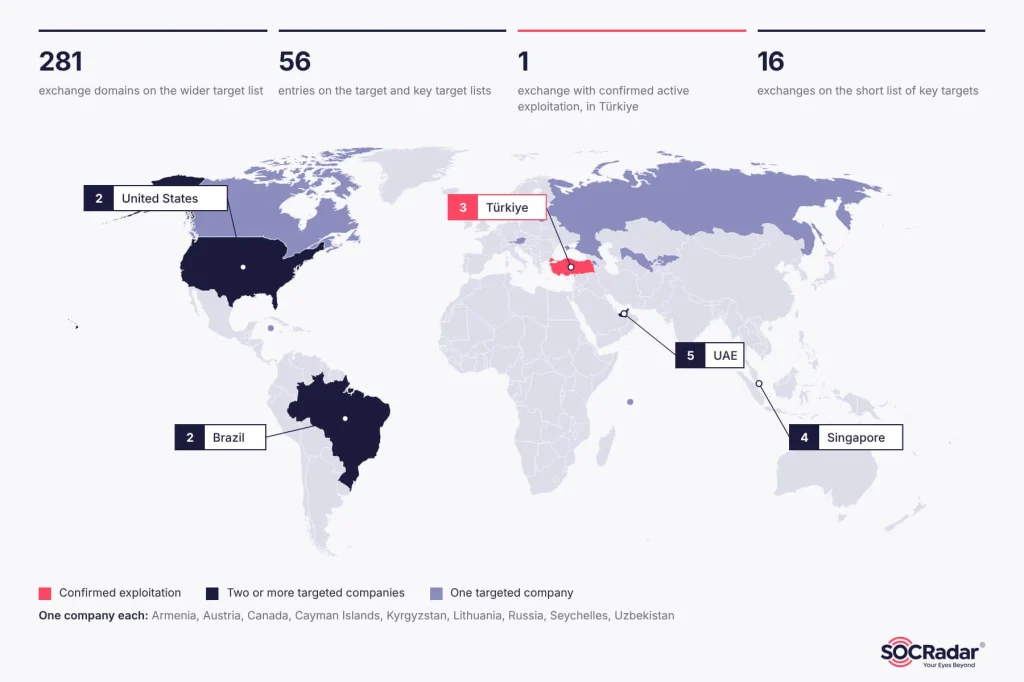
Targeted companies by reported headquarters | Image: SOCRadar
TL;DR
SOCRadar researchers uncovered the Operation ArgonHunt crypto breach after finding an unsecured staging server leaking over 1,600 attack files. The exposed directory revealed a deep compromise of a Turkish cryptocurrency exchange alongside an automated pipeline harvesting 44,096 AI API keys. Investigators shared victim indicators privately while analyzing the threat actor’s live working notes.
What was exposed
During routine threat hunting, analysts discovered a Linux server serving its temporary directory over HTTP port 8099. That single misconfiguration leaked roughly 700 MB of scripts, execution logs, and stolen credentials. As the researchers noted, “Threat actors rarely hand over their working notes. This one did.”
Inside the files, investigators found evidence of two separate campaigns run by the same operator. First, the attacker held read and write access to a cryptocurrency exchange’s production database. The directory contained stolen admin panel source code, CRM files, and credentials for over a dozen MySQL accounts.
Second, the server stored 44,096 unique API keys for Gemini, OpenAI, OpenRouter, Anthropic, and xAI. These harvested secrets included 519 Google Cloud tokens and administrative credentials. Furthermore, an intercepted traffic log showed the operator also sniffed live service account tokens.
Attempted theft vs. confirmed losses
The operator’s Python scripts logged more than 200 forged withdrawal requests across Bitcoin, Ethereum, and Tether. Specifically, the files listed 15 USDT entries worth 253,000 USDT, 19 BTC entries totaling 4.7 BTC, and a multi-currency sweep requesting 55,600 USDT, 15.87 ETH, and 0.134 BTC. However, analysts clarified that “We did not verify on-chain settlement of the individual requests, so the figures should be read as attempted theft and not as confirmed losses.” Similarly, out of 44,096 collected AI keys, the operator’s recheck logs marked 2,686 keys as active.
How it happened
The Operation ArgonHunt intrusion succeeded through weak password hashing and database misconfigurations. Initially, the attacker obtained roughly 100 staff passwords stored as unsalted MD5 hashes. After cracking 17 hashes, a Hydra brute-force run unlocked the exchange’s admin panel in one second on November 12, 2026.
Next, specialized scripts cycled through four-digit and six-digit SMS one-time codes across 12 parallel threads. Once inside, the intruder pivoted through database services using custom Python tools. One script abused the MySQL general query log to write a PHP web shell directly into the web root.
Another tool created an InfluxDB subscription to trigger server-side request forgery against internal panels. As the report explained, “In effect, the victim’s own database becomes a proxy into its internal network.” Finally, four drainer scripts modified withdrawal addresses inside the database and forged requests from localhost to bypass application checks.
Who is affected
The primary victim is an unnamed cryptocurrency exchange based in Turkiye, which has not publicly confirmed the breach. Unfortunately, target lists on the server show the operator planned wider attacks. Researchers found reconnaissance lists covering 281 exchange domains and 56 priority targets across the United Arab Emirates, Singapore, Turkiye, Brazil, and the United States.
Meanwhile, the API key harvesting campaign affects developers and enterprises using major AI platforms. Among the 2,686 active keys, OpenRouter credentials showed a 41 percent survival rate, compared to 6 percent for Gemini and under 2 percent for OpenAI. Mallory Intelligence also linked this activity to a broader wave of automated credential theft targeting AI infrastructure.
What affected people should do
Cryptocurrency exchanges should immediately audit their databases for unauthorized withdrawal modifications and rogue MySQL accounts. Security teams must replace legacy MD5 password hashes and enforce rate limits on SMS one-time codes. Additionally, administrators should restrict database file privileges and block outbound InfluxDB subscription requests.
Teams building with AI APIs must scan public repositories and traffic logs for exposed tokens. If you suspect a key leaked during Operation ArgonHunt, revoke the credential immediately and review billing logs for unauthorized compute usage. Developers should also enforce strict IP allowlists and scope limits on cloud service tokens.
Company response
SOCRadar conducted a passive investigation without touching victim systems or testing any exposed credentials. Following discovery, the threat intelligence firm shared victim-specific indicators through private disclosure channels to help affected organizations contain the intrusion. Researchers continue to monitor the operator’s infrastructure for new activity.
Support Our Threat Intelligence
Find our threat intelligence and malware analysis helpful? Support our work today and unlock a 100% ad-free reading experience!
 Buy Me a Coffee
