OPTIMJACK Optimizely Malware Hits 178 Brands With Crypto Clipper, Card Skimmer, and iOS Exploits
 Do Son
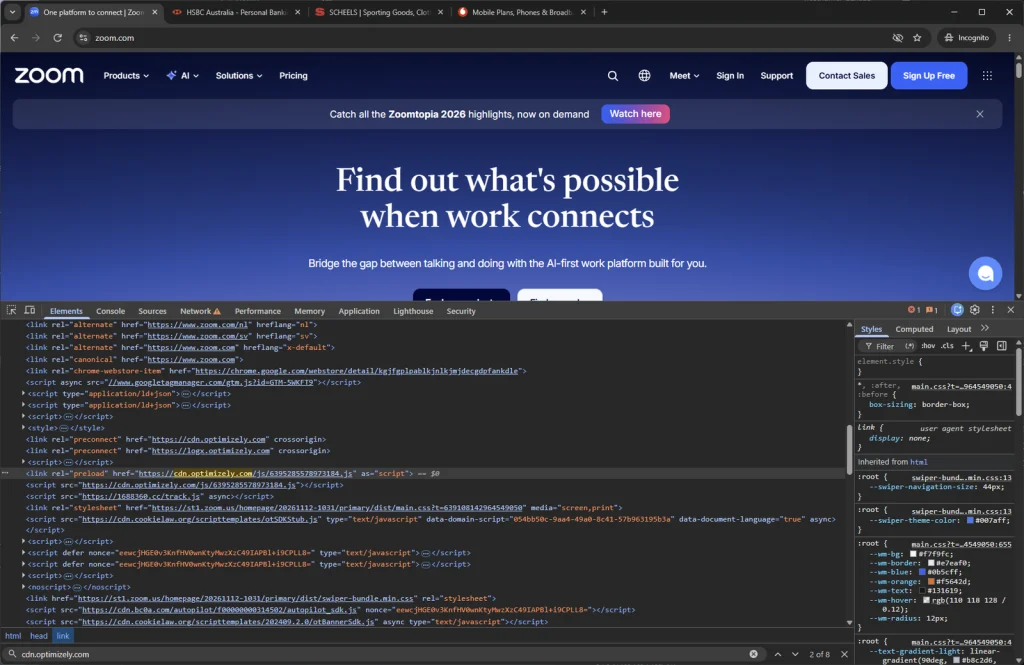
Image: Report URI
At a Glance
| Malware Family | OPTIMJACK Optimizely malware (30 KB multi-purpose JavaScript payload delivering a crypto address clipper, payment card skimmer, cookie and screenshot stealer, and Coruna / DarkSword iOS exploit kits) |
| Threat Actor | Unattributed financially motivated group (confirmed link to the earlier webshell.lol injector waves via Kissmetrics, StorifyMe, and Minute Media) |
| Target / Victims | 188 Optimizely snippets across 178 organizations (including Zoom, BBC, CNN, Fox News, Salesforce, GitLab, IKEA, HSBC, Equifax, Air France-KLM, Ledger, and Peacock; ~$6,600 to $7,040 stolen on-chain) |
| Delivery Vector | Unauthorized modification of customer Project JavaScript fields served directly from Optimizely Web CDN (cdn.optimizely.com) and custom CNAME domains |
| Key Capabilities | 8-chain checksum-validated crypto address swapping, Luhn-validated card skimming via sendBeacon, html2canvas screenshot and cookie exfiltration, and hidden iframe iOS 13 to 18.x exploitation |
TL;DR
On November 16, 2026, a supply-chain attack distributed Optimizely malware to visitors of 178 major organizations, including Zoom, CNN, the BBC, Salesforce, GitLab, HSBC, Equifax, IKEA, and Ledger. Tracked as the OPTIMJACK Optimizely malware campaign, the attack injected malicious loader code into customer Project JavaScript configurations. These were served from Optimizely’s trusted content delivery network. Over an exposure window exceeding 13 hours, the script swapped cryptocurrency wallet addresses and skimmed payment cards. Furthermore, it captured page screenshots and cookies. The script also routed iPhone and iPad users to the Coruna and DarkSword iOS exploit kits.
Delivery and Attribution
Optimizely Web allows enterprise customers to run experiments by loading a single JavaScript file from cdn.optimizely.com or a custom first-party CNAME subdomain. Each snippet includes an optional Project JavaScript (projectJS) field. This contains custom code that executes on every page where the snippet loads. On November 16, 2026, an attacker gained write access to the Project JavaScript field across dozens of unrelated customer accounts. This included Optimizely’s own main portal. In addition, the login portals were affected.
Security researcher Scott Helme at Report URI inspected 1,611 distinct Optimizely snippets and identified 188 infected files belonging to 178 organizations across 20 sectors. Banking and finance led the victim count with 32 organizations (such as HSBC, Equifax, Paychex, and ABN AMRO). This was followed by 23 technology firms (including Zoom, Salesforce, GitLab, and Bitly). There were also 20 retailers (such as IKEA, ASOS, and American Eagle), 12 entertainment brands, 10 media outlets, nine airlines, and six crypto platforms including Ledger. Meanwhile, analysts at StepSecurity examined public urlscan.io scan telemetry. This showed 76 third-party page scans across 30 domains requesting the malicious script between 08:28 and 21:23 UTC.
Confirmed Versus Suspected Attribution
Confirmed technical attribution links the November 16 incident to a threat actor that operated an injector domain in September 2026 against Turkish websites. This actor also conducted an earlier supply-chain wave between November 13 and November 16 through Kissmetrics, StorifyMe, and Minute Media. In fact, the earliest Optimizely tampering caught on the BBC’s snippet at 04:21 UTC loaded that exact earlier injector domain. Then, it switched to a newly registered .cc payload server on Google Cloud.
Furthermore, the Coruna iOS loader used on November 16 was byte-identical to a sample analyzed in October 2026. Also, two of the attacker’s .icu iOS router domains were registered on November 9 and active by November 12. However, suspected attribution applies to the exact method the intruder used to breach Optimizely.
According to the Report URI investigation, “We don’t know how the attacker got write access to so many unrelated customer projects: a compromised Optimizely system, a compromised credential with cross-customer access, or something else. That’s for Optimizely to explain. To be clear, Optimizely’s CDN served exactly what it was given; this was not a CDN cache-poisoning attack.”
Infection Chain
Because the modified snippets arrived from cdn.optimizely.com with a valid TLS certificate, every affected website executed the attacker’s loader with full page privileges. In some cases, such as on GitLab, a cookie consent manager loaded the Optimizely bundle. This then pulled the second-stage track.js script. Researchers observed three distinct loader variations inside the projectJS field. These included a plain script tag pointing to the .cc server, a Base64-obfuscated version decoded via atob(), and a full inline copy executed via eval whenever Content Security Policy (CSP) rules blocked external script loads. Notably, when Smartsheet’s snippet was cleaned during the incident, the attacker re-infected it with the Base64 variant. This proved the intruder still held active write access during initial remediation.
Rapid Live Payload Edits
By setting a 15-second HTTP cache-control header on the Google Cloud server, the operator modified the live payload repeatedly throughout the day. Report URI tracked 26 rebuilds over the course of November 16 as the attacker added new wallets. The attacker also inserted the payment card skimmer at 13:43 UTC. Additionally, the attacker appended a second batch of iOS exploit domains between 17:13 and 17:57 UTC. As the StepSecurity technical analysis noted, “The operator edited the payload at least four times in two hours. It grew from 28,877 to 30,430 bytes, and the final version went live at 17:56 UTC.”
Command-and-Control and Multi-Stage Capabilities
Once loaded in a visitor’s browser, the 30-kilobyte OPTIMJACK Optimizely malware executed four modules simultaneously. First, the cryptocurrency clipper scanned page text, form inputs, links, clipboard copy events, outgoing fetch and XHR traffic, and even hooked Function.prototype.call and apply. Whenever it detected a valid checksum-verified address for Bitcoin, Ethereum and EVM chains, TRON, Solana, TON, Litecoin, Bitcoin Cash, or Dogecoin near payment keywords like “wallet,” “deposit,” or “send,” it swapped the string for an attacker-controlled address. On-chain tracking showed the attacker’s wallets received between $6,600 and $7,040 across Bitcoin, Litecoin, Ethereum, BSC, and TRON within nine hours. The funds were then swept toward HitBTC deposit addresses starting at 13:03 UTC.
Second, the first time the script swapped a visible wallet address on a page, it loaded html2canvas from the command server. It then captured a JPEG screenshot of the victim’s browser window. The script sent it via HTTP POST to a /hit.php endpoint. This included the page URL, the original wallet addresses, and up to 8,000 characters of non-HttpOnly document cookies.
Third, the card skimmer monitored form submissions and fetch or XHR POST requests for Luhn-valid payment card numbers, expiration dates, and three- or four-digit CVV codes. When all three fields appeared outside a cross-origin payment iframe, the script exfiltrated the card data to /card.php using navigator.sendBeacon. Meanwhile, it cached a marker in sessionStorage under a cc_ prefix to avoid duplicate uploads.
Fourth, when the script detected an iPhone, iPad, or iPod user agent, it loaded two boot.js scripts from .icu domains hosted in Hong Kong and Singapore. Depending on the device version, the script injected a hidden iframe delivering the Coruna exploit chain for iOS 13 through 17. It also delivered the DarkSword exploit chain for iOS 18.x (up to iOS 18.6). Or it delivered a device fingerprinting routine for iOS 26. As a result, it forced older unpatched iPhones to reload the page every 60 seconds.
Defense and Detection Guidance
Optimizely began cleaning affected snippets around 20:40 UTC on November 16, reducing the number of infected files from 186 down to a single snippet by 21:52 UTC. However, standard repository scans and consent banners failed to stop the Optimizely malware because the malicious code resided inside a vendor-hosted file that changed dynamically without Subresource Integrity hashes. When Report URI tested 256 affected hosts, only 24 sites (15 percent) blocked the payload completely via a strict script-src CSP allowlist, while sites relying on strict-dynamic or unsafe-eval allowed the external script or its inline eval fallback to run.
Organizations using Optimizely Web must audit every project’s Project JavaScript and experiment code for unauthorized script tags or atob() calls, rotate all Optimizely account credentials and API tokens, and review CSP reports for connections to the .cc and .icu indicator domains. Furthermore, enterprises should place checkout card fields inside cross-origin payment provider iframes, rotate session tokens stored in non-HttpOnly cookies, and avoid unsafe-eval in CSP headers. Finally, consumers and employees who visited affected sites on November 16 should verify cryptocurrency transaction recipients on hardware wallet screens, monitor payment card statements for unauthorized charges, and update Apple mobile devices to iOS 18.7.3 or iOS 26.3 or later.
Support Our Threat Intelligence
Find our threat intelligence and malware analysis helpful? Support our work today and unlock a 100% ad-free reading experience!
 Buy Me a Coffee
