 Do Son
TL;DR
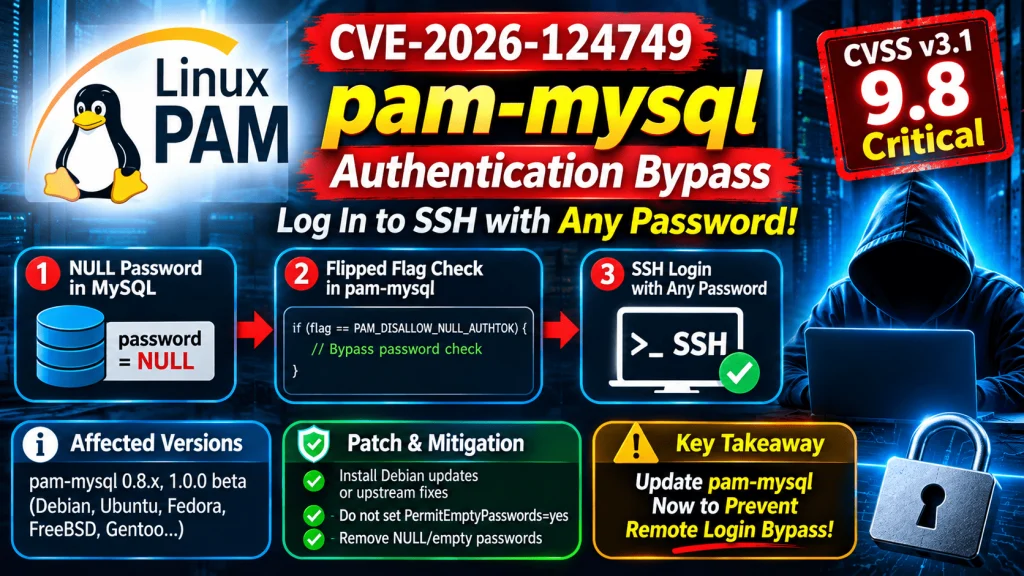
On November 19, 2026, researcher Andrey Vasilevsky disclosed a critical pam-mysql authentication bypass tracked as CVE-2026-124749 (CVSS 9.8). A flipped flag check lets remote attackers log in to stock SSH servers with any password when a stored password is NULL or empty. Admins must install Debian updates or upstream master fixes right away.
- CVE: CVE-2026-124749
- CVSS: 9.8 (Critical · CVSSv3)
- Summary: pam-MySQL (libpam-mysql, src:pam-mysql) inverts PAM_DISALLOW_NULL_AUTHTOK at both pam_sm_authenticate call sites, so an application that asks PAM to refuse passwordless accounts gets the permissive behaviour instead. On a stock sshd, an unauthenticated network…
- Status: No confirmed exploitation yet
- Action: See vendor advisory
Why It Matters
Linux mail hosts, FTP servers, and large web sites use pam-mysql to check logins against MySQL tables. Common tools like PostfixAdmin and Froxlor ship tables that hit this bug on pam-mysql 1.0 beta builds. Because OpenSSH turns on the flag by default, safe server configs face the highest risk.
So far, neither live attacks in the wild nor a public exploit script are known, though a test case exists on request. Even so, this pam-mysql authentication bypass gives full pre-auth access to open hosts.
How the Attack Works
Flipped Flag Check in pam_sm_authenticate
In the oss-sec disclosure for CVE-2026-124749, Vasilevsky notes that pam-mysql flips the PAM_DISALLOW_NULL_AUTHTOK flag at both login call sites. He states: “On a stock sshd, an unauthenticated network client authenticates as any account whose stored password column is SQL NULL, using any password. The supplied password is never compared on that branch.”
Also, OpenSSH sets this flag when PermitEmptyPasswords is set to no, which is the safe default. Vasilevsky warns: “So the inversion is reached by the safe configuration and not by the unsafe one: an administrator who has done nothing wrong gets the permissive path, and one who has set PermitEmptyPasswords yes does not.”
On the 1.0 beta line, the risk is even worse. In fact, empty string passwords also hit the flipped branch, putting standard NOT NULL DEFAULT empty tables at risk.
Affected Versions
This pam-mysql authentication bypass hits every released build of pam-mysql across major Linux systems. The 0.8.x line hits Debian 11 to 14, Ubuntu 18.04 to 22.04, Kali, FreeBSD, and Gentoo. Meanwhile, 1.0.0 beta builds hit Fedora 39 to 44, Nix, Mageia 10, Rosa, and ALT.
Patch and Mitigation Steps
Upstream lead Nigel Cunningham pushed fixes to the master branch on November 19, 2026, adding a nullok option set to off by default. Next, Debian shipped DSA-6643-1 for trixie (0.8.2-2.1) and DLA-4919-1 for bookworm (0.8.2-2+deb12u1) on November 20, 2026.
If you cannot patch now, do not set PermitEmptyPasswords to yes. Instead, purge all NULL or empty password rows from your auth tables and add NOT NULL rules. Finally, check OpenSSH logs against database backups, since bypass logins look just like normal logins.
Support Our Threat Intelligence
Find our vulnerability reports and weekly recaps helpful? Support our work today and unlock a 100% ad-free reading experience!
 Buy Me a Coffee
