 Do Son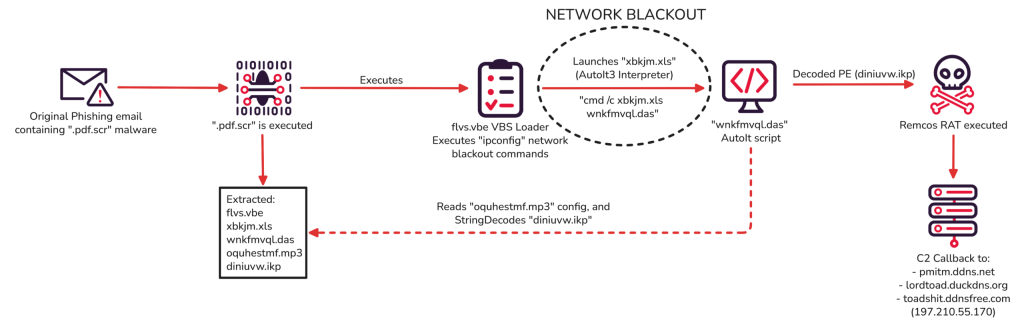
An overview of the malware infection chain from an initial phishing to C2 | Image: JUMPSEC
Security professionals recently discovered a highly dangerous malicious email operation targeting corporate networks. Specifically, threat actors initiated a sophisticated Remcos RAT phishing campaign using localized financial themes. JUMPSEC’s Detection and Response Team (DART) uncovered this malicious activity during a recent incident response investigation. The attackers trick users into downloading compressed archives disguised as official business payment slips. Consequently, corporate security groups must upgrade their endpoint monitoring tools to counter these stealthy tactics.
Analyzing the Initial Lure and Extension Masquerading
The initial attack vectors rely heavily on urgency and social engineering. For instance, the operators craft emails written in Thai containing a MediaFire download link. This link delivers a malicious binary designed to look like a standard document. According to the technical report, “the binary itself is a WinRAR SFX executable, which is a Self-Extracting archive”. Furthermore, the threat actors use dual file extensions to mislead the victim. The file utilizes a deceptive .pdf.scr layout to trick default Windows operating systems.
Uncovering the Network Blackout Technique
Once the user executes the file, the primary script initiates a highly unusual evasion routine. Specifically, the infection chain deploys a unique network blackout technique to disrupt local host communications. The embedded Visual Basic script drops internet connectivity by running the local ipconfig application. Afterward, the script processes its second-stage payload without risk of online detection. Therefore, standard network-based threat intelligence platforms remain entirely blind during this critical execution phase.
Strategic Execution Disruption
The temporary disconnect serves a very strategic operational purpose for the threat actors. As highlighted by investigators, “this network ‘blackout’ temporarily disrupts connectivity while the second-stage payload executes”. Subsequently, the script loads a renamed AutoIt3 interpreter to handle core decryption actions. The tool quickly extracts the true administrative settings block from a localized data file. Finally, the script executes an ipconfig command to safely restore the server’s network connection.
Extracting the Remcos RAT Configuration
This structural evolution within the Remcos RAT phishing campaign allows the primary remote access trojan module to initialize smoothly. The malware uses the classic RC4 cryptographic standard to decrypt its internal settings block. Security researchers successfully reversed this obfuscated layout using basic automation scripts. Consequently, the extraction process revealed several backup command and control (C2) servers. These dedicated communication points utilize popular dynamic DNS service providers to maintain stable connections.
Redundancy and Command Infrastructure
The threat actors built extensive infrastructure redundancy into this specific deployment. For example, the decrypted configuration references three separate tracking domains resolving to an identical destination. These destinations include host addresses like pmitm.ddns.net and lordtoad.duckdns.org. If a provider blocks one domain, the malware seamlessly switches to an alternate path. Meanwhile, this ongoing threat infrastructure aggressively targets multiple distinct vertical sectors simultaneously.
Attributing the Malicious Campaign Cluster
Investigators track this distinct operational cluster under the moniker BlackToad. Historically, this group displays behavioral similarities to broader West African financial crime syndicates. Specifically, analysts linked the campaign to elements of the SilverTerrier ecosystem. However, the group uses specialized crypters that do not match previously documented sub-clusters. Furthermore, recent telemetry connects this specific infrastructure directly to an active campaign called BoredFluff.
Geolocation of the Threat Infrastructure
Surprisingly, the threat actors operate their tracking servers without renting stable datacenter infrastructure. Geolocation data tracks the core internet protocol addresses directly to Onitsha, Nigeria. Interestingly, the network traffic originates from a consumer mobile carrier pool managed by MTN Nigeria. This tactical choice demonstrates how this Remcos RAT phishing campaign avoids traditional host tracking. The attacker simply runs port forwarding parameters directly from their personal mobile device connection. Thus, this operational oversight directly exposes the real-world location of the primary threat operators.
Protecting Corporate Networks Against BlackToad
Organizations must implement robust host-based defense strategies to counter these localized threats. Because the actors manipulate network configurations, signature-based network defenses frequently fail. Therefore, administrators should closely monitor unauthorized executions of basic utilities like ipconfig. Additionally, enforce strict application control policies to block unexpected script interpreters entirely. Ultimately, proactive endpoint monitoring remains the absolute best defense against advanced remote access threats.
Support Our Threat Intelligence
Find our threat intelligence and malware analysis helpful? Support our work today and unlock a 100% ad-free reading experience!
 Buy Me a Coffee
