 Do Son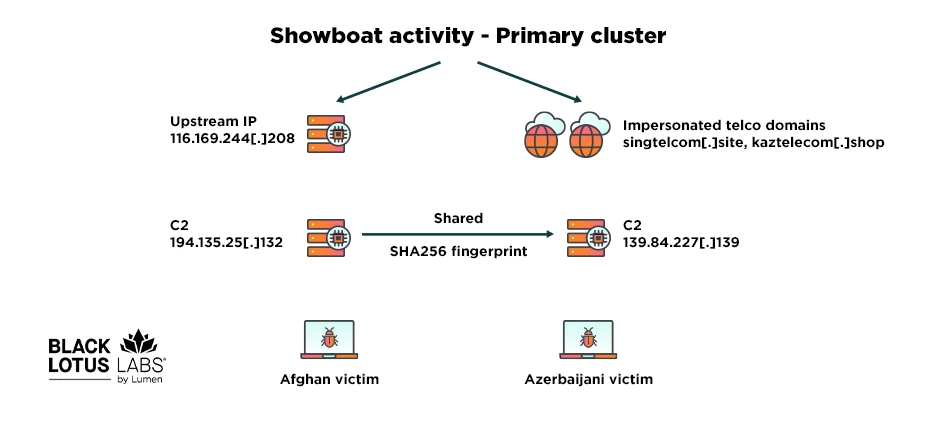
Primary cluster elements | Image: Black Lotus Labs
Threat researchers have exposed a stealthy cyber espionage tool targeting critical infrastructure. Specifically, Black Lotus Labs recently uncovered a highly modular post-exploitation toolkit. Security communities identify this dangerous toolset as the Showboat Linux malware. The malicious operation targets telecommunications providers across several strategic regions. According to intelligence reports, the campaign has remained operational since at least mid-2022. Consequently, enterprise network administrators must review their perimeter defenses to combat this stealthy threat.
Unveiling the Modular Architecture
Core Capabilities of the Toolkit
The newly discovered toolkit functions primarily as a backdoor to establish a permanent corporate foothold. To begin with, “Showboat is a modular post-exploitation framework designed for Linux systems, capable of spawning a remote shell, transferring files and functioning as a Socks5 proxy.” Furthermore, the core binary features specialized capabilities to hide its execution path from local administrators. For instance, it manipulates local environmental libraries to evade standard detection routines. Therefore, the implant allows operators to explore internal corporate structures without triggering security alerts.
Cryptographic Obfuscation Tactics
The infection process relies on an interesting cryptographic layout to shield its configuration file. For example, the payload requires a distinct initialization setup to start its installation sequence. Crucially, “The file was XOR-encrypted with a hardcoded key to each byte, using the cheeky phrase: ‘look me, AV!’” After successful decryption, the agent immediately interrogates the host environment. It collects hostnames, process lists, and desktop screenshots. Then, the malware packages these parameters inside an encrypted string disguised as a standard image file.
Tracking the Command and Control Infrastructure
Regional Geographic Correlations
Analysts utilized global network telemetry to trace the command architecture. During this tracking process, the team discovered distinct geographic indicators linked to the operators. The report highlights that “Our analysis shows a correlation between command-and-control (C2) nodes and connections associated with IP addresses that correlate to Chengdu, China.” Additionally, researchers spotted one unique control node resolving directly to a domestic telecom network within that region. This structural pattern suggests that the environment could represent a primary developer testbed.
Masquerading as Trusted Brands
Meanwhile, the deployment strategy highlights a heavy focus on infrastructure manipulation. The threat actors regularly disguise their control domains to impersonate real international technology providers. Specifically, investigators found active domains mimicking major communications brands in Southeast Asia. This clever naming scheme helps the malicious traffic blend seamlessly into regular web data. Thus, defenders frequently misclassify the dangerous command connections as routine business operations.
Analyzing the Victim Profile and Shared Tooling
Targeted Geopolitical Intrusions
The campaign’s operational reach covers multiple independent activity clusters. For example, researchers confirmed active compromises hitting telecom entities in the Middle East. The report states: “We first observed connections from an Outlook server belonging to an Afghanistan-based ISP provider, which communicated with the C2 node 194.135.25[.]132.” In addition, a separate cluster appeared to communicate with devices located in eastern Europe. Specifically, these targeted systems resided within heavily contested geopolitical zones.
Resource Pooling Among Threat Actor Groups
This geographic distribution indicates that multiple threat actors might share the code repository. When analyzing the European targets, “we believe with moderate confidence this focus on the Donbas region is another example of shared tooling among distinct groups.” This type of resource pooling is increasingly common among modern state-aligned adversaries. By utilizing a uniform framework, separate units can optimize their workflows while complicating attribution. Consequently, the Showboat Linux malware serves as a dual-use toolkit across multiple operational wings.
Defensive Engineering and Perimeter Hardening
Shifting Exploitation Parameters
This widespread campaign emphasizes a growing structural shift in cyber threat behavior. Modern adversaries are deliberately targeting edge routers and Linux-based corporate servers. Because these specialized systems rarely run endpoint detection and response software, they represent soft targets. Therefore, the Showboat Linux malware can remain undetected for years if teams only monitor standard workstations. Security managers must pivot their tracking strategies to include continuous internal traffic analysis.
Strategic Network Interception
Ultimately, robust perimeter security requires a deep focus on internal network telemetry. Organizations should actively look for anomalous internal connections that do not map to verified workflows. Furthermore, administrators must audit all system processes regularly to expose hidden hooks. Applying strict firewall rules on common administration ports can also limit corporate exposure. By hardening these overlooked edge assets, enterprises can successfully disrupt long-term espionage campaigns.
Support Our Threat Intelligence
Find our threat intelligence and malware analysis helpful? Support our work today and unlock a 100% ad-free reading experience!
 Buy Me a Coffee
