 Do Son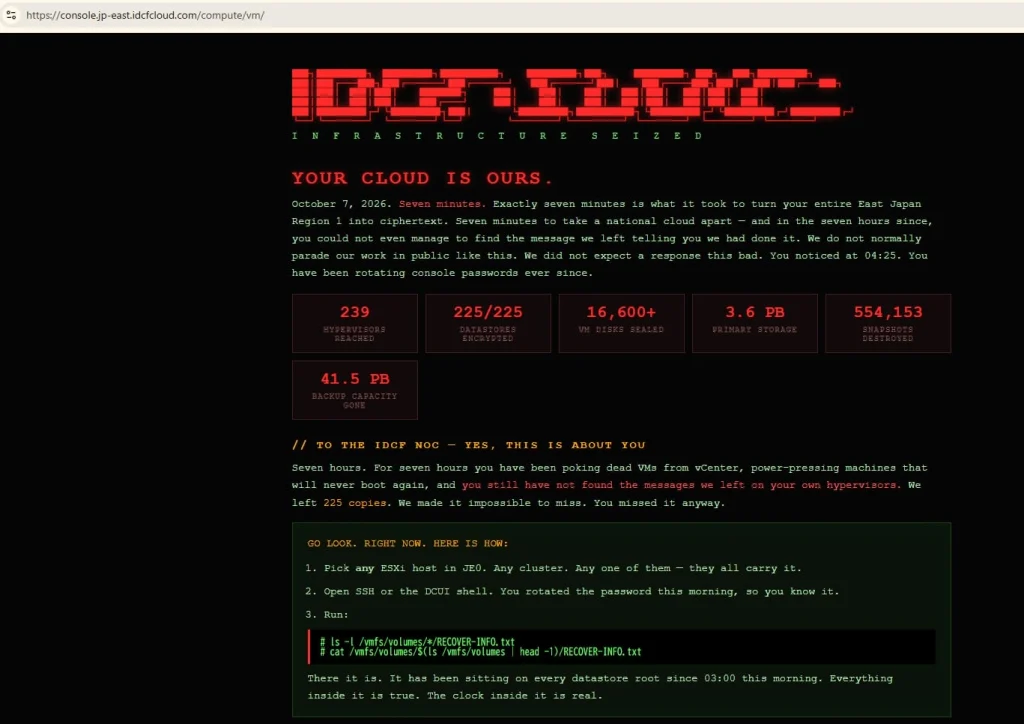
On October 7, 2026, a devastating ransomware attack struck IDCF, a prominent cloud computing platform operating under the massive SoftBank Group umbrella. Consequently, the platform experienced catastrophic failures, causing partial virtual server outages within the East Japan Region 1 that proved impossible to restart. IDCF subsequently issued an official announcement, begrudgingly confirming that four critical partitions suffered severe impacts. Disturbingly, these specific partitions provided essential services to an estimated 495 corporate enterprises and various Japanese local government entities.
Hackers Express Extreme Frustration with IT Incompetence
It is widely acknowledged that Japan’s IT sector occasionally trails behind global standards. However, one naturally assumes that specialized platforms like cloud computing possess profound technical accumulations. The fundamental problem emerged when the very hackers who launched the attack encountered unexpected difficulties. Upon successfully acquiring deep internal privileges, the assailants meticulously deposited their ransom notes within the root directory of every single compromised virtual machine.
The attackers strategically scattered 225 explicit ransom letters throughout the infrastructure. Logically, any minimally competent maintenance engineer inspecting the virtual machines on any given ESXi server should have instantaneously discovered these glaringly anomalous files. Unbelievably, after a staggering seven hours of complete service interruption, the IDCF maintenance engineers still had not located a single ransom note. Believing they were facing a routine technical glitch, the staff continuously, and fruitlessly, attempted to restart the paralyzed virtual machines. Meanwhile, the highly amused hackers monitored the engineers’ every frantic, misguided action in real-time.
Initially, the hackers genuinely wished to avoid an ostentatious public spectacle. However, utterly exasperated by the profound incompetence, they ultimately commandeered the official IDCF website itself to publicly display their ransom note. They essentially had to scream at the IDCF maintenance engineers that they were suffering a massive ransomware attack, urging them to stop hopelessly mashing the useless power buttons.
Closing Tickets Instead of Issuing Warnings
In their incredibly mocking ransom note shared on social media, the hackers highlighted another deeply humiliating detail. IDCF’s astute clients had noticed the server anomalies significantly earlier and submitted numerous support tickets pleading for technical assistance. The reported problems clearly detailed the inability to start virtual machine instances and confirmed that entire virtual servers had crashed. Shockingly, IDCF chose to respond by simply closing these urgent tickets in bulk. To add ultimate insult to injury, they absurdly continued to solicit customer satisfaction ratings for their woefully inadequate ticket handling.
The hackers openly mocked IDCF for its utter failure to issue a prompt anomaly announcement. They sarcastically wondered if the company was simply waiting for the hackers themselves to announce the disastrous news. Astonishingly, that is precisely what occurred. Because the maintenance engineers remained completely oblivious to the massive ransom notes for over seven hours, the hackers ultimately seized control of the official IDCF website. Only after the hackers publicly posted the ransom note did IDCF finally, and embarrassingly, release its own official announcement.
Support Our Threat Intelligence
Find our threat intelligence and malware analysis helpful? Support our work today and unlock a 100% ad-free reading experience!
 Buy Me a Coffee
