 Do Son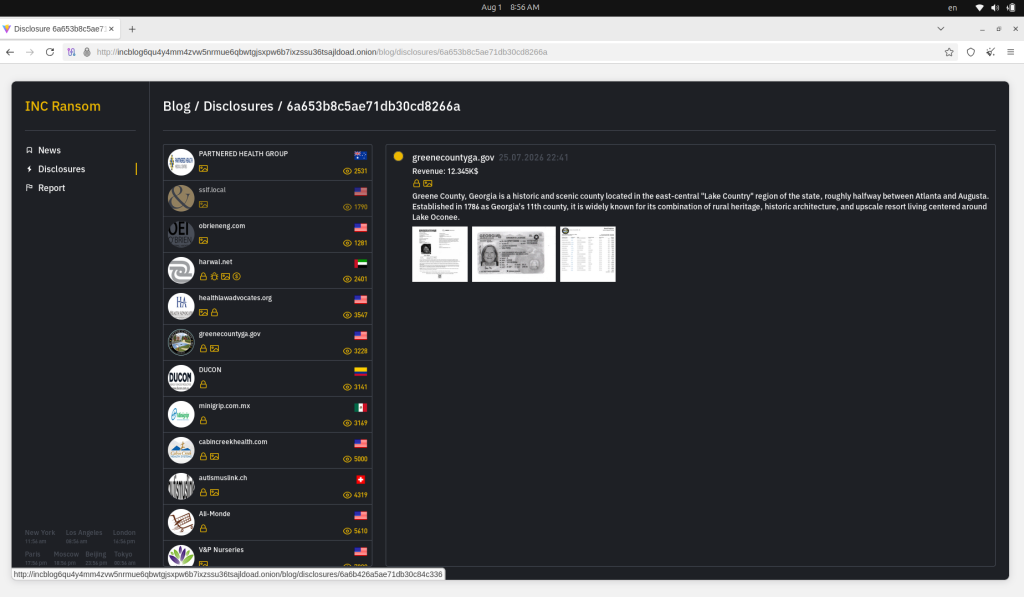
INC Ransomware's DLS
| Malware family | ROOTRUN, KNUCKLEBALL, Suo5, ORANGETAIL |
| Threat actor | UTA0533 (pre-disclosure cluster, suspected link to INC Ransomware); INC Ransomware confirmed as current dominant operator |
| Target | Internet-facing SonicWall SMA 1000 series VPN appliances |
| Delivery vector | Unauthenticated exploitation of CVE-2026-15409 and CVE-2026-15410 |
| Key capabilities | Root compromise, memory-resident web shell, credential harvesting, persistence |
| Source | Resecurity, with corroboration from Volexity and Rapid7 |
TL;DR: A SonicWall SMA exploit chain lets an unauthenticated attacker reach root on SMA 1000 VPN appliances. Volexity first tracked the activity as UTA0533 in late June. INC Ransomware has since become the dominant actor weaponizing the same chain against new victims.
Why it matters
VPN appliances sit at the network edge and process credentials for every remote user. Resecurity’s report states plainly that “a patched appliance that still contains attacker-planted malware remains compromised.” That distinction matters, because patching alone does not remove implants already deployed through the SonicWall SMA exploit chain.
A compromised SMA gateway becomes a pivot into Active Directory, internal file shares, and management networks. The appliance terminates VPN sessions and stores certificates, session tokens, and authentication policies, so a breach here has outsized reach compared with a typical server compromise.
Resecurity also reports that new INC Ransomware victims have received phone calls and emails from parties posing as helpful third parties, then pressuring them toward extortion payments. Security teams should treat any unsolicited outreach referencing a recent breach as a pressure tactic, not a legitimate offer of help, and involve law enforcement rather than negotiate directly.
Delivery
No phishing or user interaction is required. The attacker sends a single crafted WebSocket request to the appliance’s proxy endpoint. Spoofed client-identifier values trick the front-end into treating the request as legitimate internal traffic.
Reconnaissance is minimal. The attacker only needs to identify that a target device is an internet-facing SMA 1000 appliance running vulnerable firmware. No credentials, session cookie, or multi-factor state are required at any point in the delivery stage.
Infection chain
The chain unfolds in stages, described here at a conceptual level. First, the attacker opens a tunnel that reaches services normally restricted to the appliance’s own loopback interface. Next, they interact with an internal database to stage a script on disk under a low-privileged account.
The attacker then triggers a path-traversal flaw in the appliance’s hotfix-removal workflow. That flaw executes the staged script with full root privileges. From there, the SonicWall SMA exploit chain concludes with malware deployment. According to Resecurity, the attacker deploys persistent and memory-resident components documented in its full technical write-up, including a setuid backdoor and Java agents injected into the appliance’s legitimate process.
Confirmed versus suspected attribution
Volexity confirmed the pre-disclosure exploitation cluster and assigned it the label UTA0533. Rapid7 independently observed overlapping tactics during its own incident response. Resecurity’s report treats a link between UTA0533 and INC Ransomware as suspected, not confirmed, while stating that INC Ransomware is the confirmed dominant actor exploiting the chain today.
Command-and-control and data exfiltration
Once the attacker reaches root, the toolkit injects a Java-based instrumentation agent into the appliance’s trusted process rather than dropping a standalone binary. This reduces forensic footprint. A companion module then provides encrypted command-and-control over HTTPS, disguised as ordinary web traffic.
Resecurity also observed the actor capturing unencrypted directory-service traffic on a second compromised appliance, a technique aimed at harvesting domain credentials for lateral movement. Persistence survives reboots through modified startup scripts and reverse-proxy configuration changes.
Defense and detection guidance
Patch every SMA 1000 appliance to firmware 12.4.3-03453 or 12.5.0-02835 or later immediately. Because implants can survive a firmware update, pair patching with a compromise assessment on any appliance that was internet-facing and unpatched during the exposure window.
Hunt for unexpected setuid binaries, unfamiliar Python or JAR files under system directories, and modified startup scripts. Rotate every credential the appliance could have processed, including administrator passwords, directory-service bind credentials, and MFA seeds. Review logs for unusual proxy requests and unexpected outbound connections. If compromise is confirmed, Resecurity recommends a full appliance rebuild rather than an in-place fix, since backups may carry planted persistence forward.
Support Our Threat Intelligence
Find our threat intelligence and malware analysis helpful? Support our work today and unlock a 100% ad-free reading experience!
 Buy Me a Coffee
