 Do Son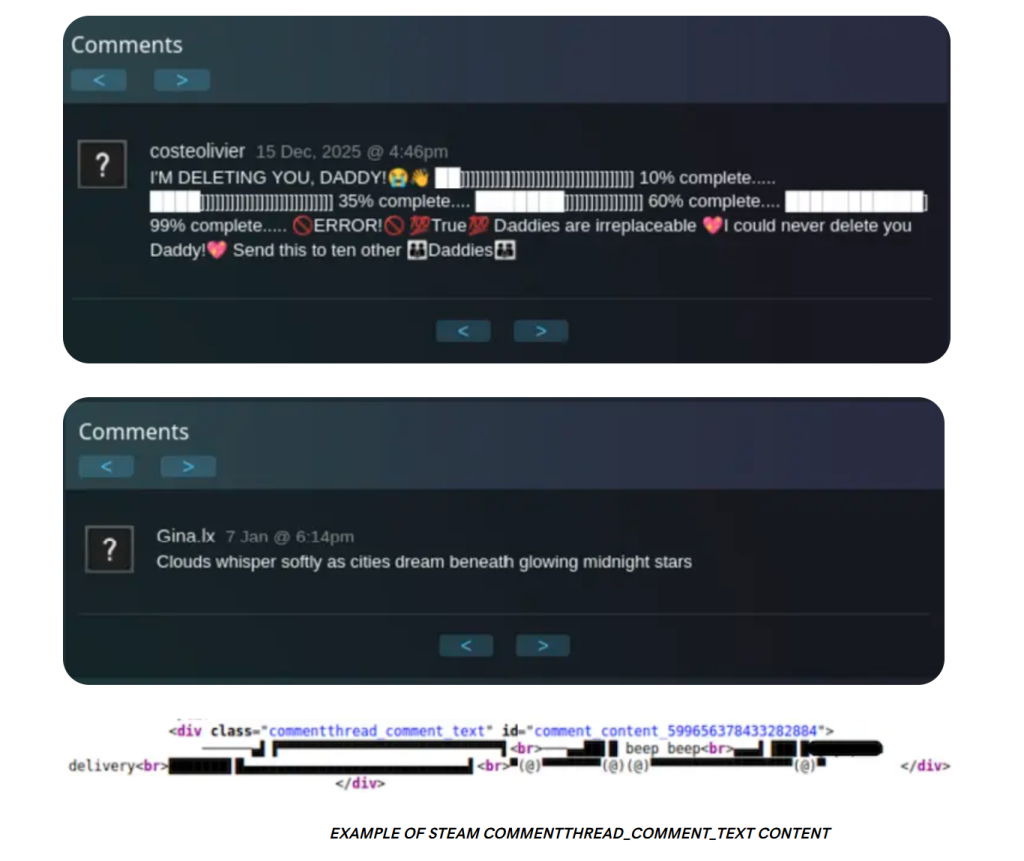
Malware disguised as ASCII art comments | Image: GoDaddy
An Unconventional Command Network Emerges
Cybersecurity defenders recently uncovered a highly unusual cyber espionage operation targeting website infrastructure. Specifically, a sophisticated Steam profile malware campaign is exploiting gaming networks to control compromised web systems. To begin with, GoDaddy Security researchers identified the anomalous behavior after inspecting compromised websites. Threat actors are hiding malicious command instructions inside user profile comment zones. Consequently, this technique allows the adversaries to keep their core control systems completely invisible to traditional network filters. So far, the silent infection has impacted nearly two thousand distinct setups.
Implementing Invisible Unicode Steganography
Hiding Code in Plain Sight
To begin with, the core mechanism relies on a clever data obfuscation trick. The script extracts raw text blocks from targeted gaming profiles using specific web request functions. Then, the application isolates binary characters that human eyes cannot perceive. The official technical report explicitly outlines this covert behavior. “The malware employs invisible Unicode characters to conceal payloads within Steam profile comments, enabling steganographic data encoding that evades traditional text-based detection methods.” Therefore, normal text filters fail to recognize the threat assets.
The Multi-Character Mapping Scheme
Subsequently, the tool translates the hidden strings back into working software paths. The decoder script specifically maps six unique zero-width characters to numeric coordinates. By using invisible Unicode steganography, the architecture reconstructs raw binary payloads out of regular ASCII art blocks. Furthermore, some advanced versions include an option for strong network encryption. The system applies AES-256-CTR routines alongside complex validation mechanisms to protect the data payload from interception. Ultimately, the process yields a clean web address that points directly to an external malicious server.
The Parallel Execution Architecture
Injecting Unauthorized Client Scripts
In addition, the architecture executes two parallel deployment tracks to manage targets. On the client side, the script injects external instructions into active web pages. Specifically, it utilizes native framework functions under false names to avoid attracting notice. For example, the software loads the rogue scripts using handles that mimic popular open-source utility libraries. As a result, visitor systems unknowingly load tracking implants every time a web page renders.
Deploying the Code-Rewriting Backdoor
Concurrently, the server-side chain establishes an enduring administrative presence. This backend script hooks into template redirect processes to monitor incoming web requests. When a specific authorization cookie arrives, the utility triggers a hidden command prompt. “A cookie-authenticated backdoor enables remote code execution, allowing attackers to modify plugin and theme files by sending base64-encoded PHP code via POST requests.” This active Steam profile malware campaign gives operators the power to rewrite local files remotely.
Defensive Strategies and Incident Cleanup
Identifying System Alterations
Ultimately, network defenders must upgrade their monitoring methods to identify these sneaky techniques. Security teams should inspect local database spaces for unusual short-term cache transients. Furthermore, scanning system files for unapproved cryptographic functions will expose the implant logic. Administrators must also flag any outward network connections traveling toward gaming domain paths.
Overcoming Persistent Threats
Indeed, eradicating the threat requires complete configuration adjustments. If defenders perform a partial cleanup, the attackers can simply push fresh scripts through the active backdoor. The advisory highlights this severe persistence capability directly. “The cookie-authenticated backdoor’s ability to remotely rewrite code allows attackers to maintain access even after detection and partial cleanup.” Therefore, teams should reset all administrator credentials and prioritize restoring systems from verified historical backups.
Support Our Threat Intelligence
Find our threat intelligence and malware analysis helpful? Support our work today and unlock a 100% ad-free reading experience!
 Buy Me a Coffee
