 Do Son
Details and a PoC are public for CVE-2026-113380, a Signal call vulnerability in RingRTC that keeps calls live after hang-up. Update now.
Signal
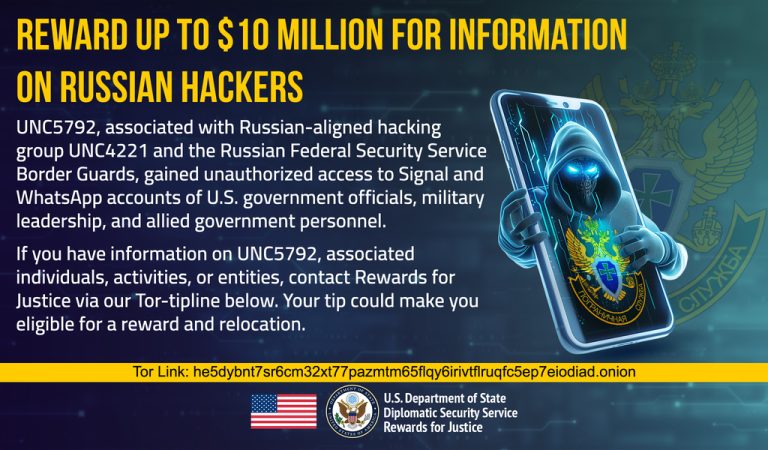
The U.S. offers a $10 million reward for UNC5792, a Russian FSB-linked group behind Signal and WhatsApp phishing of officials.

Signal's encryption is solid, but iOS is leaking your data. Learn how the FBI uses notification caches to recover deleted messages and how to stop it.

NCSC warns high-risk individuals of Russian and Chinese state actors hijacking WhatsApp and Signal. Protect your chats with these essential 2026 defense tips.

Dutch intelligence (MIVD/AIVD) warns of a global campaign using social engineering to silently hijack Signal and WhatsApp accounts of high-profile targets.

India's DoT mandated SIM-binding for all messaging apps (WhatsApp, Telegram, Signal). Users must re-verify every six hours to combat cybercrime and cross-border fraud.

CISA issued an urgent alert: Commercial spyware is actively exploiting zero-click flaws and malicious QR codes to hijack messaging apps (Signal, WhatsApp) for espionage against government and civil society targets.
The renowned end-to-end encrypted messaging app Signal has announced the launch of a cloud backup feature, allowing...
The U.S. House of Representatives has banned WhatsApp on government devices, citing security and transparency concerns. Meta strongly disputes the "high-risk" assessment.

A sophisticated spear-phishing campaign using Signal targeted Armenian civil society and government in March 2025, linked to threat actor UNC5792.

Learn how attackers exploit search engine manipulation to distribute backdoored versions of popular messaging apps like Signal and Gmail.

Discover the latest deanonymization attack exposed by security researcher Daniel. Learn how this 0-click attack leverages Cloudflare’s caching mechanisms to pinpoint user locations.

Unveiling the new HexaLocker V2: a more sophisticated and complex ransomware variant with advanced encryption and data theft features.

Get insights into APT41's DeepData framework, the latest revelation in the LightSpy espionage campaign. Discover its advanced surveillance capabilities and how it facilitates data theft across multiple communication platforms.

Learn about the first observed use of HTML smuggling by DCRat, a powerful remote access trojan. Find out how this technique allows cybercriminals to deploy malware undetected.