 Do Son
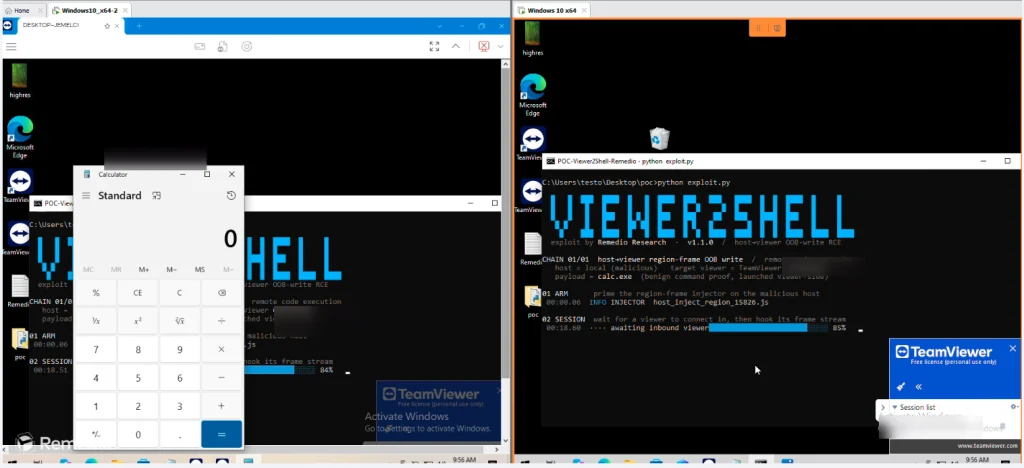
Enterprise administrators rely heavily on remote administration software to diagnose complex workstation anomalies. However, an alarming TeamViewer client vulnerability reverses traditional threat assumptions by endangering the managing technician. The flaw allows compromised remote endpoints to dispatch weaponized display metadata to the connecting client. Consequently, connecting administrators risk unexpected application termination or complete workstation takeover. Tracked formally as CVE-2026-111585, the flaw carries a severe CVSS metric of 8.8. Therefore, the vendor urges all worldwide subscribers to install version 15.83 immediately.
- CVE: CVE-2026-111585
- CVSS: 8.8 (High · CVSSv3)
- Product: TeamViewer Full Client
- Affected: < 15.83, 15.64.0 (Legacy Windows 7 & 8), 14.7.0 (Windows), 14.7.0 (Linux), 14.7.0 (macOS), 13.2.0 (Windows) (+2 more)
- Impact: Integer Overflow in TeamViewer Remote Control Screen Decompression Leading to Heap-Based Buffer Overflow
- Status: No confirmed exploitation yet
- Patched in: 15.83, 15.64.10 (Legacy Windows 7 & 8), 14.7.48868 (Windows), 14.7.48868 (Linux) (+4 more)
- EPSS: 0.3% (30-day)
- Action: Update to 15.83, 15.64.10 (Legacy Windows 7 & 8), 14.7.48868 (Windows), 14.7.48868 (Linux) (+4 more) now
Inverting Attack Vectors Against Enterprise Support
In standard operational workflows, technical assistance personnel initiate sessions to inspect subordinate machines. However, security researchers discovered that malicious hosts can subvert this relationship completely. If an adversary compromises an endpoint, that host can transmit malicious frame packets back across the established tunnel. Consequently, corporate IT departments face significant enterprise risk during routine troubleshooting appointments. Attackers can exploit this reverse breach vector to compromise the support engineer workstation directly. Furthermore, malicious actors can pivot across internal administrative subnets with elevated domain privileges.
Integer Overflow Within Display Frame Pipelines
The underlying flaw resides within the display frame negotiation routines of the client engine. Following initial authentication, the remote host reports its local screen dimensions to the controlling terminal. Subsequently, the client software computes the required memory footprint to render incoming visual updates. However, malicious endpoints can supply deliberately distorted dimensions during this negotiation phase. This crafted input triggers an integer overflow during dynamic memory allocation calculations.
As a result of this mathematical failure, the controlling client allocates an insufficient buffer memory segment. Incoming graphic frames then overflow these narrow boundaries, generating hazardous out-of-bounds memory writes. As documented in the technical disclosure on TeamViewer remote code execution, analysts bypassed platform defenses successfully. Researchers executed arbitrary binaries on target administrative machines during forensic evaluations. Meanwhile, TeamViewer confirmed that the defect causes denial of service states or arbitrary execution within client privileges.
Impacted Releases and Deployment Guidelines
The software flaw compromises various desktop installations alongside mobile remote applications. Specifically, the following distributions require prompt remediation:
- Windows, Linux, and macOS Full Client installations prior to build 15.83.
- Portable standalone executable editions on Windows operating systems prior to build 15.83.
- Android Remote Control mobile applications released prior to version 15.83.
Furthermore, legacy maintenance branches remain equally susceptible to this memory corruption vector. Therefore, systems administrators must audit their operational endpoints and deploy security updates across their fleets. Applying these patches promptly neutralizes reverse intrusion pathways and protects technical support environments against exploitation.
Support Our Threat Intelligence
Find our vulnerability reports and weekly recaps helpful? Support our work today and unlock a 100% ad-free reading experience!
 Buy Me a Coffee
