The Self-Correcting Architect: OpenAI Launches GPT-5.3-Codex to Lead the Agentic Coding Era
 Do Son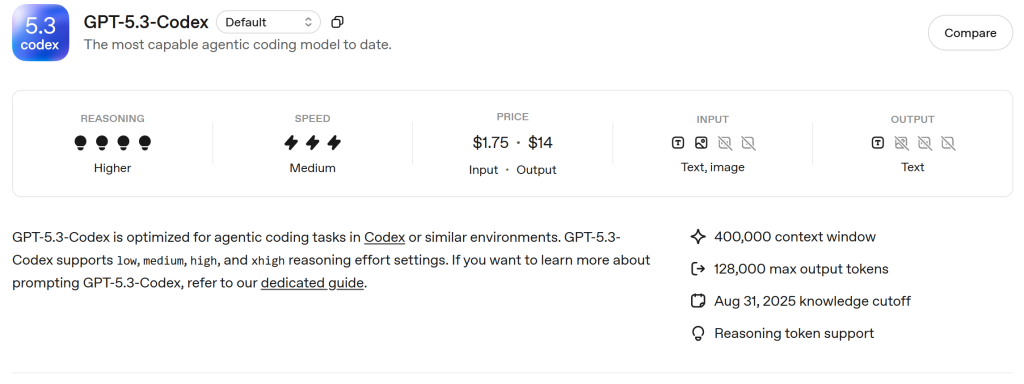
On February 5, 2026, OpenAI unveiled its specialized programming model, GPT-5.3-Codex. Initially, access was restricted to ChatGPT premium subscribers via OpenAI Codex, CLI tools, IDE extensions, and the web interface; however, the following day saw a staged deployment for developers through the API platform.
As of today, GPT-5.3-Codex has achieved universal availability. Developers may now invoke the model through the OpenAI API or integrated platforms like OpenRouter, though pricing structures may vary across different providers. The defining characteristic of GPT-5.3-Codex lies in its evolution beyond mere code generation; it stands as OpenAI’s preeminent agentic programming model, seamlessly synthesizing the unparalleled coding proficiency of GPT-5.2-Codex with the sophisticated general reasoning and domain-specific erudition of GPT-5.2.
The model introduces several transformative enhancements:
-
A 25% Increase in Temporal Efficiency: This velocity is particularly pronounced during protracted, multi-stage agentic workflows.
-
Mid-stream Interaction Guidance: Users can intervene during active tasks to pivot development directions or append requirements without degrading contextual coherence.
-
Polyglot Engineering Benchmarks: It represents the inaugural achievement on SWE-bench Pro encompassing Python, JavaScript, TypeScript, and Java.
-
Recursive Self-Optimization: The model actively participated in its own training lifecycle, debugging its execution and managing its own deployment—essentially refining its own architecture.
-
Expansive Contextual Horizon: A window of up to 400K tokens facilitates the ingestion of monolithic codebases.
-
Granular Inference Control: A new
reasoning_effortparameter (low/medium/high/xhigh) allows for the meticulous calibration of cognitive intensity.
Responses API Pricing Architecture:
-
Standard Input: $1.75 per million tokens
-
Standard Output: $14.00 per million tokens
-
Cached Input: $0.175 per million tokens (Leveraging caching significantly diminishes the costs associated with repetitive context).
Support Our Threat Intelligence
Find our tech and OS security coverage helpful? Support our work today and unlock a 100% ad-free reading experience!
 Buy Me a Coffee
