 Do Son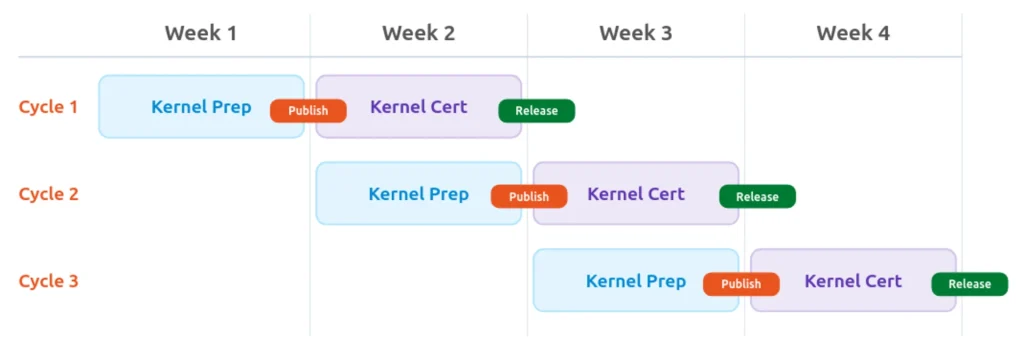
The relentless deluge of newly discovered vulnerabilities has intensified to such an extreme degree that Canonical found its historical Ubuntu kernel update rhythm fundamentally inadequate. Consequently, the corporation is aggressively transitioning its stable kernels to a drastically accelerated Stable Release Update (SRU) paradigm. Rather than maintaining the antiquated four-week cycle for standard updates and a segregated two-week cycle for emergency security patches, Canonical is forging a unified, high-velocity, two-week operational process.
Crucially, achieving a weekly release cadence does not imply that Canonical will dangerously truncate its rigorous kernel validation procedures to a mere seven days. Instead, these comprehensive two-week cycles will launch at meticulously staggered one-week intervals, deliberately overlapping. During the inaugural week of a cycle, the engineering team meticulously compiles the kernel packages, executes fundamental boot verification protocols, and subsequently publishes the candidates directly to the -proposed repositories. The crucial second week is entirely dedicated to exhaustive hardware certification, complex integration testing, and rigorous regression analysis.
Implementing the Overlapping SRU Pipeline
This massive logistical transition officially commences on September 28, 2026, initiating with two consecutive, non-overlapping two-week cycles. An additional cycle will launch on October 12. Finally, on October 26, Canonical will formally initiate the overlapping release scheme. Once this sophisticated pipeline is fully operational, pristine stable kernels will be capable of deployment every single week. This holds true despite every individual kernel still navigating the uncompromising two-week validation gauntlet.
Canonical explicitly attributes this urgent acceleration primarily to the exponential proliferation of Common Vulnerabilities and Exposures (CVEs). Advanced Large Language Models (LLMs) and highly specialized AI agents have successfully automated the arduous task of hunting for arcane code errors. This exposes profound problems significantly faster than traditional manual analysis ever could. This transformative trend has already materialized within the Linux ecosystem. Notably, an AI tool proactively discovered the devastating CopyFail vulnerability earlier in 2026. This was rapidly followed by the manifestation of a fully functional privilege escalation exploit.
The Impact of Kernel.org’s CNA Status
However, artificial intelligence merely elucidates a fraction of this explosive growth. In February 2024, the prestigious kernel.org entity officially achieved CVE Numbering Authority (CNA) status. Consequently, it began unilaterally assigning identifiers to an array of potential kernel anomalies. Linux developers deliberately employ an exceptionally cautious methodology. Given the kernel’s foundational role, virtually any rudimentary error theoretically possesses the potential to compromise systemic security, even if a viable exploitation path remains entirely unapparent at the precise moment of remediation.
This hyper-vigilant approach has astronomically inflated the volume of security records that Linux distributions must painstakingly triage. Official Linux documentation explicitly cautions that a multitude of assigned CVEs are practically inapplicable to specific, isolated systems. This is primarily because any given system only actively utilizes a minute fraction of the gargantuan kernel codebase. Nevertheless, for Canonical, this unprecedented surge inexorably translates into a monumental increase in labor dedicated to evaluating threats. Teams must also meticulously backport patches to actively supported branches, compile flawless packages, and rigorously verify the resulting Ubuntu distributions.
The sheer magnitude of this endeavor is vividly apparent when examining recent Ubuntu security bulletins. A single, isolated update tailored specifically for the Azure kernel, published on September 22, explicitly enumerated over 1,400 remediated CVEs. Furthermore, disparate updates released on that identical day contained dozens, or even hundreds, of additional security records. Concurrently, one must not evaluate systemic risk based solely upon the raw quantity of identifiers. While a significant portion of these errors may not impact specific configurations, other, more critical Linux vulnerabilities are already suffering active exploitation in the wild.
Faster Access and Interim Mitigations
System administrators possessing an urgent requirement for immediate patches can proactively retrieve kernel candidates from the -proposed repository following the conclusion of the initial week. They may subsequently execute their own rigorous acceptance testing. This proactive approach effectively truncates the waiting period to approximately a single week. However, it substantially shifts the formidable burden of validation directly onto the infrastructure owner. For the standard stable channel, Canonical steadfastly maintains its exhaustive battery of certification and regression tests. The rationale for this strategy is detailed in their announcement regarding accelerating delivery of CVE fixes with a new kernel release strategy.
Prior to the official deployment of a finalized kernel, Canonical intends to proactively publish secure, temporary mitigations whenever technically feasible. Alternatively, they may offer authoritative recommendations for systemic hardening. The corporation has established an aggressive objective to transition affected systems into a substantially fortified state within a mere 24 to 48 hours following the public disclosure of a critical problem. While these temporary measures unequivocally do not replace a comprehensive kernel upgrade, they are designed to critically truncate the perilous vulnerability window existing between initial disclosure and the deployment of a fully verified patch.
Further reading
Support Our Threat Intelligence
Find our tech and OS security coverage helpful? Support our work today and unlock a 100% ad-free reading experience!
 Buy Me a Coffee
