The $4.5 Million Squeeze: How Via LA’s Secret H.264 Fee Hike is Shaking the Streaming Industry
 Do Son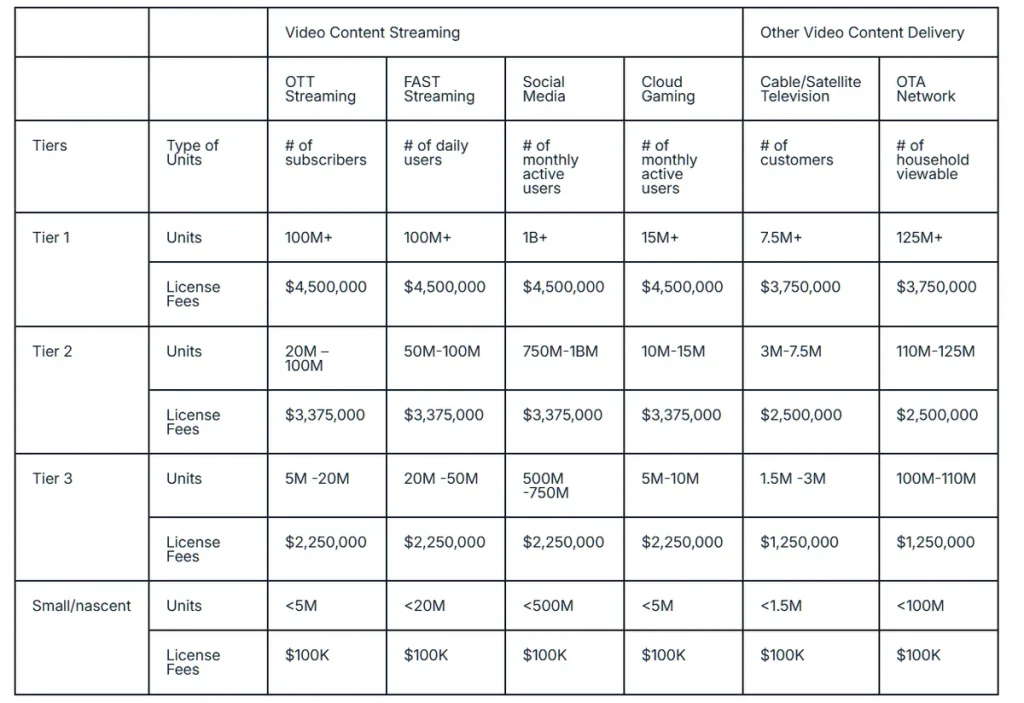
Image: VIA
The Via Licensing Alliance (Via LA), the administrative entity overseeing the H.264/AVC patent pool, has surreptitiously recalibrated its licensing fee structure. The previous fixed annual levy of $100,000 has been supplanted by a graduated tier system, which may compel preeminent platforms to remit upwards of $4.5 million per annum in patent royalties.
This fiscal restructuring pertains exclusively to nascent clients who have not previously secured authorization and intend to seek H.264/AVC licensure in 2026 or thereafter; conversely, those who formalized their agreements by the twilight of 2025 may persist under the ancestral pricing terms. This substantial inflation of H.264/AVC royalties likely mirrors the cost trajectory of H.265/HEVC, which previously incited global discord following significant fee hikes—an escalation so severe it precipitated the prohibition of ASUS and MSI laptop sales within German jurisdictions.
Via LA asserted that it had engaged in private overtures with numerous unauthorized entities throughout 2025, encouraging them to enshrine agreements under the then-extant terms. However, rather than promulgating a public manifesto, the agency elected to conduct these negotiations through discrete, individual communiqués.
Consequently, any streaming enterprise that failed to reach an accord with Via LA prior to the 2026 threshold must now adhere to the revised tiered pricing, which is predicated upon the platform’s classification and magnitude. The newly ratified fee schedule is delineated as follows:
- Small or Emerging Platforms: Entities designated as such by Via LA remain eligible for the $100,000 annual rate.
- Top-Tier Platforms: Services exceeding 100 million daily active users are encumbered with a $4.5 million annual fee.
- Premier Social Media Platforms: Entities with over 1 billion monthly active users are similarly assessed at $4.5 million annually.
- Elite Cloud Gaming Platforms: Services with a monthly active user base surpassing 15 million must provide $4.5 million per annum.
- Secondary and Tertiary Platforms: Based on user metrics, these tiers are assessed at $3.375 million and $2.25 million annually, respectively.
H.264/AVC remains the preeminent video codec of the digital age, serving as either the foundational or secondary protocol for nearly all streaming conduits, hardware encoders, and browsers. Although a significant portion of its underlying patents has lapsed into the public domain, the expiration of specific patents does not summarily absolve an entity of its overarching licensing obligations.
Patent litigator Jim Harlan posits that when adjudicating disputes over “fair, reasonable, and non-discriminatory” (FRAND) rates, judiciaries evaluate the potency and remaining duration of active patents rather than a mere numerical tally. Evidently, a platform cannot disentangle itself from valid intellectual property by asserting exclusive reliance upon expired patents.
The restructuring by Via LA intensifies a broader inflationary trend in codec licensure; the Avanci and Access Advance pools are concurrently levying fees for the utilization of HEVC, VVC, VP9, and AV1. Access Advance maintains a fee ceiling of approximately $6300 million per annum, while Avanci mandates a royalty of 1.6% to 2.0% of platform revenue, or a per-user monthly charge of $0.12 to $0.15. In aggregate, these cumulative royalties could impose an annual fiscal burden of hundreds of millions of dollars upon major platforms.
In 2025, Dell and HP elected to deactivate H.265 decoding capabilities in select personal computers, citing the exorbitant patent fees as the primary catalyst. The predicament lies in the subsequent reliance on software-based solutions, which precipitates a drastic erosion of decoding efficiency and a significant surge in power consumption. Ultimately, this upward trajectory of licensing costs threatens to destabilize the industry, forcing the end-user to either endure inflated hardware prices or acquiesce to substandard technological alternatives.
Support Our Threat Intelligence
Find our tech and OS security coverage helpful? Support our work today and unlock a 100% ad-free reading experience!
 Buy Me a Coffee
