Freedom to Reboot: Microsoft Finally Separates Windows 11 Updates from the Power Menu
 Do Son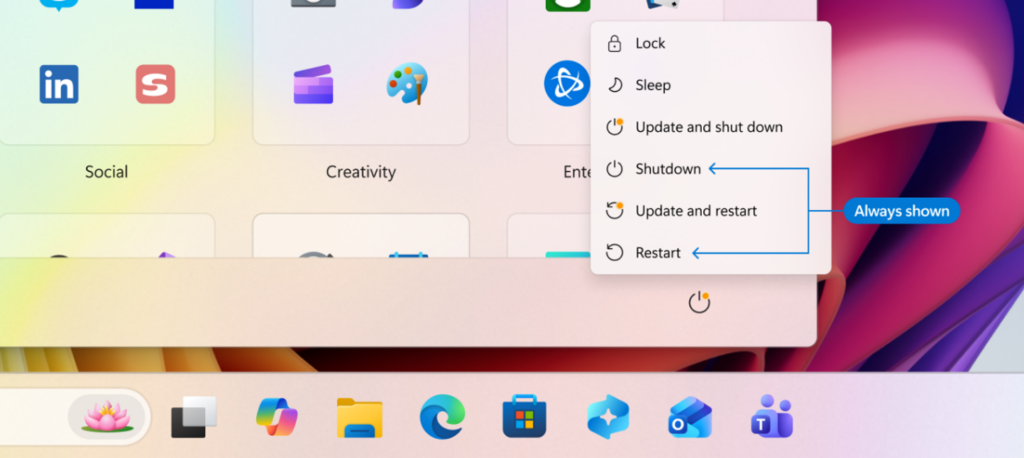
In recent weeks, we have meticulously observed the transformative shifts in the Windows 11 update mechanism. Among the refinements currently undergoing evaluation in the beta channel is a provision allowing users to suspend updates indefinitely; while each selection remains capped at a 35-day duration, users may now invoke successive delays without limitation. Furthermore, a pivotal adjustment ensures that users retain the prerogative to bypass update installations during system restarts or shutdowns.
To appreciate the significance of this shift, one must consider the prevailing architecture: presently, once an update is downloaded and staged, the system issues a prompt mandating a reboot to finalize the installation. This terminal phase often demands several minutes—and in extreme scenarios, upwards of ten—to conclude.
Historically, the power menu would autonomously transition to “Shut down and update” or “Restart and update,” often providing no alternative for a standard power cycle. This proves particularly vexing when software irregularities necessitate a rapid reboot to preserve workflow; in such instances, being tethered to a mandatory installation is an unwelcome interruption. Furthermore, for critical security mandates, Windows 11 occasionally omits the “update” label entirely, executing the installation surreptitiously during what the user assumes is a standard shutdown, thereby rendering the power options inherently unpredictable.
Microsoft’s nascent refinement prioritizes operational predictability by bifurcating these choices. Users are now presented with a clear dichotomy: Shut down, Restart, Shut down and update, and Restart and update. By selecting the standard power options, users can circumvent immediate installations, thereby avoiding unforeseen delays when time is of the essence.
These enhancements are currently live in Windows 11 Build 26300.8289. Once disseminated to the stable branch, this update will empower users to command their systems with confidence, deferring maintenance to more opportune moments of leisure. Microsoft affirmed in its official dispatch that the objective is to render the power menu more intuitive, ensuring that Windows adheres strictly to user intent—whether for a swift reboot or a prompt departure—rather than initiating an unbidden installation sequence.
It is essential to distinguish this deliberate architectural change from a recent, unrelated bug. The latter involved a systemic anomaly where the “Shut down and update” command inadvertently triggered a system reboot instead of a complete power-off. With the latest cumulative patches, that particular instability has been neutralized, ensuring that the system now correctly observes the user’s command to remain powered down following an installation.
Support Our Threat Intelligence
Find our tech and OS security coverage helpful? Support our work today and unlock a 100% ad-free reading experience!
 Buy Me a Coffee
