 Do Son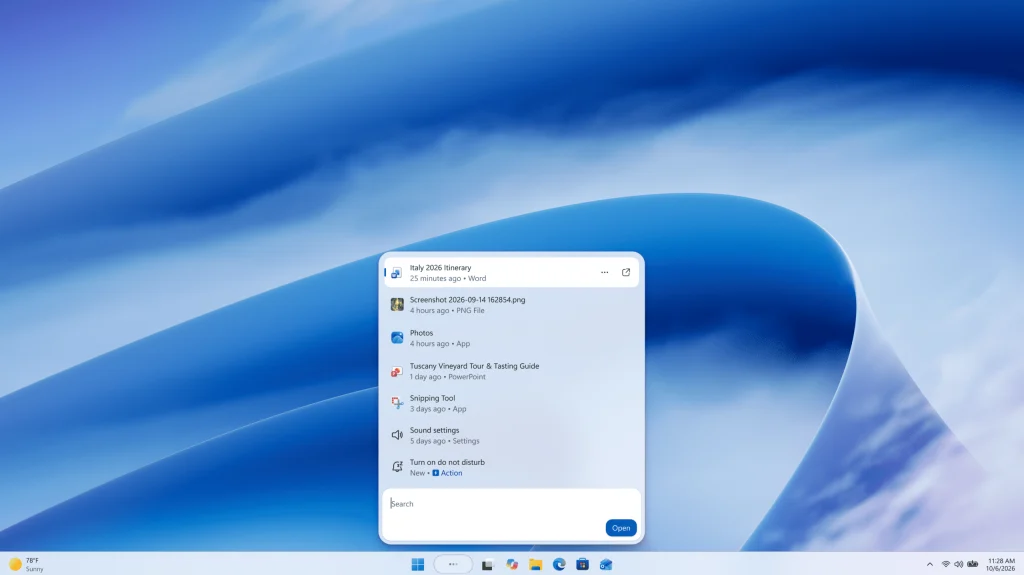
Less than a year after pledging to excise superfluous Copilot integrations from Windows 11, Microsoft has unearthed a significantly more astute and organic solution. During the recent Surface event, the technology behemoth officially heralded a profound autumnal transformation for the Windows Search Menu and taskbar. These elements are being transmuted directly into a highly context-aware artificial intelligence chatbot. Moreover, they serve as a centralized nexus for system control.
Concurrently, Microsoft unveiled an avant-garde software orchestration suite christened “Hybrid Intelligence.” They proclaimed Windows’ formal ascension into a novel epoch of synergistic cloud-to-edge computing.
The Search Box as a Command Line: Semantic Control Over Windows
Pavan Davuluri, Microsoft’s Executive Vice President of Windows and Devices, practically demonstrated this paradigm-shifting search experience. The future iteration of the Windows search box transcends the mere retrieval of files or web pages. Users need only input succinct directives to execute thousands of intricate system operations.
For instance, upon typing “increase microphone volume,” an elegant volume slider instantaneously manifests atop the interface for immediate calibration. A simple textual command rapidly toggles Dark Mode or activates Do Not Disturb.
Furthermore, should your smartphone be paired with your Windows environment, you can transmit text messages directly by typing within the taskbar. This entirely circumvents the necessity to retrieve the mobile device or launch supplementary applications. Users may also seamlessly converse with Copilot directly through the search interface. This transformation is detailed in their announcement regarding a faster, more streamlined Windows Search. As a result, it effectively eliminates the need to launch its standalone application.
Davuluri vehemently emphasized, “To render AI an intrinsic facet of daily existence, we must integrate it precisely where individuals reside most frequently – woven into the very workflows through which humanity realizes its ambitions. We are hurtling toward an unprecedented frontier: a reality where individuals merely articulate their desires, and the Windows PC, upon acquiring authorization, executes those wishes on their behalf.”
The Advent of Hybrid Intelligence: A Dynamic Equilibrium of Privacy and Compute
Another radiant highlight of the presentation was the introduction of “Hybrid Intelligence.” This is an architecture endowing the personal computer with the capability to execute AI models locally.
This sophisticated framework permits the rejuvenated Copilot to access native, on-device files and execute intricate actions across disparate applications and settings. Importantly, its foundational logic is predicated upon “dynamic routing.” When confronted with Herculean generative tasks, Copilot inherently summons vast cloud computational reservoirs. Conversely, when navigating sensitive scenarios fraught with cost or privacy implications, the system autonomously pivots. It then delegates the prompts directly to localized models functioning upon the user’s silicon.
Microsoft showcased the evolutionary leap of its internal personal AI assistant, “Autopilot,” beneath this Hybrid Intelligence umbrella. Operating under the strict pretense that absolutely no data ascends to the cloud, Autopilot leveraged local models to autonomously scour a labyrinth of native folders, identify tax return documents, systematically rename them, compress them into a solitary zip archive, and culminate the process by drafting a comprehensive email bound for an accountant. This demonstration immaculately addressed the acute privacy vulnerabilities that plague both monolithic enterprises and individual users.
MXC Security Sandboxes: Erecting an Aegis for Local AI Agents
For visionary developers utilizing Copilot as a cryptographic coding auxiliary, Microsoft delivered a paramount security escalation. To preempt localized AI agents from perpetrating unauthorized overreach or malicious behavior whilst executing cross-application maneuvers, Windows inaugurated the unprecedented “Microsoft Execution Containers” (MXC) technology.
This intrinsic support guarantees that local AI agents remain perpetually confined within an impregnable, sandboxed environment. Therefore, it affords developers unparalleled tranquility when orchestrating native Windows applications via Copilot.
The vanguard Copilot features, fortified by the robust Hybrid Intelligence architecture, are projected for a phased rollout to Windows PCs over the ensuing months.
From GUI to Intent-Driven Design: Realigning the Trajectory of AI
Over the preceding biennium, Microsoft indiscriminately shoehorned Copilot buttons throughout the Windows topography, inciting considerable user backlash. This meticulous recalibration demonstrates that the corporation has ultimately comprehended a profound truth. Users do not crave an isolated window merely for the sake of interacting with artificial intelligence. On the contrary, they desperately require a system interface capable of comprehending the nuances of human intent.
Profoundly integrating AI directly into the ubiquitous search box—a UI element engaged countless times daily—represents the definitive inflection point. This marks the transition from Windows’ traditional Graphical User Interface (GUI) toward an Intent-Driven UI. As a consequence, users are no longer burdened with memorizing the obscure subdirectories where arcane settings reside. Indeed, a simple keystroke resolves the dilemma.
Furthermore, the localized computational prowess of Hybrid Intelligence, coupled with the MXC sandboxing mechanism, provides a profound panacea for enterprise cybersecurity anxieties. This hybrid architecture routes trivial or private matters directly to localized Neural Processing Units (NPUs). Meanwhile, it escalates monumental tasks to the cloud. Not only does this drastically diminish Microsoft's server overhead, but it concurrently heralds the arrival of a truly indispensable, system-level application. This ultimately validates the very existence of the AI PC.
Support Our Threat Intelligence
Find our tech and OS security coverage helpful? Support our work today and unlock a 100% ad-free reading experience!
 Buy Me a Coffee
