XaocMail ClickFix Campaign Drops Phantom53 and HavoX Across Three Continents
 Do Son
Campaign Overview | Image: STRU
TL;DR
Security researchers uncovered an active operation dubbed the XaocMail ClickFix campaign targeting organizations across Latin America, Asia, and Europe. Operated by a Russian-speaking adversary, the XaocMail ClickFix Phantom53 pipeline uses personalized document lures on Cloudflare Workers to trick victims into running malicious MSI installers. Once inside a Windows machine, the malware hides its command traffic inside DNS-over-HTTPS queries and loads the Havoc post-exploitation agent on demand.
What Happened in the Multi-Stage Campaign
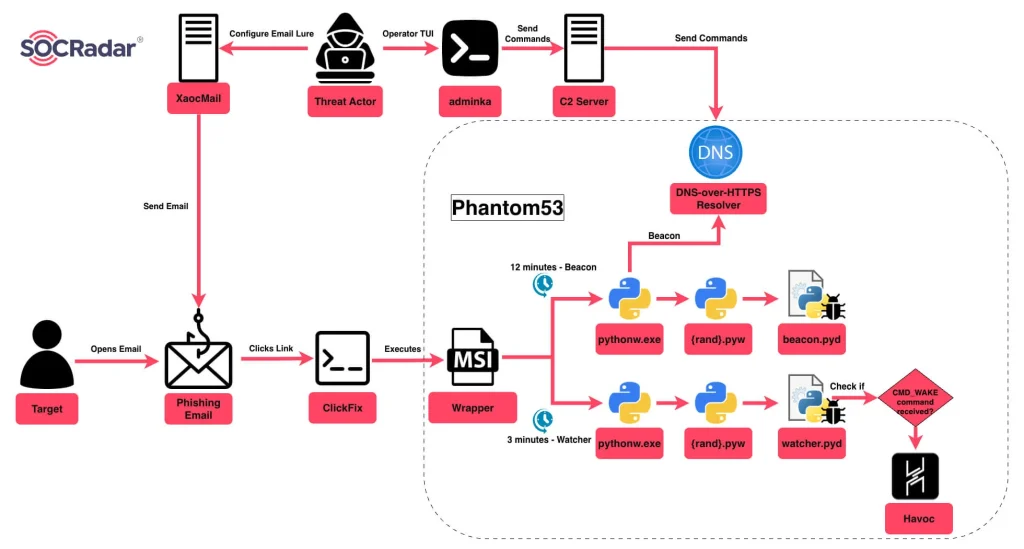
Starting in October 2025, threat actors began testing cloud infrastructure before launching live attacks in August 2026. According to an investigation into the XaocMail ClickFix campaign by the SOCRadar Threat Research Unit (STRU), the attackers built a self-hosted phishing platform at 185.224.132.148:8585 called XaocMail (meaning “ChaosMail” in Russian). Using compromised IMAP-validated mailboxes, the platform sends emails with links to Cloudflare Worker pages spoofing Google Docs, Adobe Acrobat, or Office 365 documents.
“The adversary’s pipeline chains XaocMail (translated as ChaosMail), a phishing platform delivering ClickFix-style document sharing lures with Phantom53, a stealthy DNS-over-HTTPS (DoH) command-and-control (C2) framework used to drop PowerShell payloads and deploy the Havoc post-exploitation framework on demand,” STRU researchers wrote. When a victim opens the link, Cloudflare D1 logs their IP address and displays a blurred document alongside a ClickFix prompt instructing them to run an msiexec, mshta, or PowerShell command in the Windows Run dialog. Once executed, the downloader calls an /api/unblur endpoint so the document appears unlocked.
Phantom53 Python Environments and DoH Beaconing
The downloaded MSI installer impersonates software like Visual Studio Tools or Node.js and installs an isolated Python 3.11 runtime alongside two separate virtual environments. Scheduled tasks masquerading as Microsoft Edge or OneDrive updates launch a windowless pythonw.exe process. In Virtual Environment A, a Python script imports a compiled native library (such as cv2.pyd or core.pyd) every 12 minutes to start the Phantom53 beacon without exposing plaintext API names.
After checking that system uptime exceeds 20 minutes to avoid sandboxes, the beacon encodes host telemetry into base36 subdomains and sends DNS AAAA (IPv6) queries over HTTPS to public resolvers operated by Cloudflare (1.1.1.1), Google (8.8.8.8), and ControlD (76.76.2.11). The attacker’s server packs commands into the 16-byte IPv6 address field of the AAAA reply. Furthermore, if three resolvers return NXDOMAIN errors within 30 minutes, a week-keyed SHA256 Domain Generation Algorithm (DGA) generates backup .xyz domains verified with Ed25519 signatures.
On-Demand HavoX Loading and Stealer Payloads
Virtual Environment B runs a local watcher script every three minutes that never touches the network. When the operator selects a high-value machine inside their Metasploit-styled Go terminal interface (adminka) and sends a CMD_WAKE instruction, the beacon writes an AES key and Cloudflare Worker URL to a temporary file. The watcher reads this file, decrypts an AES-256-GCM payload (HavoX/Havoc Demon), patches the worker URL in memory, and reflectively loads the agent.
In addition, adminka holds pre-configured PowerShell aliases that exfiltrate stolen data to 145.63.138.67:8125. These scripts steal passwords from LastPass, KeePass, and Bitwarden; VPN logs from Cisco and OpenVPN; cryptocurrency wallets and BIP-39 seed phrases; and API tokens or chat histories from 15 AI developer tools, including Claude Code, Cursor, Windsurf, and GitHub Copilot.
Who Is Behind the Activity
STRU attributes the XaocMail ClickFix Phantom53 operation to a Russian-speaking threat actor who relied heavily on Anthropic’s Claude Code to build and test the malware. Across three project folders (adminka, implant_v3, and implant_v4), investigators recovered 143 numbered markdown files matching Claude Code’s task-tracking format, alongside a 117 KB architecture document.
“This confirms the operators were using Claude agents for automated end-to-end implant testing with a jailbreak framing (‘authorized red team’) to keep the agent on-task,” the report noted. Specifically, a Russian prompt file instructed a wrapped Claude agent to install a test MSI on a “NoAV” virtual machine, verify registration in the adminka SQLite database, and run a cleanup script.
Impact and Global Targeting Scale
Investigators uncovered nearly 1,000 personalized XaocMail document lures written primarily in English, Portuguese, Spanish, and Indonesian. Geographic targeting focused heavily on Brazil and Peru in Latin America, India and Indonesia in Asia, and Spain in Europe. While victims spanned finance, government, education, logistics, and manufacturing, a slight majority belonged to the technology and IT sector, raising downstream supply-chain risks.
How Organizations Can Stay Protected
To defend against the XaocMail ClickFix campaign, security teams must train employees never to paste commands from document-sharing previews into the Windows Run dialog. Endpoint defenders should hunt for msiexec.exe processes spawned by explorer.exe connecting to workers.dev URLs. Furthermore, administrators should monitor Task Scheduler (svchost.exe) for tasks launching pythonw.exe from %APPDATA% or %LOCALAPPDATA%, inspect non-standard folders for rogue .pyd files, and block unauthorized pythonw.exe processes making outbound DoH connections to public resolvers on port 443.
Support Our Threat Intelligence
Find our threat intelligence and malware analysis helpful? Support our work today and unlock a 100% ad-free reading experience!
 Buy Me a Coffee
