Skip to content
July 24, 2026
  • Linkedin
  • Twitter
  • Facebook
  • Youtube

Daily CyberSecurity

Zero-hour alerts. Unmatched analysis.

Primary Menu
  • Home
  • CVE Data
    • CVE Watchtower
    • Top Exploited CVEs
    • CVE Stats by Vendor
    • Q2 2026 Report
  • Cyber Criminals
  • Data Leak
  • Linux
  • Malware
  • Vulnerability
  • Submit Press Release
  • Weekly Recap
Light/Dark Button
  • Home
  • News
  • Malware
  • Your car spies on you: a malware against your privacy
  • Malware

Your car spies on you: a malware against your privacy

Gianpiero Costantino July 19, 2018 4 minutes read
car malware
Add Daily CyberSecurity as a preferred source on Google

The introduction of ICT systems in vehicles, such as the driving and parking assistant, Internet connectivity, and in general all the cyber-physical features installed in cars, could pose risks in terms of security and data privacy of the driver, comparable to those now known by personal computers.

One of the main issues is the ability to know personal information and vehicle data, such as fuel consumption, oil level, handbrake operation, and so on, made voluntarily and illegally public outside or stolen through computer attacks on vehicle communication systems.

In fact, by accessing the internal communication network of the car (Controller Area Network – Can bus) it is possible to read the data exchanged among the control units, modify them, replicate them and/or block them, thus causing various problems; from the slightest, how to provide the driver with incorrect information about some vehicle consumption data, to tamper with the car’s brakes by blocking the messages before they reach the control units.

CANDY: an attack on the Android Infotainment systems

Vehicles that use the In-Vehicle Infotainment (IVI) based on the Android operating system and connected to the CAN bus, can provide access points to unauthorized users. So, installing applications from not official stores could hide malware that allows remote access to the infotainment device.

To study its effects, we developed a malware, which exploits a social-engineering diffusion mechanism, and once it is installed in the victim vehicle and accesses services, such as, car internal microphone, parking cameras, GPS positions, and CAN network, in an unauthorized way.

Our target system is an Android Radio with Android 4.4 KitKat. The radio is installed on a can that is connected to the CAN bus network through a CAN bus-decoder that allows the radio to show a set of vehicle’s information through apposite APPs. The radio is connected to the Internet through a 3G dongle. The permanent Internet connection guarantees a high-level of coverage and allows the driver to have features similar to those of smart-phones, such as messaging, e-mails, surfing the Web, installing APPs and so on.

We designed and developed an App Android that acts as a Trojan-horse in the Infotainment system. To use an appealing Trojan-horse APP for the victim, we chose an APP that shows gas stations close to the vehicle. To make the attack more sophisticated, we injected into the Trojan-horse APP additional code whose scope is to steal driver and vehicle information.
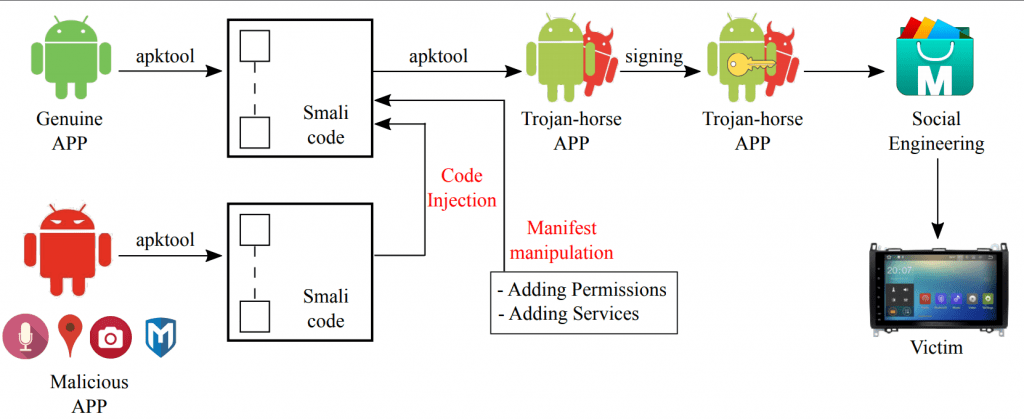
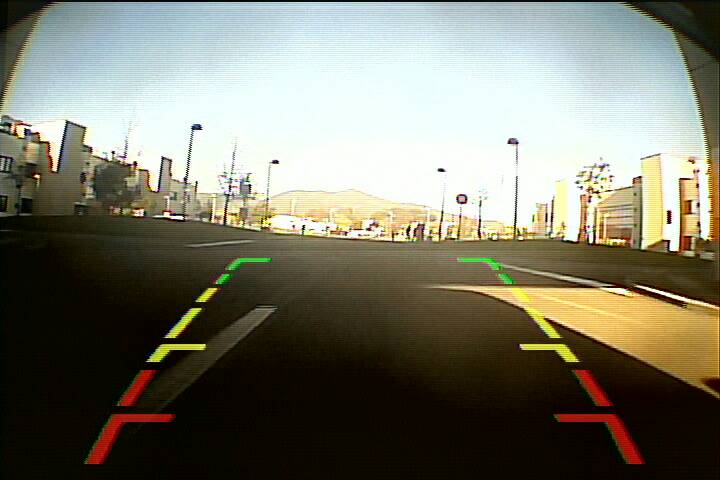
When the Trojan-horse App is executed, the back-door is opened and in parallel, the microphone of the infotainment system starts recording the conversation that occurs inside the vehicle. When the attacker wants to retrieve the recordings, the GPS coordinates, and the images, she uses a remote shell, embedded in the malware payload, to download the files.
In addition, the attacker, through the same shell, is able to interact with the Android system mining the privacy of the user by spoofing the information circulating on the CAN bus about vehicle attributes. In fact, this attack violates the confidentiality of the messages exchanged in the CAN bus network since these messages are not encrypted. The exchanged messages through ECUs contain information related to the vehicle, for instance, parking sensors, car doors opened, engine information and so on.
Conclusion
CANDY allows an attacker to violate the privacy of a user by stealing her private information stored on the infotainment system. In addition, the malicious APP is able to track the position of the vehicle and, consequently of all its passengers by using the remote shell.

More Info on this YouTube video

Contacts:

– Gianpiero Costantino – gianpiero.costantino@iit.cnr.it
– Ilaria Matteucci – ilaria.matteucci@iit.cnr.it
Istituto di Informatica e Telematica (IIT)- Consiglio Nazionale Delle Ricerche (CNR) – Pisa, Italy

Get Zero-Hour Vulnerability Alerts

Critical CVEs, CVSS scores, and PoC updates — straight to your inbox every week.


We respect your inbox. Unsubscribe anytime.

Related coverage

  • CVE-2024-9474 Exploited: LITTLELAMB.WOOLTEA Backdoor Discovered in Palo Alto Devices
  • SpyNote RAT Evolves: Targets Your Cryptocurrency Wallet
  • North African Human Rights Activists Targeted by New “Starry Addax” Malware Campaign
  • New Stealthy Backdoor “Squidoor” Linked to Chinese Threat Actor
  • Evil Corp Cybercriminals Exposed: UK Sanctions 16 Individuals Linked to Russian State and LockBit
Track all actively exploited CVEs →

Support Our Threat Intelligence

If you find our CVE report and cybersecurity news helpful, consider supporting our work.

Buy Me a Coffee Logo Buy Me a Coffee PayPal
Crypto QR Code
USDT (TRC20):
TN8BdV8cp4T1Cd28gK9qTAnZknzzuwyUtm
USDT (ERC20):
0x3725e1a7d3bc5765499fa6aaafe307fabcd75bce

Share this article:

Facebook Post LinkedIn Telegram
Tags: car malware

Search

Translation

CVE WATCHTOWER
🚨

Receive alerts for vulnerabilities being exploited in the wild.

⚡

Get notified instantly when a Proof of Concept (PoC) exploit is published.

🔍

Access critical info on vulnerabilities even when marked as "RESERVED".

🧠

Insights powered by decades of expertise and global intelligence sources.

🎯

Customize alerts with up to 10 keywords for your specific tech stack.

📊

Export the raw CVE database for SIEM integration and reporting.

Upgrade Package

🚨 Active Exploits in the Wild

  • CVE-2026-16232CVSS 9.1
    An authentication bypass vulnerability in the Check Point SmartConsole login process allows an unauthenticated remote attacker to obtain...
    CISA KEV📅 Added to KEV: Jul 22, 2026
  • CVE-2026-50522CVSS 9.8
    Deserialization of untrusted data in Microsoft Office SharePoint allows an unauthorized attacker to execute code over a network.
    Admin intelCISA KEV📅 Added to KEV: Jul 22, 2026📅 Updated: Jul 21, 2026
  • CVE-2026-63030CVSS 9.8
    WordPress 6.9.x before 6.9.5 and 7.0.x before 7.0.2 is affected by a REST API batch endpoint route confusion...
    Admin intelCISA KEV📅 Added to KEV: Jul 21, 2026📅 Updated: Jul 21, 2026
  • CVE-2026-60137CVSS 5.9
    WordPress 6.8.x before 6.8.6, 6.9.x before 6.9.5, and 7.0.x before 7.0.2 does not properly sanitise the author__not_in parameter...
    Admin intelCISA KEV📅 Added to KEV: Jul 21, 2026📅 Updated: Jul 21, 2026
  • CVE-2026-0770CVSS 9.8
    Langflow exec_globals Inclusion of Functionality from Untrusted Control Sphere Remote Code Execution Vulnerability. This vulnerability allows remote attackers...
    CISA KEV📅 Added to KEV: Jul 21, 2026
  • CVE-2021-27137CVSS 8.1
    An issue was discovered in router/upnp/src/ssdp.c in DD-WRT before 45724. An unsafe strcpy in the UPnP handling functionality...
    CISA KEV📅 Added to KEV: Jul 21, 2026
  • CVE-2026-6875CVSS 9.5
    ServiceNow has addressed a remote code execution vulnerability that was identified in the ServiceNow AI platform. This vulnerability...
    Admin intel📅 Updated: Jul 18, 2026
  • CVE-2026-39808CVSS 9.8
    A improper neutralization of special elements used in an os command ('os command injection') vulnerability in Fortinet FortiSandbox...
    CISA KEV📅 Added to KEV: Jul 16, 2026
Powered by CVE Watchtower

🔴 Live Critical Threats

  • CVE-2026-15704CVSS 9.8
    In Eclipse BaSyx Go Components versions up to and including 1.0.0, ABAC-enabled...
  • CVE-2026-62825CVSS 10.0
    Improper authentication in Azure Key Vault allows an unauthorized attacker to elevate...
  • CVE-2026-58275CVSS 10.0
    Missing authorization in Azure DNS allows an unauthorized attacker to elevate privileges...
  • CVE-2026-56191CVSS 10.0
    Improper authentication in Microsoft Exchange Online allows an unauthorized attacker to perform...
  • CVE-2026-56165CVSS 9.8
    Heap-based buffer overflow in Microsoft Account allows an unauthorized attacker to execute...
  • CVE-2026-56160CVSS 9.1
    Improper authorization in Azure Red Hat OpenShift (ARO) allows an authorized attacker...
  • CVE-2026-54120CVSS 9.9
    Improper input validation in Microsoft Surface allows an authorized attacker to execute...
  • CVE-2026-50517CVSS 9.9
    Deserialization of untrusted data in M365 Copilot allows an authorized attacker to...
  • CVE-2026-42933CVSS 10.0
    Pronetiqs IntraVUE versions 3.2.1a14 and prior have an unintended proxy or intermediary...
  • CVE-2026-63359CVSS 9.8
    The Appriss Insights (Equifax) Victim Information Notification Exchange (VINE) applications allow an...
Powered by CVE WATCHTOWER

Our Websites
  • Penetration Testing Tools
  • The Daily Information Technology
  • Top Exploited CVEs
  • Daily CyberSecurity

    • About SecurityOnline.info
    • Advertise with us
    • Announcement
    • Contact
    • Contributor Register
    • Login
    • Disclaimer
    • DCMA
    • Privacy Policy
    • About SecurityOnline.info
    • Advertise on SecurityOnline.info
    • Contact Us

    When you purchase through links on our site, we may earn an affiliate commission. Here’s how it works

    • CVE Watchtower
    • CVE Statistics by Vendor 2026
    • Q2 2026 Report
    • Top Exploited CVEs
    • Linkedin
    • Twitter
    • Facebook
    • Youtube
    © 2017 - 2026 Daily CyberSecurity. All Rights Reserved.