 Do Son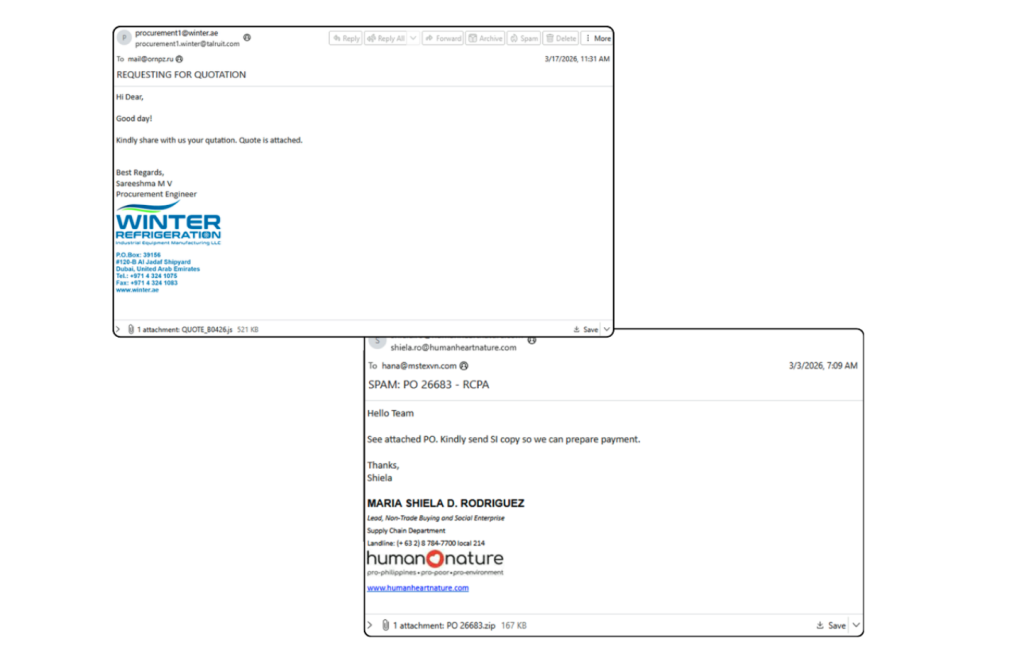
Two phishing emails from the campaigns launched throughout March 2026 | Image: Intrinsec
Global cybersecurity researchers recently uncovered a massive wave of malicious email distributions hitting international organizations. Specifically, Intrinsec’s cyber threat intelligence team tracked multiple campaigns distributing highly obfuscated software implants. Threat actors intentionally deployed malicious JavaScript payloads to establish sneaky initial access channels. To hide their activities, the operators relied entirely on abusive bulletproof hosting networks. Consequently, these secure nodes shielded the attackers from rapid take-down attempts by law enforcement. Defenders must now evaluate their perimeter visibility to counter this evasive threat model.
Decoding the Infrastructure Core
To begin with, forensic analysis maps the illicit backend traffic to two primary threat locations. The threat group split its command actions across distinct regions to boost infrastructure resilience. To illustrate this setup, the official report notes that a single campaign hosted both the spam-sending IP and the backdoor’s command architecture across split providers. Specifically, the researchers named GHOSTYNETWORKS in the United States and OMEGATECH in the Seychelles. Furthermore, both autonomous systems feature high volumes of verified abuse metrics. Therefore, standard web security providers advise blocking all traffic to these network prefixes immediately.
Tracking the AnonRDP and Virtualine Networks
Additionally, data correlation reveals that GHOSTYNETWORKS acts as a front for older cybercrime providers. Analysts trace this entity directly back to an infamous provider known as AnonRDP. Meanwhile, corporate registration documents name Daniel Mishayev as the prime legal organizer for these operations. Underground forum data indicates this person sets up shell companies to bypass corporate blocklists. On the other hand, OMEGATECH functions as a strategic front for Russia-based Virtualine. Consequently, these abusive bulletproof hosting networks provide stable environments for automated malware campaigns.
Victimology Targets Financial Institutions
Surprisingly, the campaign’s targeting parameters cover an incredibly diverse array of economic sectors. Intrinsec observed spearphishing lures hitting the finance ministries of both Transnistria and Sri Lanka. For example, the threat group targets financially vulnerable nations to exploit weaker security budgets. In addition, the operators heavily targeted energy infrastructure firms. They sent deceptive billing templates directly to the CIO of Ukraine’s Grand Distribution. Subsequently, another phishing wave targeted Russia’s major oil-refining enterprise, Orsknefteorgsintez. Thus, the financial motivation behind these malicious efforts remains explicitly clear to investigators.
Overlaps with Advanced Threat Syndicates
Furthermore, more advanced cyber espionage syndicates actively utilize this exact same delivery architecture. For instance, a financially motivated cybercrime group called TeamPCP used GHOSTYNETWORKS during March 2026. The adversarial group leveraged these nodes to host command paths for the PUREHVNC tool. Concurrently, they executed a significant supply-chain compromise against the PyPI LiteLLM package. The threat report summarizes this incident: “The group published trojanized versions (v1.82.7 and v1.82.8) that embedded a credential-stealing payload.” Clearly, these hosting clusters amplify the overall reach of modern supply chain threats.
Security Mitigations for Enterprise Defenders
Ultimately, network engineers must deploy rigid technical controls to defeat script-based intrusions. Organizations cannot rely solely on basic employee training programs to survive these attacks. Instead, security teams should block all inbound traffic originating from known rogue autonomous systems. Administrators must also implement strict application control rules to prevent script execution. Specifically, monitoring native tools like wscript and cscript will expose hidden execution paths. Finally, updating email security gateways will intercept malicious attachments before they land.
Support Our Threat Intelligence
Find our threat intelligence and malware analysis helpful? Support our work today and unlock a 100% ad-free reading experience!
 Buy Me a Coffee
