 Do Son

TL;DR
On September 20, 2026, attackers ran 41 suspected AI-written PowerShell modules on an African stock exchange server in just over three minutes. During this AI-assisted African stock exchange attack, the scripts hunted for cloud keys, tested credentials against an investment API, and sent results over DNS lookups. Although investigators found six Witchetty espionage implants on the same server, the operator behind the PowerShell sweep remains unattributed.
What Happened During the Three-Minute Sweep
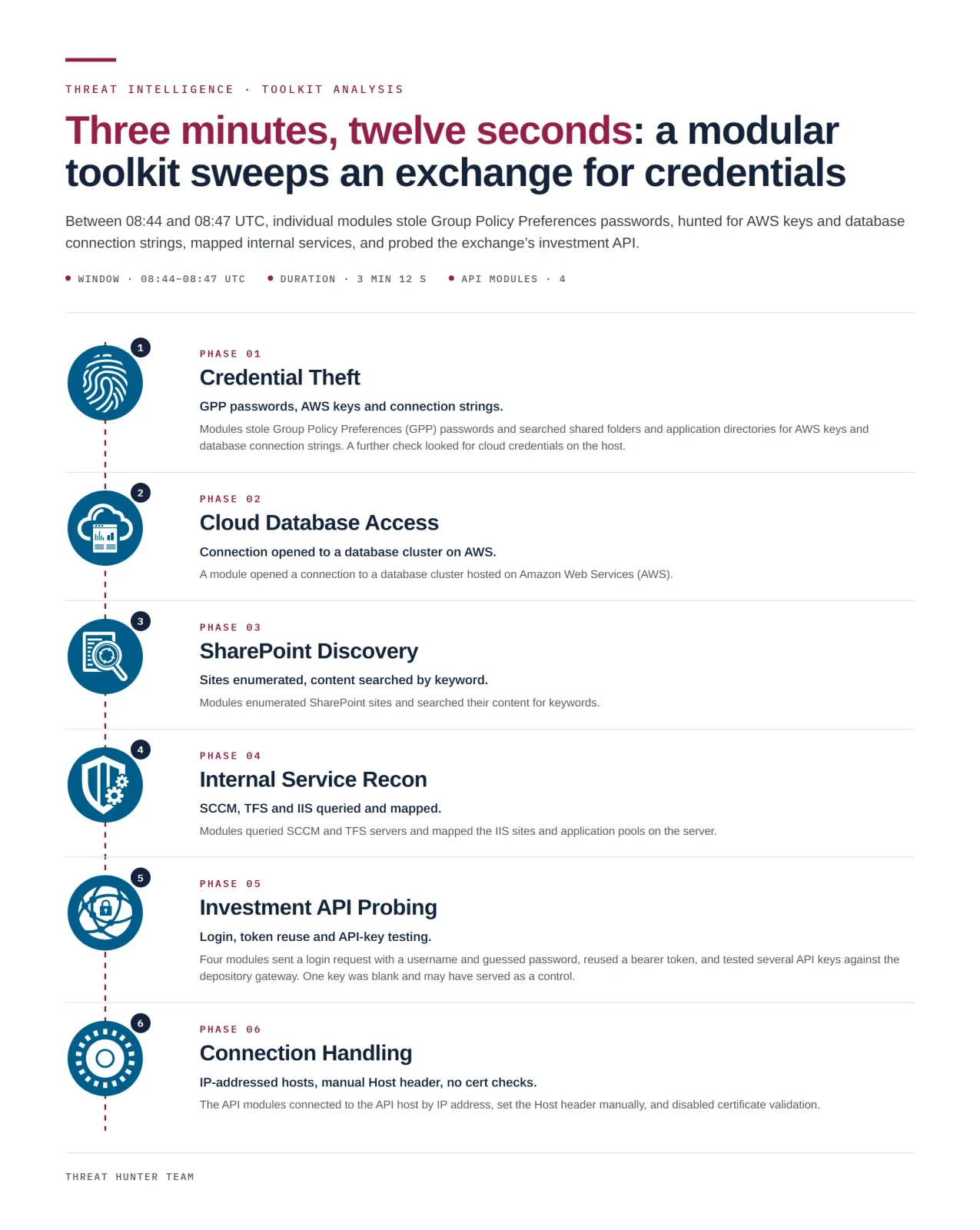
Between 08:44 and 08:47 UTC on September 20, 2026, 41 single-purpose PowerShell scripts executed under a web shell on an Internet Information Services (IIS) server. According to a report on the African stock exchange AI-assisted attack by Symantec’s Threat Hunter Team, a new module launched every few seconds. Each script targeted a specific layer of the exchange’s network, including SharePoint, System Center Configuration Manager (SCCM), Team Foundation Server (TFS), and Amazon Web Services (AWS) databases.
“The toolkit is one of the clearest examples of suspected machine-written attack tooling that we have seen to date,” Symantec researchers wrote. Specifically, the modules scanned domain SYSVOL shares, local web roots, and deployment folders for hardcoded passwords, Group Policy Preferences credentials, and AWS access keys. Four dedicated modules then probed the exchange’s investment API and a securities depository gateway. These scripts connected by IP address, disabled certificate checks, and tested a guessed password, a reused bearer token, and multiple API keys.
Signs of AI Authorship and DNS Exfiltration
Rather than writing shared helper code, the author repeated the exact same scaffolding across all 41 files. Every script opened with identical error-handling lines, used generic variable names, and copied a DNS exfiltration loop byte for byte. A human developer would typically write that loop once as a shared function, whereas an AI model prompted for standalone scripts reproduces the same block each time.
To hide stolen data from web proxies, each module converted its output into hex characters and split it into 50-character chunks. Next, the scripts resolved unique subdomains under oast.pro, a public out-of-band testing service. Each subdomain included a module tag, such as spid1 for host enumeration or awslocal1 for cloud hunting, allowing the remote collector to reassemble the findings.
Who Is Behind the Activity
Investigators found malicious activity on the compromised server dating back to April 2026, including six persistence implants. Symantec attributes those six implants with high confidence to Witchetty (also tracked as Looking Frog), a China-linked espionage subgroup of TA410 first documented by ESET in April 2022. Notably, Symantec previously caught Witchetty targeting this exact same African stock exchange in 2022 using ProxyShell and ProxyLogon exploits.
However, researchers did not attribute the 41-module PowerShell toolkit to Witchetty. “Three explanations fit the evidence. Witchetty may have returned with new tooling. A second and more capable operator may have used the access that Witchetty established. Or an unrelated actor may have used the same compromise,” the report noted. Furthermore, the motive remains unclear: testing banking gateways suggests financial crime, while checking a specific investor’s number points to targeted espionage.
Impact and Financial Sector Risks
Because the hex-encoded DNS lookups went to an external collector that researchers cannot inspect, investigators do not know if any stolen keys or tokens worked. Symantec found no direct evidence of privilege escalation or confirmed financial theft during the African stock exchange attack. Still, the breach highlights a growing wave of intrusions hitting financial institutions, alongside the multi-billion-dollar Binance hack and a $110 million heist at French bank Credit Mutuel Arkea.
How Organizations Can Stay Protected
To defend against an AI-assisted African stock exchange attack, security teams must monitor both web servers and outbound DNS traffic. As Spectrum Security’s Delta Research Team advised in its detection breakdown, defenders should alert on PowerShell processes spawned by the IIS worker process (w3wp.exe) and inspect PowerShell script block logs (Event ID 4104) for rapid WMI and SharePoint sweeps. Administrators should also remove plaintext secrets from SYSVOL, C:\Deployer, and web.config files. Finally, network teams should monitor DNS resolver logs for high volumes of 50-character hex subdomains querying public out-of-band testing services like oast.pro.
Support Our Threat Intelligence
Find our threat intelligence and malware analysis helpful? Support our work today and unlock a 100% ad-free reading experience!
 Buy Me a Coffee
