Anthropic Launches “Memory Import” to Rescue Your ChatGPT Context Amid #QuitGPT Exodus
 Do Son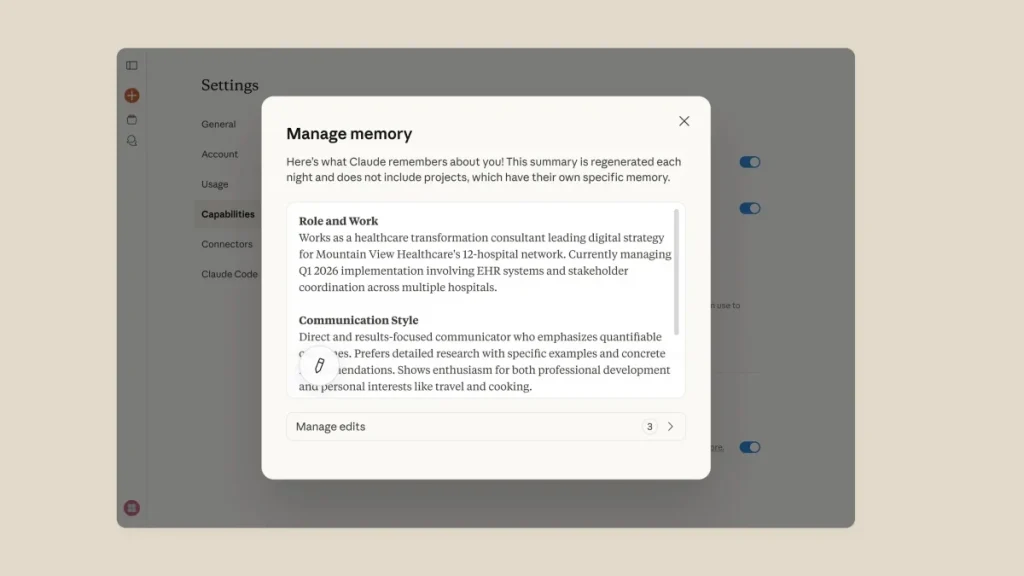
Precisely as OpenAI inadvertently ignited a colossal “#QuitGPT” exodus by securing a contract with the United States Department of Defense, Anthropic unceremoniously delivered a decisive blow. Anthropic has just heralded the introduction of a novel “Memory Import” utility for its premier AI assistant, Claude. This ingenious feature empowers users—via a meticulously crafted prompt—to painlessly transplant the personal preferences and conversational context they have painstakingly cultivated on rival platforms, such as ChatGPT, Gemini, or Copilot, directly into Claude.
Historically, the paramount tribulation for users seeking to transition to a new primary AI assistant was the arduous necessity of “starting from scratch” to reestablish conversational rapport. Anthropic’s newly unveiled “Memory Import” circumvents this entirely; users require no coding acumen, nor must they await the advent of API export interfaces from competing platforms. By merely copying an official “memory extraction prompt” provided by Anthropic and pasting it into ChatGPT or Gemini, users can compel their erstwhile AI systems to disgorge a comprehensive ledger of their directive preferences, project intricacies, and historical context. Ultimately, one need only replicate the generated output and seamlessly paste it into the “Manage memory” enclave within Claude’s settings. Anthropic notes that Claude requires approximately 24 hours to meticulously digest and assimilate this newly imported tapestry of context. Upon completion, users may click the “View what Claude knows about you” prompt for verification, retaining the liberty to manually refine the contours of these memories.
Anthropic astutely underscores, however, that Claude’s mnemonic capabilities are predominantly anchored upon “work-related subjects to elevate collaborative efficacy”; consequently, it may refrain from deliberately archiving excessively intimate, non-professional minutiae. The orchestration of this feature’s debut is undeniably bereft of coincidence.
Only recently, Anthropic witnessed the dissolution of its negotiations with the United States Department of Defense (DoD), a rupture born of its unwavering refusal to dismantle AI safety guardrails—specifically, its strict prohibitions against “mass domestic surveillance” and “fully autonomous weapons systems.” Subsequently, OpenAI’s eager embrace of the very classified military contract that Anthropic had spurned ignited a firestorm of indignation across the digital sphere.
Disillusioned European and American users, appalled by OpenAI’s perceived metamorphosis into an arm of the “military-industrial complex,” spearheaded the sweeping “#QuitGPT” boycott, precipitating the cancellation of hundreds of thousands of ChatGPT subscriptions. Capitalizing on this precise, vulnerable juncture, Anthropic unveiled its “memory migration” tool—a siren song directed at those disaffected users who remained tethered by the agonizing prospect of abandoning their cultivated AI memories. It was a clarion call proclaiming, “The gates are open; bring your baggage hither!” The efficacy of this masterful stratagem has been nothing short of astounding. Buoyed by the tempest of the boycott and the promise of a frictionless transition, Claude has recently eclipsed the perennially dominant ChatGPT on the App Store’s free application charts, triumphantly seizing the vanguard position.
Within the software services arena—and particularly in the crucible of large language models—the “Switching Cost” endures as a corporation’s most formidable moat. Devoting months, or even years, to instructing ChatGPT on your identity, the nuances of your projects, and your idiosyncratic coding predilections creates a profound synergy; a synergy that traditionally faced total obliteration upon migrating to a nascent platform.
Historically, OpenAI has conspicuously withheld a comprehensive memory data export function, a calculated maneuver to enchain its most devoted users. Anthropic’s deployment of “natural language prompts” to reverse-engineer and siphon ChatGPT’s memory artfully circumvents these entrenched technical barricades. This stratagem not only annihilates the adversary’s moat but also, amidst the turbulent “#QuitGPT” public relations crisis, brilliantly casts Anthropic as the “anti-establishment hero,” fiercely defending moral imperatives. Moving forward, the arms race in generative AI will transcend mere algorithmic computational supremacy; the veritable crusade for “digital memory sovereignty” has merely entered its most incendiary chapter.
Support Our Threat Intelligence
Find our tech and OS security coverage helpful? Support our work today and unlock a 100% ad-free reading experience!
 Buy Me a Coffee
