 Do Son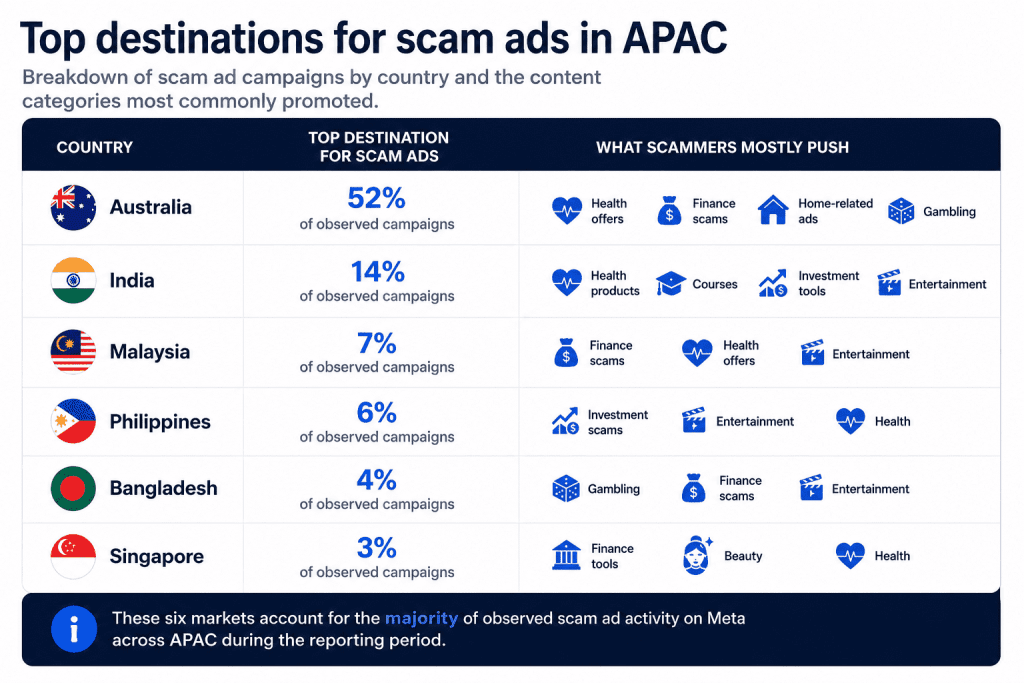
Broad Malvertising Infrastructure Reuses Templates at Scale
Security researchers recently uncovered a massive underground fraud network stretching across the Asia-Pacific region. Specifically, analysts exposed a coordinated network of APAC malvertising scam campaigns designed to deceive millions of internet users. These fraudulent entities purchase high-visibility placement directly on popular Meta advertising platforms. By doing so, the threat clusters quickly generate immense user reach across multiple countries. Consequently, corporate threat intelligence groups are warning consumers to scrutinize unexpected links.
To begin with, the scale of this deceptive operation is remarkably vast. Forensic specialists monitored more than 12,000 distinct fraudulent events in a four-month window. Furthermore, these malicious promotions achieved over 400,000 individual views from unsuspecting users. The published industry writeup outlines this broad footprint directly. “Between January and April 2026, Alexandra Svetlana DINULICA and Vlad Mihai Sireanu of Bitdefender Labs tracked more than 400,000 scam ad sightings tied to over 12,000 scam campaigns across 13 APAC countries.”
Analyzing the Primary Exploitation Themes
The Prevalence of Medical Deception
Subsequently, data analysis shows that the operations focus heavily on personal health anxieties. Medical-related promotions lead the overall dataset at 19%. These campaigns abuse consumer vulnerabilities using emotionally persuasive storytelling and manufactured medical authority. For instance, attackers create fake medical breakthroughs or unverified respiratory remedies. They use fake testimonials and conspiracy narratives to drive rapid user conversions.
Financial Bait and Artificial Intelligence Scams
In addition, financial fraud accounts for 18% of the monitored activity. Scammers rely on fake news stories regarding central banks and prominent national economists. Alternatively, they push automated investment tools promising guaranteed returns through custom software. The report mentions: “The third pattern is investment fraud. Instead of promising profits directly, these campaigns talk of ‘Al-powered insights,’ ‘stock diagnostics,’ or automated strategies.”
Deconstructing the Unified Redirection Machinery
However, the underlying technical delivery layout remains surprisingly uniform across distinct themes. While the surface text changes frequently, the core traffic routing system does not. First, a user interacts with a paid ad displaying a real corporate domain. Then, the browser initiates a hidden chain of intermediary redirects. Ultimately, the user lands on a credential theft portal or a malicious file repository. This rotation makes tracking extremely challenging for traditional security blocklists.
Moreover, the campaign profiles distinct regional populations using customized local tactics. For example, the adversaries push highly polished breaking news templates inside Australia. Australia alone represents a massive 52% of the total dataset. Conversely, the strategy shifts toward sheer volume in the Indian market. In that region, the actors use dozens of automated profiles to flood communication feeds simultaneously.
Tracking Cross-Border Infrastructure Reuse
Furthermore, the threat groups maintain high efficiency by utilizing identical server coordinates. This inter-connected setup allows the campaign to pivot seamlessly across international boundaries. The analysis explains: “Across markets, scammers reuse infrastructure, fake pages, redirect chains, and campaign templates.” Therefore, individual localized alerts often connect directly to a centralized crime cluster.
Ultimately, this ongoing wave of APAC malvertising scam campaigns presents a severe risk to corporate endpoints. Clicking these items exposes organizational networks to spyware infections and credential leaks. Therefore, enterprise security teams must enforce rigid multi-factor authentication. They should also block connection paths to newly registered domains. In conclusion, continuous threat visibility across Meta advertising platforms remains mandatory to stop these automated delivery systems.
Support Our Threat Intelligence
Find our threat intelligence and malware analysis helpful? Support our work today and unlock a 100% ad-free reading experience!
 Buy Me a Coffee
