 Do Son
 At a glance
| Field | Details |
|---|---|
| Actor or Group | Unattributed cybercrime operators |
| Activity Type | Email filter evasion, credential harvesting, and business loan fraud |
| Targets or Victims | Corporate employees and enterprise email systems receiving financial lures |
| Scale | Millions of daily messages peaking above 2.3 million per day |
| Jurisdiction Status | Tracked by private threat researchers; no criminal charges announced |
| Source | Microsoft Defender for Office 365 Research and Fortra |
Executive Summary
Microsoft security researchers uncovered a massive email operation using an AI-era evasion method known as ASCII smuggling phishing. Attackers hide invisible Unicode characters inside financial lure terms to slip past email filters. Security teams must update their text parsers to identify these hidden characters before delivery.
What Happened in the Evasion Campaign
On February 9, 2026, Microsoft threat intelligence detected a sudden surge in suspicious email traffic. Attackers repurposed an evasion concept known from artificial intelligence research. Security analysts originally documented ASCII smuggling in prompt injection tests against large language models. In those tests, researchers used hidden Unicode tag characters to pass secret instructions to AI systems without human awareness.
However, cybercriminals inverted this approach during recent attacks. As the Microsoft report notes, “Instead of using these characters to hide instructions from people while exposing them to AI models, the attacker used them to split financial lure words such as ‘funding’ to prevent email filters from parsing them.” The attackers targeted high-value words like funding, capital, and loans.
The technique relies on the Unicode Tags block, spanning from U+E0000 to U+E007F. Standard fonts do not render these specific code points on screens. Therefore, an email recipient sees standard text without unusual formatting. Behind the scenes, the attacker inserts the invisible U+E0020 tag space character directly into keywords. For instance, the system processes the word “funding” as “fun” followed by the invisible tag and “ding”.
This splitting confuses traditional spam filters. Basic keyword matchers fail because the contiguous string no longer exists in the raw byte stream. In addition, machine learning tokenizers encounter unfamiliar word fragments. Security analysts observed this ASCII smuggling phishing technique altering how security filters inspect inbound messages. Consequently, the modified text slips past traditional filters. The complete analysis appears in the Microsoft threat research report.
Who Is Behind the Phishing Activity
Microsoft researchers currently track this activity as unattributed cybercrime. The campaign lacks definitive ties to known state-sponsored groups. However, researchers hold high confidence that the operators run commercial financial fraud funnels.
Threat analysts linked this wave to an ongoing Small Business Administration loan scam previously reported by cybersecurity firm Fortra. The attackers previously delivered messages without special characters before adopting Unicode evasion.
Furthermore, the campaign relayed messages through legitimate infrastructure belonging to marketing provider ActiveCampaign. Attackers routed outbound emails through approximately 150 disposable sender domains. They also masked destinations with genuine click-tracking links. In response, ActiveCampaign stated, “We appreciate Microsoft’s research and welcome collaboration with the security community to combat this activity.” The company confirmed that its internal scanners now flag heavy usage of hidden Unicode characters.
Impact and Operational Scale
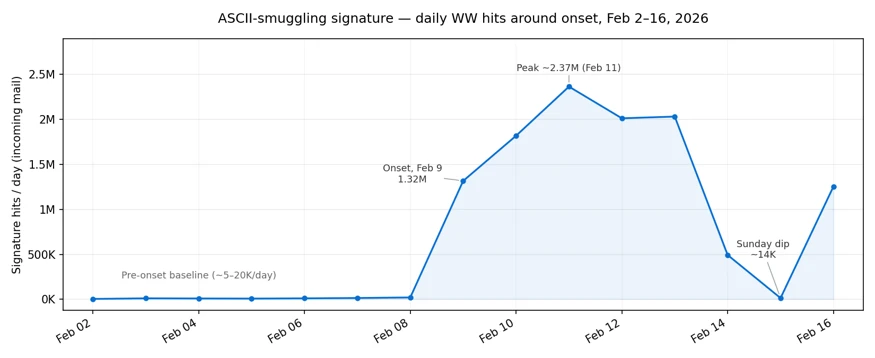
The operational scale of this campaign reached extraordinary levels within hours of launch. On February 8, Microsoft telemetry tracked roughly 21,000 hits on its detection signatures. The following day, daily detections jumped past 1.3 million messages. The activity peaked on February 11 at over 2.3 million daily emails.
The attackers maintained an aggressive weekday schedule for approximately three months. Every Monday morning, volume jumped to multi-million thresholds. Conversely, activity dropped to near zero on weekends. This automated pattern suggests the use of scheduled commercial mailers. By late March, message volume gradually declined by eighty percent. High-volume transmissions finally stopped after May 15, 2026.
Over ninety-six percent of flagged messages originated from a single network block. The attackers rotated domains built around twenty-eight specific words, including capital, advance, and boost. Consequently, millions of enterprise mailboxes encountered deceptive financial offers designed for fraud or credential theft.
Defense Guidance and Mailbox Protection
Organizations must adjust mail inspection pipelines to defeat this ASCII smuggling phishing evasion method. Security teams should not assume standard filters detect hidden tag characters. Defenders need layered controls across all email gateways.
First, administrators must audit text normalization pipelines. Email security gateways should strip or normalize Unicode tag characters in the U+E0000 to U+E007F range before tokenization. However, systems must preserve valid tag sequences used in regional flag emojis, such as England, Scotland, and Wales.
Second, organizations should adopt visual inspection techniques. Advanced filters can render incoming messages into images and apply optical character recognition. This process extracts text exactly as users view it, neutralizing character insertion tricks.
Third, defenders should flag emails containing unusual tag characters outside standard emoji sequences. Microsoft observed that over 99 percent of these malicious messages were blocked by layered reputation filters. By combining sender authentication checks, IP reputation monitoring, and character sanitization, defenders can secure inboxes against evolving evasion tactics.
Support Our Threat Intelligence
Find our threat intelligence and malware analysis helpful? Support our work today and unlock a 100% ad-free reading experience!
 Buy Me a Coffee
