Skip to content
June 4, 2026
  • Linkedin
  • Twitter
  • Facebook
  • Youtube

Daily CyberSecurity

Zero-hour alerts. Unmatched analysis.

Primary Menu
  • Home
  • CVE Watchtower
  • Cyber Criminals
  • Data Leak
  • Linux
  • Malware
  • Vulnerability
  • Submit Press Release
  • Vulnerability Report
Light/Dark Button
  • Home
  • News
  • Malware
  • Beware of LinkedIn: Ducktail Malware’s Sneaky ZIP Attack Revealed
  • Malware

Beware of LinkedIn: Ducktail Malware’s Sneaky ZIP Attack Revealed

Do Son January 4, 2024 3 minutes read
0
Ducktail LinkedIn

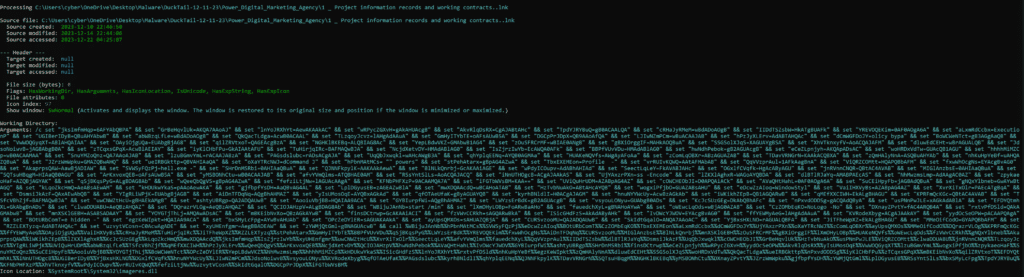
Project information records and working contracts.lnk contents

Add as a preferred
source on Google

In December 2023, the cybersecurity community was alerted to a new form of cyber threat – the Ducktail malware. This incident, detected by the eSentire Threat Response Unit (TRU), targeted a digital marketing professional, revealing the sophisticated mechanisms of this malware and underscoring the vulnerabilities in professional networks.

Ducktail began its infiltration through a seemingly innocuous channel – LinkedIn. The attackers sent a private message to the target containing a ZIP archive. This method of delivery highlights a new frontier in cyber attacks, exploiting professional networks and platforms for malware distribution. The use of LinkedIn, a platform known for its professional credibility, marks a concerning trend in how attackers are evolving their strategies to breach defenses.

Project information records and working contracts.lnk contents | Image: TRU

The archive contained bloated shortcuts, over 800MB in size, with batch scripts executing PowerShell commands. These shortcuts were the initial step in a complex attack chain. Upon decoding, these scripts led to the download of additional PowerShell scripts from suspicious URLs. These scripts had two primary functions: to bypass User Account Control (UAC) settings and to execute administrative privileges based on the system’s UAC status.

The Ducktail malware showcased a meticulous approach to evading detection. It checked the system’s UAC settings from the registry and employed techniques to bypass UAC. If UAC was disabled, it downloaded and executed a file with administrative privileges. If UAC was enabled, it used fodhelper.exe, a known method for bypassing UAC on Windows, to overwrite legitimate system files with malicious ones.

The culmination of this attack involved the downloading and execution of two core payloads – ‘mainbot.exe’ and ‘myRdpService.exe’. These .NET payloads, compiled using native Ahead-Of-Time (AOT) compilation, made the analysis process more complicated. The payloads were responsible for establishing a connection with the command-and-control server, executing remote commands, and potentially exfiltrating data. This functionality highlights the risk of sensitive information theft and the need for robust network monitoring and data loss prevention strategies.

The Ducktail malware incident teaches us several critical lessons:

  • Professional networks are not immune to cyber threats. The creativity of attackers in exploiting these platforms calls for heightened caution when interacting with unsolicited messages and attachments.
  • The creation of scheduled tasks and services along with techniques to bypass UAC indicates a focus on avoiding detection and maintaining persistence on infected systems.
  • The ability to query Windows Management Instrumentation for active antivirus products and add exclusion paths to Windows Defender reveals an intent to circumvent standard security defenses.
Rate this post

Support Our Threat Intelligence

If you find our CVE report and cybersecurity news helpful, consider supporting our work.

Buy Me a Coffee Logo Buy Me a Coffee PayPal
Crypto QR Code
USDT (TRC20):
TN8BdV8cp4T1Cd28gK9qTAnZknzzuwyUtm
USDT (ERC20):
0x3725e1a7d3bc5765499fa6aaafe307fabcd75bce

Share this article:

Facebook Post LinkedIn Telegram

Related posts:

  1. Massive Cyber Campaign Exploits 4,000 ISP IPs in the U.S. and China for Credential Theft and Cryptojacking
  2. Beyond Detection: PyBitmessage Protocol Used for Covert Monero Mining Campaign
  3. Fake Google Meet Page Tricks Users into Running Malware
  4. XwormRAT Resurfaces with Steganography-Powered Attack Chain
  5. PhantomCaptcha Spyware Targets Ukraine NGOs with Fake Cloudflare Lure to Deploy WebSocket RAT

Do Son

Do Son (aka Ddos) is a seasoned news reporter, bringing over a decade of expertise to the forefront of cyber security and technology reporting. My work provides timely and insightful analysis of emerging trends and critical developments in these rapidly evolving sectors.

Tags: Ducktail malware LinkedIn mainbot.exe myRdpService.exe powershell User Account Control

Leave a Reply Cancel reply

You must be logged in to post a comment.

Search

Translation

CVE WATCHTOWER
🚨

Receive alerts for vulnerabilities being exploited in the wild.

⚡

Get notified instantly when a Proof of Concept (PoC) exploit is published.

🔍

Access critical info on vulnerabilities even when marked as "RESERVED".

🧠

Insights powered by decades of expertise and global intelligence sources.

🎯

Customize alerts with up to 10 keywords for your specific tech stack.

📊

Export the raw CVE database for SIEM integration and reporting.

Upgrade Package

🔴 Live Critical Threats

  • CVE-2019-25741CVSS 9.8
    Mobatek MobaXterm 12.1 contains a structured exception handling (SEH) based buffer overflow...
  • CVE-2019-25738CVSS 9.8
    WordPress Hybrid Composer 1.4.6 contains an unauthenticated settings change vulnerability that allows...
  • CVE-2019-25729CVSS 9.8
    PDF Signer 3.0 contains a server-side template injection vulnerability that allows unauthenticated...
  • CVE-2019-25727CVSS 9.8
    WordPress Plugin ad manager wd 1.0.11 contains an arbitrary file download vulnerability...
  • CVE-2026-8037CVSS 9.6
    OS Command Injection Remote Code Execution Vulnerability in API in Progress ADC...
  • CVE-2026-4104CVSS 9.8
    Authorization bypass through User-Controlled SQL primary key vulnerability in Akmer Informatics Automation...
  • CVE-2026-10840CVSS 9.6
    A flaw was found in the OpenShift Pipelines operator. The tekton-scheduler-rolebinding ClusterRoleBinding...
  • CVE-2026-41283CVSS 9.9
    OpenStack Mistral through 22.0.0 allows Arbitrary Remote Code Execution when the API...
  • CVE-2026-44182
    ### Summary The environment variables used during the rendering of the Kubernetes...
  • CVE-2026-44181
    ### Summary The environment variables (`KERNEL_XXX`) used during the rendering of the...
Powered by CVE WATCHTOWER

Recent Zero-Day Vulnerabilities

  • Android Zero-Day Flaw Exploited in the Wild: June 2026 Patches Released
  • Exploited in the Wild: Critical OWA Spoofing Flaw (CVE-2026-42897) Hits On-Premises Exchange Servers
  • Exploited in the Wild: Maximum CVSS 10 SD-WAN Flaw (CVE-2026-20182) Grants Admin Control
  • Exploited in the Wild: Critical 9.8 CVSS RCE Hits Canon GUARDIANWALL MailSuite
  • Exploit Code Released: Public PoC Dumps for Windows BitLocker Bypass and SYSTEM Elevation Zero-Days
  • Exploited in the Wild: “Dirty Frag” Linux Vulnerability Grants Instant Root Access
Our Websites
  • Penetration Testing Tools
  • The Daily Information Technology
  • Daily CyberSecurity

    • About SecurityOnline.info
    • Advertise with us
    • Announcement
    • Contact
    • Contributor Register
    • Login
    • About SecurityOnline.info
    • Advertise on SecurityOnline.info
    • Contact Us

    When you purchase through links on our site, we may earn an affiliate commission. Here’s how it works

    • Disclaimer
    • Privacy Policy
    • DMCA NOTICE
    • Linkedin
    • Twitter
    • Facebook
    • Youtube
    Copyright Daily CyberSecurity © All rights reserved.