 Do Son
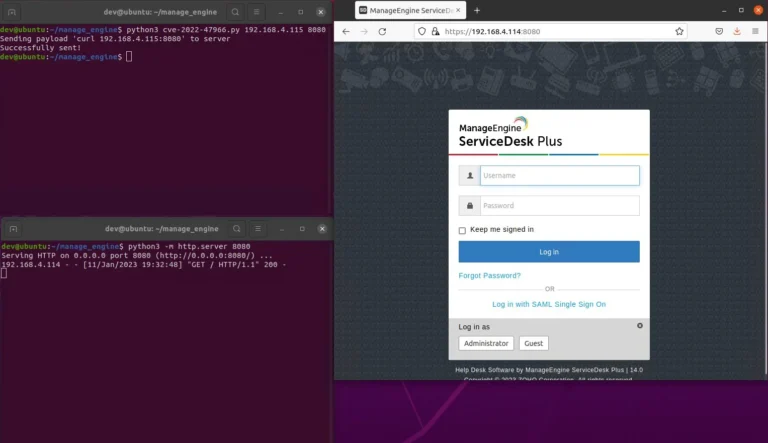
James Horseman released IOCs associated with the flaw before and today PoC exploit code is now available for CVE-2022-47966
Vulnerability

CVE-2023-22809 was discovered by researchers Matthieu Barjole and Victor Cutillas of Synacktiv in the sudoedit function for Linux

a local authenticated malicious user may potentially exploit CVE-2022-34393 by using an SMI to gain arbitrary code execution in SMRAM

Tracked as CVE-2022-41903 (CVSS 9.9/10 severity), the security flaw can be exploited by sending specially-crafted input.

CVE-2022-46891 impacts the GPU memory processing operations and could be exploited to bypass security restrictions

The patch provides cover for three documented security vulnerabilities: CVE-2006-20001, CVE-2022-36760, and CVE-2022-37436.

A critical-severity SQL injection vulnerability in the SQL Alchemy connector of Superset (CVE-2022-41703) was said to affect version 1.5.2

The most severe of these issues is CVE-2021-26316, an arbitrary code execution vulnerability in AMD EPYC and Ryzen processors

By executing a specially-crafted program, an authenticated attacker could exploit CVE-2023-0179 to gain elevated privileges as root.

Tracked as CVE-2023-22602, Apache Shiro could allow a remote attacker to bypass security restrictions, caused by a flaw when Shiro and Spring Boot

Blasty shared a Github page hosting PoC for the vulnerability in Lexmark Printer that allows attacker to take control of the affected device

an attacker could exploit CVE-2023-20018 (CVSS score of 8.6) to access certain restricted parts of the web interface.

CVE-2023-20025 (CVSS score: 9.0), has been described as an authentication bypass vulnerability in Cisco Small Business RV016, RV042, RV042G, RV082

CVE-2023-0210 affects the Linux kernel's ksmbd NTLMv2 authentication and is known to crash the OS immediately in Linux-based systems

The vulnerabilities tracked as CVE-2022-36926, CVE-2022-36927, CVE-2022-36930, and CVE-2022-36929, and all rated high severity

CVE-2022-43389 allows a remote unauthenticated attacker to execute some OS commands or to cause DoS conditions on a vulnerable device

Tracked as CVE-2023-21674 (CVSS score: 8.8), the flaw could allow a remote attacker to gain elevated privileges on the system

Successfully exploiting CVE-2022-44877 allows a remote attacker to gain full remote code execution on the server.

CVE-2022-39947 allows a remote authenticated attacker to execute arbitrary code on the system, caused by an OS command injection vulnerability

The PoC exploit targets CVE-2022-46164, a critical vulnerability that could allow a remote attacker to bypass security restrictions

CVE-2022-43931, is an out-of-bounds write vulnerability in Synology VPN Plus Server, allows remote attackers to execute arbitrary commands

CVE-2022-43396 could allow a remote attacker to execute arbitrary commands on the system, caused by a bypass flaw in the blocklist