 Do Son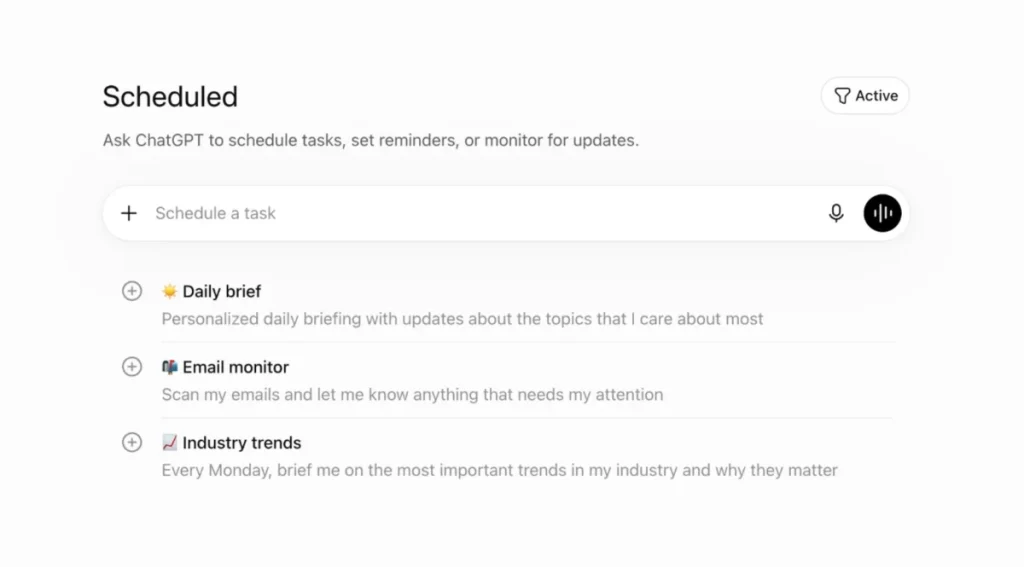
To imbue its AI assistant with more proactive, agentic capabilities, OpenAI recently announced a groundbreaking feature. They are officially introducing “Scheduled Tasks” to ChatGPT. According to recent ChatGPT release notes, this update will gradually roll out to Plus, Pro, Team, and Enterprise users. Consequently, users will not merely command ChatGPT to send timed reminders or manage routine cyclical workflows. The AI will also transform into a vigilant, 24-hour web-monitoring assistant. It will autonomously dispatch valuable notifications when it discovers specific, critical information online.
Deciphering the Four Core Mechanisms
OpenAI states that this new Scheduled Tasks system is remarkably intuitive for searching and managing. Furthermore, underlying optimizations ensure superior execution speed and unwavering stability. The core operational logic encompasses four vital pillars:
1. Dedicated Management Dashboard
The ChatGPT interface sidebar now features an independent “Scheduled Tasks” section. Here, users can instantly view all currently queued tasks and their next anticipated execution times. Additionally, they can pause, resume, edit, or delete any schedule at their convenience.
2. Flexible Scheduling Protocols
When establishing execution times, users enjoy remarkable flexibility. They can pinpoint highly specific hours, such as every Monday at 9:00 AM. Alternatively, they can select broader, more generalized timeframes like morning, noon, or evening.
3. Intelligent Network Monitoring
Crucially, ChatGPT’s monitoring tasks now possess robust network retrieval capabilities. They can even read data fluctuations from linked third-party applications. More intelligently, the AI avoids spamming users while patrolling the background. It only pushes alerts when it detects truly essential information worth communicating.
4. Anti-Abuse Security Safeguards
To prevent the exploitation of expensive computational resources, OpenAI implemented specific safeguards. Mechanistically, Scheduled Tasks can execute a maximum of once per hour. Furthermore, the system may automatically suspend unattended tasks that completely lack human interaction for prolonged periods.
Consequently, with the arrival of this comprehensive new system, ChatGPT legacy active task feature, “Pulse,” will retire. OpenAI anticipates officially taking Pulse offline in two weeks.
Evolving from Reactive to Proactive
Analyzing OpenAI’s strategic deployment of Scheduled Tasks reveals a profound shift. ChatGPT’s original interaction model was strictly “ask and answer, passively respond.” Now, it is rapidly evolving toward the core paradigm of a proactive AI Agent.
Previously, tracking a new tech product’s price or summarizing specific news required programming skills. Users had to connect ChatGPT to external automation tools like Make or Zapier via APIs. Today, OpenAI embeds this capability directly within the ChatGPT web and app interfaces. They have even endowed it with contextual awareness it remains silent unless something vital occurs. Undoubtedly, this “automated patrolling” experience will dramatically increase the platform stickiness for corporate managers and premium users.
Ultimately, this rollout presents fascinating complementary and competitive dynamics with Microsoft’s recently unveiled Copilot Cowork agent system. Tech behemoths are fiercely focusing on AI workforces capable of laboring silently in the background, even when devices are off. The victor in this next-generation office revolution will be the AI that demonstrates superior efficiency, precision, and seamless third-party integration.
Support Our Threat Intelligence
Find our tech and OS security coverage helpful? Support our work today and unlock a 100% ad-free reading experience!
 Buy Me a Coffee
