 Do Son
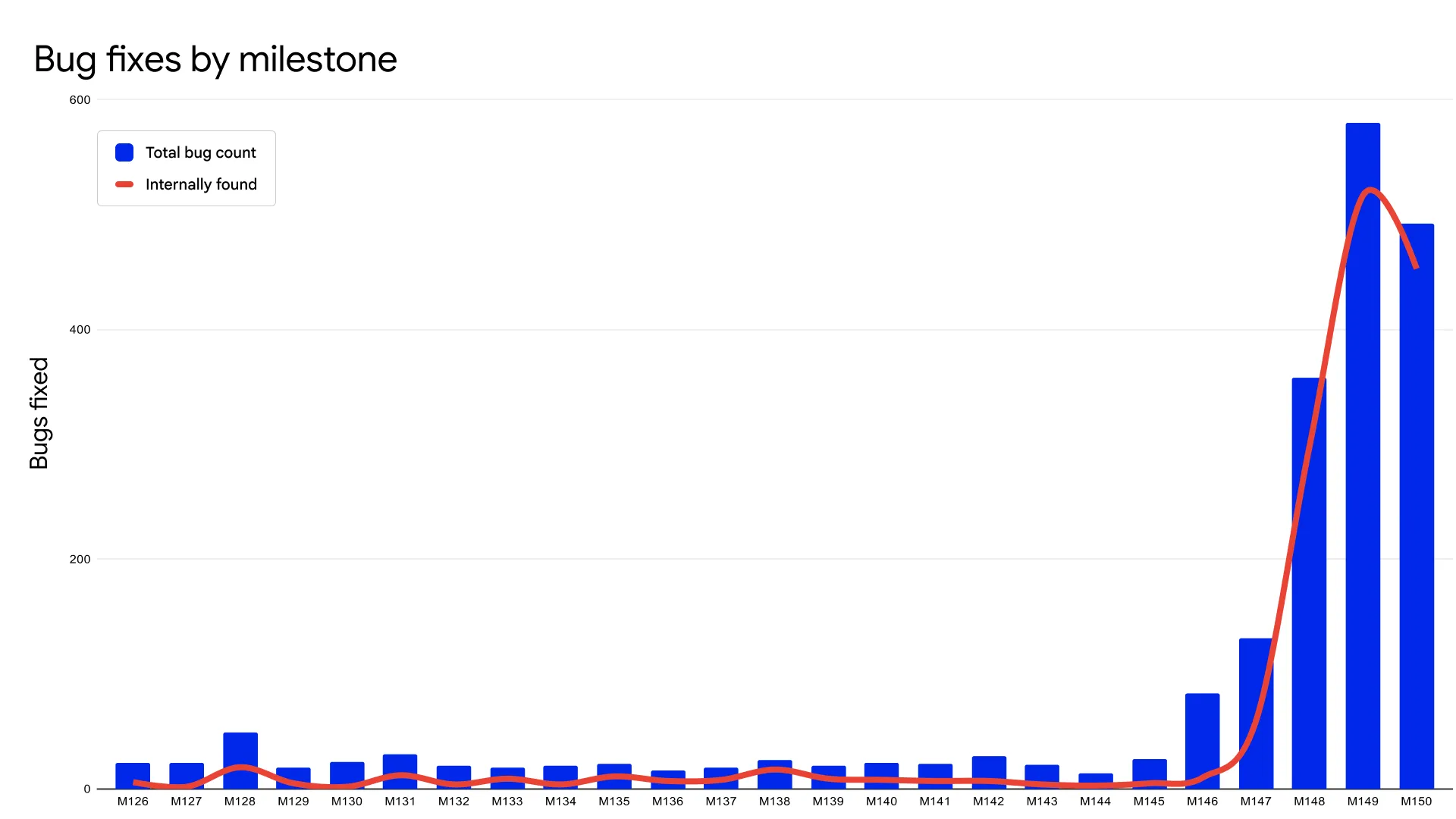
Google recently disclosed a striking set of numbers on its blog. Chrome 149.x and 150.x, both shipped in June, together resolved 1,072 security vulnerabilities. This week’s Chrome 151.x added another 370 fixes. Across these three major releases, Google patched a total of 1,442 flaws.
Outpacing 23 Prior Major Versions Combined
Google’s own data underlines the scale. Chrome 126.x through 148.x, spanning 23 major versions, never surpassed 1,000 fixes in total. Yet Chrome 149.x and 150.x alone exceeded that mark. Adding Chrome 151.x pushes the count to 1,442, as Google detailed in its security blog post.
Taking Chrome 151.x as an example, its 370 fixes break down clearly. Google itself discovered and reported 349 of those vulnerabilities. External security firms and independent researchers reported the rest. Among the 370 flaws, 7 earned a critical severity rating, meaning attackers could weaponise them in real attacks.
AI Is Driving the Surge
A volume this large plainly does not come from manual effort alone. The majority of these vulnerabilities were unearthed by Google or external researchers using artificial intelligence. With AI’s help, the entire industry is accelerating its pace of vulnerability discovery.
The volume even overwhelmed the Chrome team’s documentation capacity. In many cases, the team relied on AI to draft vulnerability descriptions and CVE write-ups, simply because there were too many bugs and too little time to compose each one by hand.
Biweekly Security Updates to Keep Pace
Google previously announced that Chrome’s security update cadence would shorten to every two weeks. Under this schedule, Google ships a new Chrome version, specifically a patch release, once every fortnight to address known flaws.
The faster cycle is a direct response to rapidly evolving AI-driven attacks. Google frames it as meeting the threat at the speed it now moves.
In the same blog post, Google also stressed the importance of proper public disclosure. Every security vulnerability that reaches a Chrome stable release, whether found internally or reported externally, is documented and disclosed following standard best practices. This lets customers, security firms, and researchers track and review every flaw, which preserves Chrome’s security transparency.
Support Our Threat Intelligence
Find our tech and OS security coverage helpful? Support our work today and unlock a 100% ad-free reading experience!
 Buy Me a Coffee
