 Do Son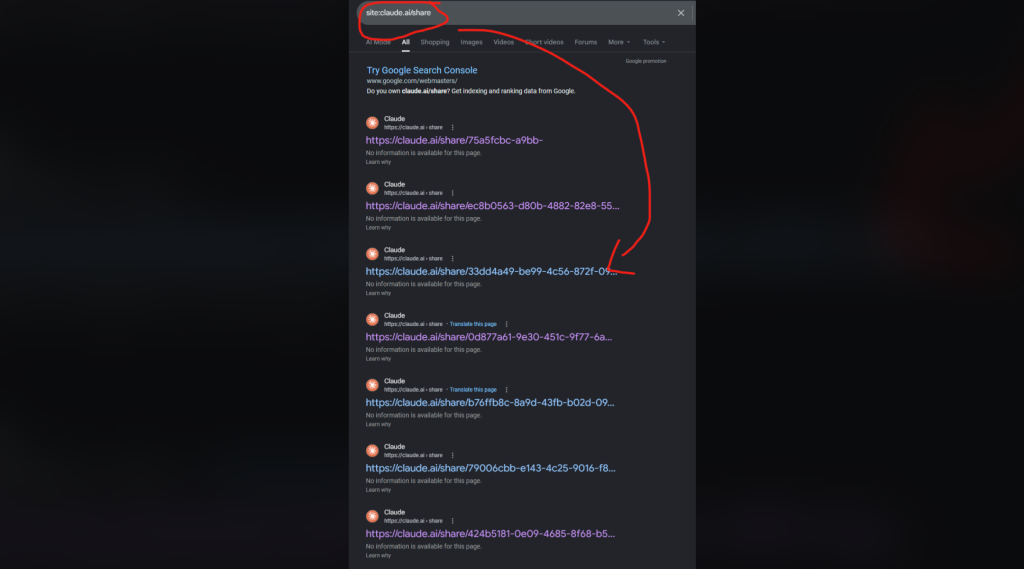
Image: Reddit
Over the weekend, users noticed something unsettling. Claude AI conversation shares were appearing in Google search results. Anthropic had not blocked search engines from crawling those share links.
As a result, a simple site: query could surface many shared-conversation links already indexed by Google and other engines. Some of those shares contained users’ private information, as users documented on Reddit.
What This Is, and What It Is Not
First, an important clarification. This was not a breach of Anthropic’s backend database. Nor did it leak chats that users never shared.
The indexed material came from share links that users created themselves. In other words, anyone with the link could already view the conversation publicly. The trouble is one of understanding, though. Many users assumed a share link only reached the colleague or friend they sent it to.
From a web perspective, that assumption is dangerous. Such links can appear on public pages, forums, and social platforms. Search engines can then discover and index them. Consequently, other people can find the links through search and read the conversations directly.
Some Shares Held Highly Sensitive Data
Because Anthropic did not block crawling, Google, Bing, and Yandex all indexed large numbers of shares. Testers found alarming content inside some of them.
The examples were serious. Certain shares reportedly included wallet private keys, illicit-sounding consultations, internal company task details, and personally identifiable information.
Publishing such material to the open internet carries obvious risk. Claude does warn users about the danger when they create a share link. However, many people never grasp that generating the link alone can expose the conversation, sensitive contents included.
Others assume safety as long as they never forward the link to strangers. Non-technical users simply do not know how search crawlers work. Therefore, Anthropic should have set a directive blocking search-engine indexing. Because it did not enforce one strictly, the links spread across major engines.
Anthropic has now contacted search providers to pull the links. Some engines may still hold residual or cached copies, though. If you have ever shared a conversation containing sensitive content, find that chat and delete it directly.
The Root Cause: A Misconfiguration
The underlying problem looks like a technical misconfiguration. Claude’s /share/* path was set to disallow crawling in robots.txt. At the same time, the page response header carried X-Robots-Tag: none, which is equivalent to noindex, nofollow.
That sounds like double protection. In practice, it may backfire. Google’s own documentation is explicit here.
When robots.txt blocks a page, the crawler cannot read the page at all. It therefore never sees the noindex directive or the X-Robots-Tag header inside. The engine may skip the body text, yet it can still discover the URL through external links and then show that URL in search results.
So Google indexed many claude.ai/share/* URLs. The page descriptions showed no available information, but other users could still click through and read the conversation.
ChatGPT Hit the Same Snag Last Year
This is not a new class of mistake. In 2025, many ChatGPT share links likewise turned up in Google search. OpenAI had not enforced strict crawler blocking either.
OpenAI argued that it warned users of the risks at share time. Even so, it overestimated user sophistication. Most ordinary users may never read the warning before generating a link.
Cloud storage services have stumbled the same way before. Once a user created a password-free public share link, they assumed safety as long as they told no one. Yet crawlers could still index those links, and files stored in the drive ended up publicly exposed.
Support Our Threat Intelligence
Find our threat intelligence and malware analysis helpful? Support our work today and unlock a 100% ad-free reading experience!
 Buy Me a Coffee
