Cloudflare Mesh Challenges Tailscale with Post-Quantum Security for AI Agents
 Do Son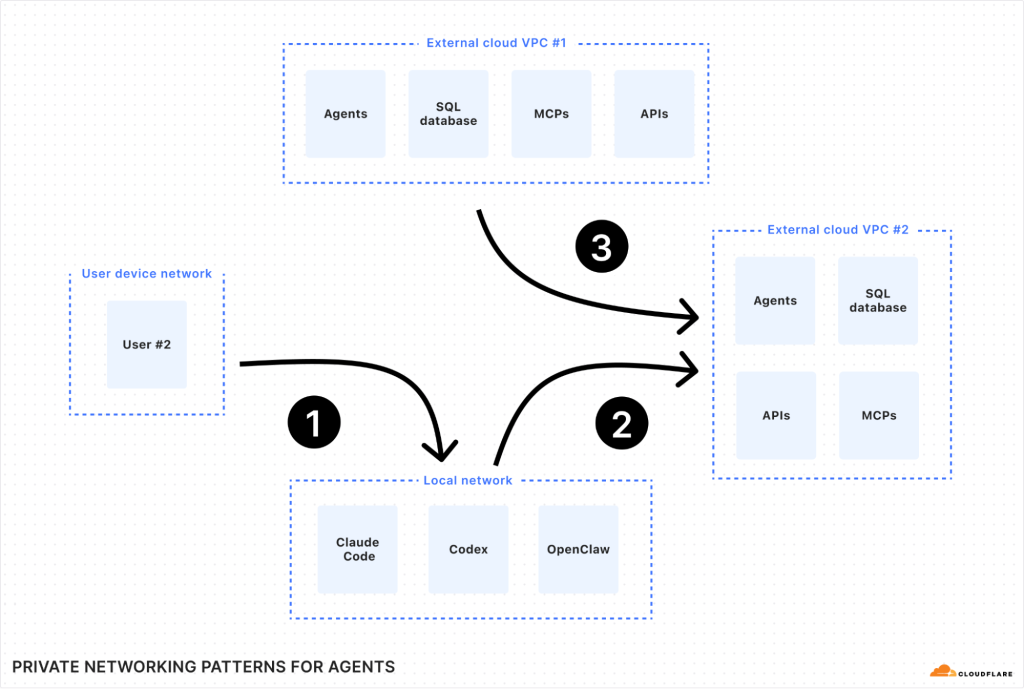
The internet infrastructure titan Cloudflare has inaugurated Cloudflare Mesh, a sophisticated private networking utility engineered to interconnect disparate devices via encrypted tunnels. This architecture facilitates secure access within a private mesh topology, where conventional hardware and autonomous AI agents alike function as nodes within the Cloudflare Mesh ecosystem.
Cloudflare Mesh accommodates a diverse array of operational scenarios, including the governance of infrastructure access, the management of secure SSH and RDP sessions, and the deployment of browser isolation to ensure fortified web navigation. Furthermore, it serves to prevent exfiltration of sensitive data and provides a secure conduit for interacting with cloud-based agents, thereby bolstering the security of SaaS environments.
In the realm of remote networking, comparison with the esteemed open-source service Tailscale is inevitable. While both platforms facilitate secure connectivity, their underlying technical philosophies and strategic implementations diverge significantly:
- Routing Methodology: Tailscale prioritizes peer-to-peer (P2P) encrypted direct connections supplemented by relay nodes; conversely, Mesh routes all traffic through Cloudflare’s global encrypted relay network.
- Cryptographic Standards: While Tailscale relies on WireGuard for end-to-end encryption, Mesh leverages post-quantum cryptography, with all traffic processed through Cloudflare’s infrastructure.
- Protocol Support: Both services offer robust compatibility, encompassing TCP, UDP, and ICMP traffic.
- Subnet Routing: Tailscale boasts an expansive range of supported devices; at present, Mesh is optimized for virtual machines, servers, and devices equipped with graphical user interfaces.
- Security Integration: Tailscale features ACLs, MagicDNS, and integrated SSH; Mesh inherits the comprehensive Zero Trust suite of the Cloudflare One ecosystem.
- AI Integration: While Tailscale can accommodate intelligent agents through manual configuration, Mesh offers native integration with services such as Cloudflare Workers.
- Free-Tier Provisioning: Tailscale affords individuals and small collectives up to 100 devices/users; Mesh provides a complimentary allocation of 50 devices and 50 users per account.
The fundamental distinction lies in their objectives: Tailscale pursues minimal latency and heightened privacy through P2P connectivity, whereas Cloudflare Mesh emphasizes service consistency, unified security mandates, and enterprise-grade administrative controls.
In its official memorandum, Cloudflare clarified the distinction between Mesh and Cloudflare Tunnel. While both offer private egress to Cloudflare’s network, Tunnel remains the ideal solution for unidirectional traffic; in contrast, Mesh provides a holistic, bidirectional many-to-many networking environment.
Within the Mesh, every device and node is assigned a private IP address for mutual accessibility. Applications or AI agents operating within this framework can seamlessly discover and engage with any other resource on the Mesh, obviating the need for individual tunnels for every discrete resource. All Mesh traffic is orchestrated across Cloudflare’s global backbone, a resilient infrastructure that spans numerous global metropolises, ensuring stable cross-network access without requiring users to maintain their own relay servers.
Support Our Threat Intelligence
Find our tech and OS security coverage helpful? Support our work today and unlock a 100% ad-free reading experience!
 Buy Me a Coffee
