Public PoC for CVE-2026-52923 Allows Attackers to Escalate to Root Privilege
 Do Son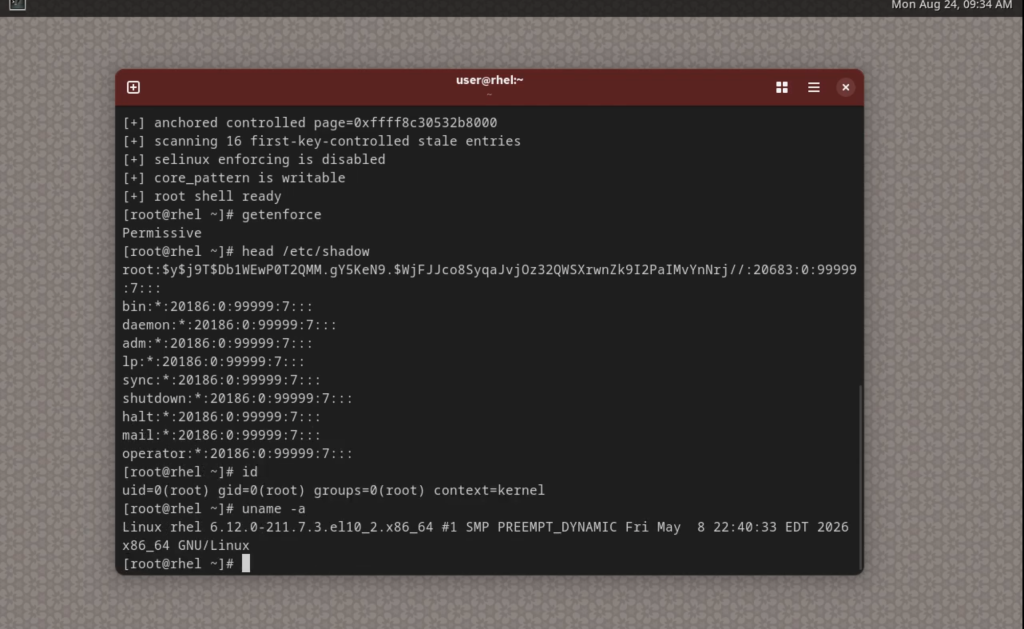
Security researchers publicly disclosed a proof-of-concept exploit for CVE-2026-52923. This Linux kernel flaw carries a CVSS score of 7.8 and allows local attackers to escalate to root privilege. Therefore, system administrators should update vulnerable Linux distributions immediately to prevent system compromise.
- CVE: CVE-2026-52923
- CVSS: 7.8 (High · CVSSv3)
- Product: Linux
- Affected: 03f595668017f1a1fb971c02fc37140bc6e7bb1c, 3.8
- Impact: ipc: limit next_id allocation to the valid ID range
- Status: No confirmed exploitation yet
- Patched in: 3bbe2bb9111ce6967a951bfac79af142d816fae5, 8c58a92849175f5e2ab7bc2734b3b89afe79f6ef, af24e202b543ded8a34f1d5d3db54eb916173f04, 157ce2c6836ce0ff19108a819f38df061345425f (+12 more)
- EPSS: 0.2% (30-day)
- Action: Update to 3bbe2bb9111ce6967a951bfac79af142d816fae5, 8c58a92849175f5e2ab7bc2734b3b89afe79f6ef, af24e202b543ded8a34f1d5d3db54eb916173f04, 157ce2c6836ce0ff19108a819f38df061345425f (+12 more) now
See a Linux kernel CVE's exploit risk spike before it becomes a headline.
Get EPSS spike alertsWhy This Vulnerability Matters
This security weakness introduces a direct privilege escalation path on multi-user systems. Attackers with unprivileged local accounts can obtain full administrative control over the operating system. Furthermore, security firm NebuSec confirmed the severity by publishing functional exploit code. Although investigators have not confirmed active exploitation in the wild, the public availability of exploit code significantly heightens the risk. Sourced industry estimates indicate that millions of enterprise Linux servers rely on these core kernel functions daily.
How the Attack Works
The defect resides in the checkpoint/restore path within the SysV IPC subsystem. Specifically, the ipc_idr_alloc function fails to restrict ID allocation boundaries properly. Because the routine uses an open-ended upper limit, allocations can spill beyond the valid ipc_mni range.
When a process removes the shared memory object, the kernel truncates the index. Consequently, the operating system deletes the wrong entry and leaves a dangling pointer in memory. A subsequent query to /proc/sysvipc/shm dereferences this freed memory. Attackers trigger this use-after-free condition to manipulate memory structures and elevate privileges.
Affected Versions
The issue impacts Linux kernel branches containing code originally introduced in January 2013. The flaw affects enterprise distributions, including Red Hat Enterprise Linux 10 releases. Upstream maintainers resolved the vulnerability in May 2026, and enterprise vendors backported patches in August 2026.
Patch and Mitigation Steps
Kernel maintainers resolved this Linux kernel flaw by bounding allocation requests directly to ipc_mni. System administrators must apply the latest distribution kernel updates immediately. You can review the exploit code in the NebuSec security research repository. Finally, administrators must reboot all updated hosts to load the patched kernel.
Support Our Threat Intelligence
Find our vulnerability reports and weekly recaps helpful? Support our work today and unlock a 100% ad-free reading experience!
 Buy Me a Coffee
