 Do Son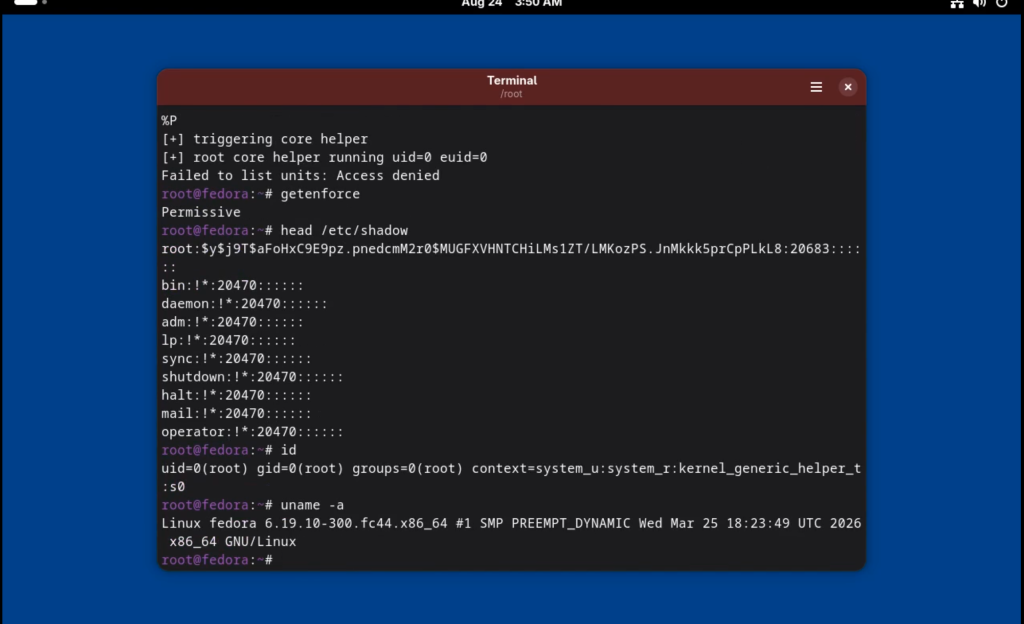
A signed comparison error exposes a critical flaw within the Linux kernel. Specifically, this CVE-2026-52933 privilege escalation vulnerability allows malicious system control. Meanwhile, security researchers have publicly disclosed a working proof-of-concept exploit for this bug.
- CVE: CVE-2026-52933
- CVSS: 7.8 (High · CVSSv3)
- Product: Linux
- Affected: a26a35e9019fd70bf3cf647dcfdae87abc7bacea, 4b702b7d11ce1b9d26fc6d7c5a7ef4ac1d455048, bc4e6ee16778149811333a969a7a893d4cc110c5, 5.15.82, 6.0.11, 6.1
- Impact: io_uring/poll: fix signed comparison in io_poll_get_ownership()
- Status: No confirmed exploitation yet
- Patched in: 81bf96b0abbfa4cd47ea32e12596aed3855fb2f3, cf522703d4f194991615763697ae25a3f9539763, fc47043f3d9af3efa407665b47f8378ec691ba18, ea0697129807d718037f618221037aa0660ee3c5 (+10 more)
- EPSS: 0.1% (30-day)
- Action: Update to 81bf96b0abbfa4cd47ea32e12596aed3855fb2f3, cf522703d4f194991615763697ae25a3f9539763, fc47043f3d9af3efa407665b47f8378ec691ba18, ea0697129807d718037f618221037aa0660ee3c5 (+10 more) now
Why It Matters
This vulnerability carries a high CVSS score of 7.8. Moreover, the io_uring subsystem is a core component in modern Linux environments. A successful Linux kernel io_uring exploit grants attackers complete system control. NebuSec researchers recently published the exploit code publicly. Currently, experts have not confirmed any active exploitation in the wild. However, the public proof-of-concept greatly lowers the barrier for future attacks.
How the Attack Works
According to the official kernel advisory, the issue resides in the io_poll_get_ownership() function. Initially, it uses a signed comparison to check a specific slowpath threshold. The atomic_read() operation returns a signed integer. If the IO_POLL_CANCEL_FLAG is active, the value becomes negative during signed math. Consequently, the threshold comparison evaluates to false. Ultimately, this logic failure prevents the kernel from triggering the required slowpath. Thus, attackers manipulate this resource mismanagement to gain elevated system privileges.
Affected Versions
The vulnerability impacts multiple recent Linux kernel branches. Linux powers millions of enterprise servers worldwide. Therefore, many systems likely rely on the affected io_uring polling mechanics. Fortunately, upstream patches address the flaw in versions 6.1.175, 6.6.140, 6.12.86, 6.18.27, and 7.0.4. Otherwise, systems running earlier unpatched versions remain highly vulnerable.
Patch or Mitigation Steps
System administrators must apply the latest kernel updates immediately to prevent CVE-2026-52933 privilege escalation. The official fix casts the atomic_read() result to an unsigned integer. Next, this simple change forces the cancel flag to act as a large positive value. As a result, the kernel triggers the slowpath correctly. Finally, if immediate patching is impossible, teams should restrict user access to io_uring features.
Support Our Threat Intelligence
Find our vulnerability reports and weekly recaps helpful? Support our work today and unlock a 100% ad-free reading experience!
 Buy Me a Coffee
