 Do Son
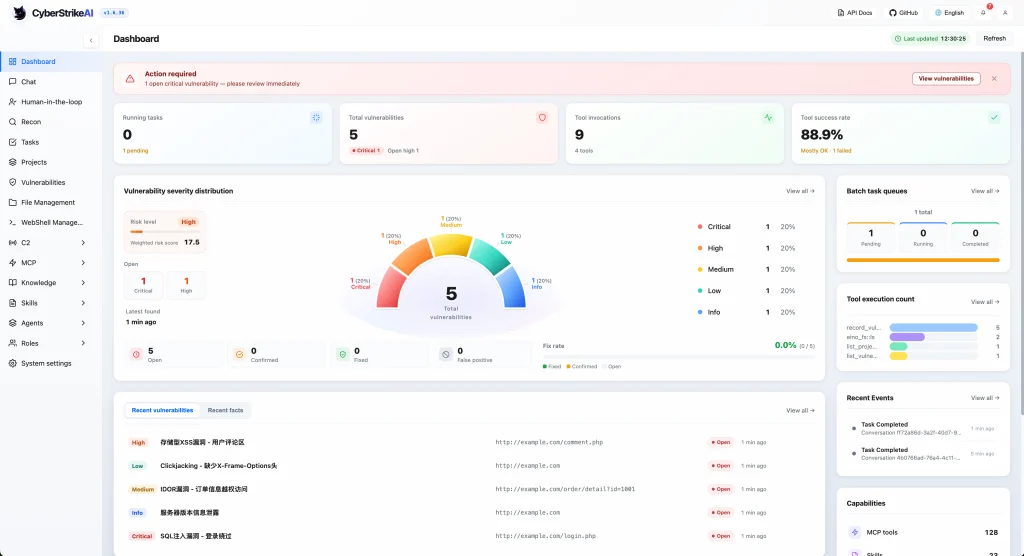
CyberStrikeAI Dashboard from GitHub
TL;DR
Between September 30 and October 16, 2026, a threat actor launched a CyberStrikeAI AWS intrusion across four cloud accounts using eight stolen identities. During the initial burst, the automated platform pulled 56 EC2 startup scripts in just 141 milliseconds before pausing for two weeks to evade fixed alert correlation windows. This CyberStrikeAI AWS CloudTrail intrusion marks the first documented case of the open-source AI offensive framework targeting Amazon Web Services environments.
What Happened During the 16-Day Operation
One external server at 43.240.29.11 read 56 EC2 user data scripts in 141 milliseconds on September 30, 2026. According to an investigation into the CyberStrikeAI AWS CloudTrail intrusion by Elastic Security Labs, the attacker abused stolen credentials belonging to five IAM service users and three EC2 instance roles across four separate accounts. Because the instance role sessions carried EC2 instance IDs as their names, investigators determined the credentials were stolen directly from running virtual machines, likely via server-side request forgery (SSRF) or host compromise.
The attack unfolded across four distinct phases over 16 days. In Phase 1 on September 30, the server called GetCallerIdentity on four service accounts within 51 minutes to check which keys worked. Notably, three calls across three different accounts landed within the exact same second. In Phase 2 that same day, an compromised EC2 role (aliased as app-role) accessed AWS Secrets Manager via GetSecretValue, ran a single test query, and then fired 56 DescribeInstanceAttribute calls in 141 milliseconds (roughly 2.5 milliseconds per request) to extract userData startup scripts.
SSM Decryption and the 14-Day Dormant Gap
On October 1 and October 2 (Phase 3), the server revalidated its stolen keys, pulled additional secrets from a non-production role, and pivoted to a third EC2 role (container-role). Within 29 seconds on October 2, container-role decrypted a SecureString parameter via AWS Systems Manager (SSM) GetParameter and issued an SSM SendCommand to run remote instructions. Next, the operator went completely silent for 14 days.
“One server read 56 EC2 user data scripts in 141 milliseconds. Then it went quiet for 14 days and came back. That gap did more damage than the burst, because fixed correlation windows cannot span two weeks,” Elastic researchers wrote. On October 16 (Phase 4), the server returned to revalidate credentials across two previous accounts and accessed a fourth AWS account for the first time.
Who Is Behind the Activity
While Elastic Security Labs has not linked the intrusion to a named threat group, analysts confirmed with high confidence that the source IP (43.240.29.11) ran CyberStrikeAI, an open-source penetration testing platform that pairs large language model (LLM) agents with offensive tools. Earlier in 2026, researcher Will Thomas at Team Cymru tracked 21 IP addresses running CyberStrikeAI against Fortinet edge appliances. However, this campaign represents the first time the platform has been observed attacking AWS infrastructure.
FOFA scan data from September 29, 2026 — one day before the first AWS alert — showed 43.240.29.11 serving the default CyberStrikeAI web panel on port 8080 inside AS133199 (SonderCloud Limited, Hong Kong). Furthermore, two neighboring servers (43.240.29.28 and 43.240.29.33) presented the exact same self-signed ECDSA TLS certificate (serial number 3356730520974368630, issued September 15, 2026). “We call this AI-assisted on the strength of the tool attribution and the machine-speed behavior in the logs. We cannot prove an LLM agent was making the decisions, and we do not know how the attacker obtained the credentials,” the report noted.
Impact and Alert Correlation Challenges
Across the 16-day CyberStrikeAI AWS intrusion, the attacker triggered 78 alerts across six detection rules, with 83% (65 alerts) firing on the first day. Because EC2 userData scripts frequently store hardcoded database passwords, API tokens, and SSH keys, harvesting 57 startup scripts gave the attacker broad access to application secrets.
Crucially, every single alert registered as low or medium severity because legitimate cloud roles make the exact same API calls daily. “All 78 alerts were medium or low severity and only made sense once correlated by source IP,” Elastic explained. Traditional security information and event management (SIEM) rules using short, fixed time windows failed to connect the September 30 burst with the October 16 return visit.
How Organizations Can Stay Protected
Because stolen cloud credentials hit public AWS API endpoints directly, perimeter firewall rules and network access control lists cannot stop the API calls. Instead, defenders must contain the compromised identities immediately. Elastic demonstrated an automated remediation workflow using AWS Lambda that triggers on bulk enumeration alerts, deactivates stolen IAM access keys via iam:UpdateAccessKey, revokes active temporary tokens using an inline aws:TokenIssueTime deny policy, and quarantines the user.
To defend against a CyberStrikeAI AWS CloudTrail intrusion, cloud administrators should remove plaintext secrets from EC2 userData startup scripts and store them in AWS Secrets Manager. Security teams should restrict the ec2:DescribeInstanceAttribute permission using IAM or Service Control Policies and replace compromised EC2 instances rather than just rotating keys. Finally, threat hunters should search CloudTrail logs for bursts of more than 20 userData reads in 10 minutes, multi-account GetCallerIdentity calls from a single external IP, and connections from 43.240.29.11, 43.240.29.28, and 43.240.29.33.
Support Our Threat Intelligence
Find our threat intelligence and malware analysis helpful? Support our work today and unlock a 100% ad-free reading experience!
 Buy Me a Coffee
