 Do Son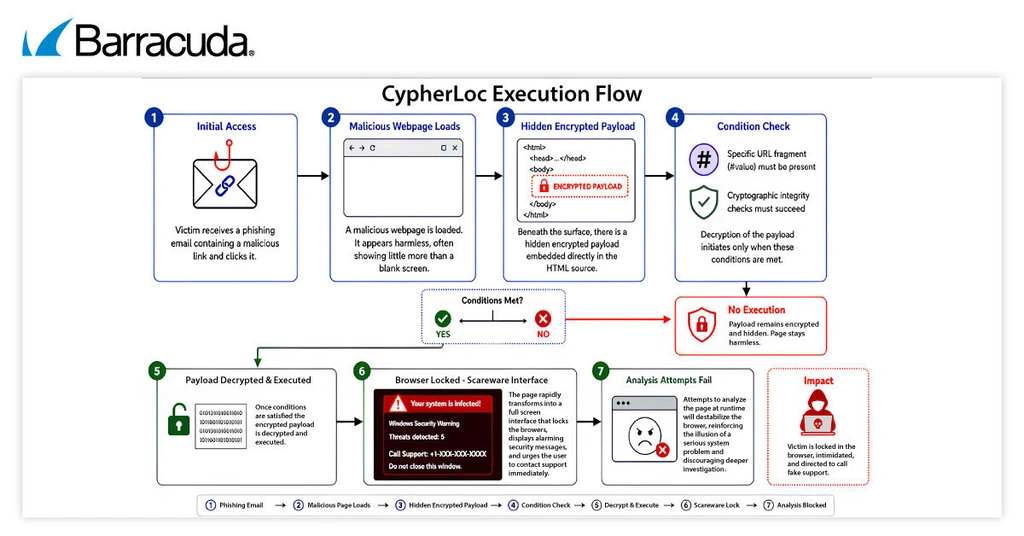
CypherLoc execution flow | Image: Barracuda
Threat intelligence experts have uncovered a massive browser-manipulation campaign active across the global digital landscape. Specifically, researchers identified the CypherLoc scareware kit as a primary driver of recent technical support scams. Since early 2026, malicious actors have launched approximately 2.8 million attacks using this infrastructure. Consequently, corporate security teams must educate their workforce about these aggressive web-based traps immediately.
The Mechanics of Browser-Resident Deception
To begin with, the attack sequence usually starts with a deceptive phishing email. This message directs the target user to a malicious landing page through an embedded link. Initially, the web page looks completely harmless or shows a blank screen. However, a hidden trigger within the code executes under specific environmental conditions.
Cryptographic Gatekeeping
Furthermore, the malicious payload remains encrypted until the victim’s device passes specific validation checks. For instance, “The code only decrypts when the page is opened under the right conditions: when the required URL fragment hash is present and the page passes a series of cryptographic integrity checks.” Alternatively, if an automated web scanner opens the link without the correct token, the exploit script refuses to activate. Instead, the page redirects to a benign blank interface to hide from automated analysis tools.
Implementing Aggressive Browser Controls
Following this, once validation succeeds, the system launches the CypherLoc scareware kit into full execution mode. The original webpage erases itself instantly to display a highly counterfeit security alert interface. Additionally, the script disables standard context menus, takes over the full-screen mode, and hides the mouse cursor. This aggressive behavior traps the victim inside the browser application completely to induce anxiety.
Persistent Audio Disturbances
In addition, the malicious site triggers repetitive warning loops during the encounter. These alert sirens play automatically whenever a trapped user clicks anywhere on the layout. This continuous audio bombardment quickly degrades browser processing capabilities. Consequently, the user experiences significant application lag, reinforcing the fabricated narrative of a virus infection.
Psychological Manipulation Tactics
Subsequently, the fake warning screen displays the victim’s public IP address to create panic. The kit also renders unfunctional login forms to increase the illusion of active system tracking. Ultimately, the entire screen pressures users into calling fraudulent help helplines. The threat report summarizes that “CypherLoc relies on stealth and user concern, using the browser to pressure victims into scamming themselves.”
Disrupting Security Diagnostics
If an experienced user attempts to open browser developer tools to investigate, the platform launches defensive countermeasures. Specifically, the code triggers a continuous loop of asset reloads and layout recalculations to crash the analysis environment. This excessive noise causes intense browser instability and triggers simulated system error windows. Therefore, organizations must implement robust anti-phishing filters and modern endpoint protections to mitigate this evolving threat vector effectively.
Support Our Threat Intelligence
Find our threat intelligence and malware analysis helpful? Support our work today and unlock a 100% ad-free reading experience!
 Buy Me a Coffee
